
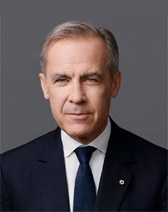
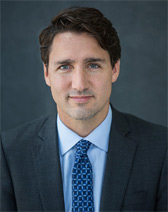
Mark Carney
Canadian politician who served as Governor of the Bank of Canada from 2008 to 2013 and Governor of the Bank of England from 2013 to 2020, before becoming Prime Minister of Canada on March 14, 2025.
Born on March 16, 1965
Age: 61
Profession: Prime Minister, Economist
Place of Birth: Fort Smith, Northwest Territories, Canada
Mark Carney, whose full name is Mark Joseph Carney, was born on March 16, 1965, in Fort Smith, Northwest Territories, Canada. He is a Canadian politician, economist and former central banker. He served as Governor of the Bank of Canada from 2008 to 2013 and Governor of the Bank of England from 2013 to 2020. On March 9, 2025, he was elected leader of the Liberal Party of Canada and became Canada's 24th Prime Minister on March 14, succeeding Justin Trudeau. Following the federal election of April 28, 2025, he continued leading the government. As of November 2026, he remains Prime Minister of Canada.
Early Life and Education
Mark Carney was born in Fort Smith, a town in Canada's Northwest Territories. His parents, Robert Carney and Verlie Carney, were educators. He grew up in Edmonton, Alberta, where his family settled during his childhood.
He attended St. Francis Xavier High School in Edmonton. He later moved to the United States to study economics at Harvard University, graduating in 1988 with a bachelor's degree.
Carney continued his education in the United Kingdom at University of Oxford. He earned a master's degree in economics in 1993 and completed his doctorate in 1995. His studies included work at St Peter's College and Nuffield College.
Career at Goldman Sachs
After graduating from Harvard, Mark Carney joined the American investment bank Goldman Sachs. He worked for the company for approximately thirteen years, holding positions in London, Tokyo, New York and Toronto.
His work included financial markets, investment banking and sovereign debt. He gained experience in international finance before entering public service in Canada.
Bank of Canada and the 2008 Financial Crisis
In August 2003, Mark Carney was appointed Deputy Governor of the Bank of Canada. In November 2004, he moved to Canada's Department of Finance as Senior Associate Deputy Minister of Finance.
On February 1, 2008, he became Governor of the Bank of Canada, succeeding David Dodge. His appointment came shortly before the global financial crisis intensified.
During the crisis, the Bank of Canada lowered its policy interest rate and introduced measures intended to maintain confidence in the financial system. Carney also announced that the bank expected to keep its key interest rate at a low level for an extended period, subject to inflation conditions.
This approach, known as forward guidance, was intended to influence borrowing costs and expectations about future monetary policy.
Canada's banking system avoided the scale of failures experienced in several other countries during the crisis. Carney's monetary policy decisions were one component of the country's economic response, alongside fiscal measures, banking regulation and other factors.
In November 2011, he was appointed Chair of the Financial Stability Board, an international body responsible for coordinating financial regulation and monitoring risks to the global financial system.
Governor of the Bank of England
On November 26, 2012, the British government announced that Mark Carney had been selected as the next Governor of the Bank of England. His appointment was approved by Queen Elizabeth II during the premiership of David Cameron, following a selection process overseen by Chancellor George Osborne.
Carney assumed office on July 1, 2013, succeeding Mervyn King. He became the first person without British citizenship to hold the governorship of the institution in its modern history.
During his tenure, the Bank of England continued using monetary policy measures introduced after the financial crisis. Carney also supervised reforms to financial regulation and the bank's responsibilities for financial stability.
Following the June 2016 referendum in which the United Kingdom voted to leave the European Union, he addressed the economic uncertainty associated with Brexit. The Bank of England adopted measures intended to support financial markets and economic activity.
His warnings about the potential economic effects of Brexit attracted criticism from some politicians supporting withdrawal from the European Union. He was accused of participating in what they called "Project Fear," while Carney maintained that evaluating economic risks was part of the central bank's responsibilities.
He completed his term on March 15, 2020. Andrew Bailey succeeded him as Governor on March 16, 2020.
Climate Finance and International Activities
After leaving the Bank of England, Mark Carney continued working on international finance and climate-related economic policy.
He served as the United Nations Special Envoy on Climate Action and Finance under Secretary-General António Guterres. In that role, he promoted the involvement of financial institutions in efforts to reduce greenhouse gas emissions and support investment in the transition to lower-carbon energy systems.
He also participated in initiatives involving sustainable finance, including the Glasgow Financial Alliance for Net Zero (GFANZ), and held senior positions connected with Brookfield Asset Management.
His positions on carbon pricing and the economic transition away from fossil fuels attracted criticism from some Canadian conservative politicians, particularly over the potential costs of climate policies for households and businesses.
In 2021, he published Value(s): Building a Better World for All, a book examining financial markets, economic values and the relationship between public institutions and private enterprise.
Election as Leader of the Liberal Party
On January 6, 2025, Prime Minister Justin Trudeau announced that he would resign as leader of the Liberal Party of Canada and step down as Prime Minister once his successor had been selected.
Mark Carney entered the Liberal leadership election alongside candidates including Chrystia Freeland, Karina Gould and Frank Baylis.
On March 9, 2025, he won the leadership contest with 85.9 percent of the final vote. He succeeded Trudeau as party leader and prepared to form a new government.
Becoming Prime Minister of Canada
On March 14, 2025, Mark Carney was sworn in as Canada's 24th Prime Minister, succeeding Justin Trudeau. He initially led the government without holding a seat in the Canadian House of Commons.
His appointment came during a period of growing tension between Canada and the United States. US President Donald Trump had announced tariffs affecting Canadian exports and repeatedly referred to the possibility of Canada becoming the 51st US state.
Carney opposed these statements and presented the protection of Canadian sovereignty and economic independence as central priorities of his government.
2025 Canadian Federal Election
On March 23, 2025, Mark Carney called an early federal election for April 28, 2025.
During the campaign, the Liberal Party emphasized Canada's economic relationship with the United States, the consequences of American tariffs, housing affordability and domestic economic development.
The principal opposition party was the Conservative Party of Canada, led by Pierre Poilievre.
In the April 28 election, the Liberals won 169 of the 343 seats in the House of Commons, while the Conservatives won 144 seats. The Liberals secured the largest number of seats but initially fell short of the 172 needed for a parliamentary majority.
Carney was also elected to Parliament for the first time, winning the Nepean constituency in Ontario with 63.8 percent of the valid vote.
After the election, he continued as Prime Minister at the head of a Liberal minority government.
Canada–United States Relations
Following the election, Mark Carney continued negotiations with the administration of President Donald Trump over tariffs and economic cooperation.
On April 28, 2025, after the election results became clear, Carney delivered a victory speech in which he rejected suggestions that Canada could become part of the United States. He defended Canada's sovereignty and criticized American tariffs as harmful to Canadian industries and workers.
The dispute affected sectors including steel, aluminum, automobiles and manufacturing. The Canadian government introduced measures to support businesses affected by tariffs and sought to diversify international trade relationships.
In October 2026, Carney and Ontario Premier Doug Ford announced additional measures and investments aimed at supporting Ontario industries and workers affected by American trade restrictions.
Government Policies in 2026
During 2026, Mark Carney's government introduced policies addressing industrial investment, housing, national security and Canada's dependence on American markets.
Following by-elections and changes in parliamentary affiliation, the Liberal Party reached a parliamentary majority in April 2026. Its seat total changed again during the year. As of November 1, 2026, the party held 173 of the 343 seats in the House of Commons.
On October 29, 2026, Carney announced The Plan for a Stronger Canada, a national security strategy addressing economic security, cyber threats, international partnerships and the country's ability to respond to external pressures.
On November 5, 2026, his government presented its federal budget, proposing investments and tax measures concerning infrastructure, industrial development, housing, energy and defence. The budget also included measures intended to support businesses affected by American tariffs and encourage exports to markets outside the United States.
Personal Life
Mark Carney married British economist Diana Fox Carney in 1994. The couple met while studying at Oxford University.
They have four daughters: Cleo, Tess, Amelia and Sasha.
Professional and Political Career
- 1988–2003 – Goldman Sachs, various financial positions
- 2003–2004 – Deputy Governor of the Bank of Canada
- 2004–2008 – Senior Associate Deputy Minister of Finance, Canada
- 2008–2013 – Governor of the Bank of Canada
- 2011–2018 – Chair of the Financial Stability Board
- 2013–2020 – Governor of the Bank of England
- 2020–2025 – International climate finance and investment activities
- 2025–present – Leader of the Liberal Party of Canada
- 2025–present – Prime Minister of Canada
- 2025–present – Member of Parliament for Nepean, Ontario
Book
- 2021 – Value(s): Building a Better World for All
Source: Biyografiler.com
Frequently asked questions about Mark Carney
Who is Mark Carney?, Mark Carney biography, Mark Carney life story, Mark Carney age, Mark Carney facts, Mark Carney birthplace, Mark Carney photos, Mark Carney videos, Mark Carney career
Related Biographies

Lamine Yamal
Professional footballer

Kylian Mbappe
Professional footballer

Brad Pitt
Actor

Erling Haaland
Professional footballer

Keanu Reeves
Actor

Leonardo DiCaprio
Actor

Mark Carney
Prime Minister, Economist

Mark Hamill
Actor, Voice Actor

Mark Spitz
Professional Swimmer

Marc Benioff
Entrepreneur, Business Executive, Investor

Malala Yousafzai
Activist, Author

Mark Hamill
Actor, Voice Actor

Jensen Huang
Entrepreneur, CEO, Engineer

Hailey Bieber
Model, Entrepreneur
Lamine Yamal
Professional footballer

Demi Moore
Actress

Sadio Mane
Professional footballer