
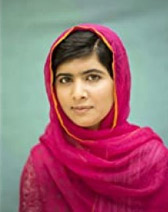
Malala Yousafzai
Youngest Nobel Peace Prize laureate, awarded jointly with Kailash Satyarthi in 2014 at the age of 17.
Born on July 12, 1997
Age: 29
Profession: Activist, Author
Place of Birth: Mingora, Swat Valley, Pakistan
Malala Yousafzai was born on July 12, 1997, in Mingora, in Pakistan's Swat Valley. She is a Pakistani education activist, human rights advocate and author who campaigns for girls' access to education. In 2009, at the age of eleven, she began writing anonymously for BBC Urdu about life under Taliban rule. On October 9, 2012, she survived an assassination attempt by a Pakistani Taliban gunman while returning home from school. She subsequently co-founded Malala Fund and continued campaigning for girls' education internationally. In 2014, at seventeen, she shared the Nobel Peace Prize with Indian children's rights activist Kailash Satyarthi, becoming the youngest Nobel laureate in history.
Early Life and Family
Malala Yousafzai was born into a Pashtun Muslim family in Mingora, the principal city of Pakistan's Swat Valley. Her father, Ziauddin Yousafzai, is a teacher, school administrator and education activist. Her mother is Toor Pekai Yousafzai. She has two younger brothers, Khushal Yousafzai and Atal Yousafzai.
She was named after Malalai of Maiwand, an Afghan woman remembered for her role in the 1880 Battle of Maiwand during the Second Anglo-Afghan War.
Her father operated the Khushal School in Swat and encouraged his daughter to attend lessons and speak about educational rights. Malala grew up surrounded by teachers and students. She learned Pashto, Urdu and English and developed an interest in reading and public speaking.
She later identified former Pakistani Prime Minister Benazir Bhutto as one of the political figures who influenced her childhood understanding of women's participation in public life.
Taliban Control of Swat and Her First Public Speech
From 2007 onward, the Pakistani Taliban expanded their control over the Swat Valley. Armed militants attacked schools, imposed restrictions on cultural activities and threatened girls who continued attending classes.
In September 2008, when she was eleven, Malala Yousafzai spoke at a press club in Peshawar about the closure of girls' schools. Her address questioned the Taliban's authority to deny children their basic right to education.
Her remarks were reported by Pakistani newspapers and television stations. As the restrictions became more severe, many families withdrew their daughters from school out of fear of violence.
BBC Urdu Diary and the New York Times Documentary
In January 2009, Malala Yousafzai began writing a diary for BBC Urdu under the pseudonym Gul Makai. Her entries described school closures, threats from militants and the uncertainty of everyday life in Swat.
She wrote about her desire to continue studying despite the restrictions. Her identity was initially concealed because speaking publicly against the militants could endanger her family.
In the same year, she participated in the Open Minds youth project of the Institute for War and Peace Reporting, which encouraged young people to discuss social issues through journalism and debate.
Journalist Adam B. Ellick documented her life and her family's experiences for The New York Times in 2009. His documentary, Class Dismissed, recorded the disruption of girls' education and the displacement of families during the Pakistani military's operation against militants in Swat.
Following the military operation, Malala returned to school and continued giving interviews about girls' education.
2011 Recognition and Growing Threats
In 2011, Malala Yousafzai was nominated for the International Children's Peace Prize, following a recommendation supported by Archbishop Desmond Tutu.
That year, she received Pakistan's first National Youth Peace Prize, subsequently renamed the National Malala Peace Prize.
Her growing public profile brought further attention to her educational campaign. It also exposed her to threats from militants who opposed her public statements.
The October 9, 2012 Assassination Attempt
On October 9, 2012, Malala Yousafzai was travelling home from school after examinations when an armed member of the Pakistani Taliban stopped the school vehicle in the Swat Valley.
The attacker identified Malala and fired at her. A bullet struck her head and travelled through her neck and shoulder area. Two other students, Shazia Ramzan and Kainat Riaz, were also injured.
Malala was initially treated in Peshawar before being transferred to a military hospital in Rawalpindi. Her condition was critical, and she underwent emergency medical treatment.
On October 15, 2012, she was transferred to Queen Elizabeth Hospital Birmingham in the United Kingdom for specialist treatment and rehabilitation. She underwent further operations and recovered sufficiently to resume her education.
The Pakistani Taliban publicly claimed responsibility for the attack, citing her campaign for girls' education. Governments, human rights organizations and religious leaders condemned the shooting. A group of Pakistani Muslim clerics also issued a religious declaration rejecting the attempted assassination.
The attack generated international public support for Malala and the other injured students. Because of continuing security risks, she and her family remained in Britain.
United Nations Address and Malala Fund
On July 12, 2013, her sixteenth birthday, Malala Yousafzai delivered a speech at the United Nations headquarters in New York, calling for education to be available to all children, particularly girls excluded from school by discrimination, poverty and violence.
The date became associated with Malala Day, an international occasion for drawing attention to children's educational rights.
In 2013, she established Malala Fund with her father, Ziauddin Yousafzai, with support from education and social entrepreneur Shiza Shahid, who became its first chief executive.
The nonprofit organization supports local activists, education initiatives and policy campaigns intended to help girls complete twelve years of free, safe and quality education.
Through the organization, Malala met Syrian refugees in Jordan, young students in Kenya and girls' rights advocates in other countries. In Nigeria, she spoke against the 2014 kidnapping of schoolgirls by the armed group Boko Haram.
I Am Malala and the Sakharov Prize
In October 2013, Malala Yousafzai published I Am Malala: The Girl Who Stood Up for Education and Was Shot by the Taliban, written with journalist Christina Lamb.
The autobiography described her childhood in Swat, the rise of Taliban control, the attack and her recovery in Britain. It became an international bestseller and was subsequently adapted into editions for younger readers.
In 2013, the European Parliament awarded her the Sakharov Prize for Freedom of Thought in recognition of her campaign for children's education.
Time magazine included her in its list of the world's 100 most influential people in 2013, 2014 and 2015.
2014 Nobel Peace Prize
On October 10, 2014, the Norwegian Nobel Committee announced that Malala Yousafzai and Indian children's rights campaigner Kailash Satyarthi would share the Nobel Peace Prize.
The committee recognized their work opposing the suppression of children and young people and defending children's right to education.
Malala was seventeen years old when she received the award in Oslo on December 10, 2014, becoming the youngest Nobel Prize recipient up to that date.
She directed her share of the Nobel Prize money toward educational projects, including the establishment of a school for girls in Pakistan's Shangla district. The school was inaugurated in 2018.
After receiving the prize, she continued speaking about the need for every girl to have access to twelve years of free and safe education.
Education in Britain and Oxford University
Following her recovery, Malala Yousafzai resumed her education in Birmingham, England. She attended Edgbaston High School for Girls from 2013 to 2017.
In 2017, she was admitted to Lady Margaret Hall, a college of the University of Oxford, to study Philosophy, Politics and Economics (PPE).
She graduated in 2020 with a bachelor's degree. During her university years, she continued working with Malala Fund and speaking publicly about barriers to girls' education.
In 2023, she was appointed an honorary fellow of Linacre College at Oxford.
Later Campaigns and International Work
In April 2017, Malala Yousafzai became the youngest person to address the Canadian House of Commons and received honorary Canadian citizenship.
In 2018, she returned to Pakistan for the first time since the 2012 attack. During the visit, she met supporters and visited educational projects.
After the Taliban returned to power in Afghanistan in August 2021 and imposed restrictions on girls' secondary and higher education, Malala repeatedly called on governments and international institutions to support Afghan girls' educational rights.
Through Malala Fund, she has supported alternative learning opportunities and organizations led by Afghan women. The organization has also advocated international legal recognition of gender apartheid in response to restrictions imposed on women and girls in Afghanistan.
Her work has continued to address girls' education in countries affected by conflict, displacement, child marriage and poverty.
Marriage and Personal Life
In November 2021, Malala Yousafzai married Asser Malik in a small Islamic marriage ceremony in Birmingham, attended by family members.
Malik has worked in cricket administration in Pakistan. Malala has discussed their relationship and her experiences of marriage in interviews and her later autobiographical writing.
Books and Recent Publications
In addition to her first autobiography, Malala Yousafzai published Malala's Magic Pencil in 2017, an illustrated children's book about her childhood and her belief in the importance of education.
Her 2019 book We Are Displaced: My Journey and Stories from Refugee Girls Around the World combined her experiences of leaving Pakistan with the accounts of young women displaced by conflict and persecution.
On October 21, 2025, she published Finding My Way, her second memoir. The book examined her university years, personal relationships, marriage and experiences adjusting to adulthood after becoming a public figure as a teenager.
Selected Awards and Recognition
- 2011 – Pakistan National Youth Peace Prize
- 2011 – Nomination for the International Children's Peace Prize
- 2013 – Sakharov Prize for Freedom of Thought
- 2013–2015 – Included in Time magazine's annual list of 100 influential people
- 2014 – Nobel Peace Prize, shared with Kailash Satyarthi
- 2017 – Honorary Canadian citizenship
- 2023 – Honorary Fellowship, Linacre College, University of Oxford
Books
- 2013 – I Am Malala: The Girl Who Stood Up for Education and Was Shot by the Taliban – With Christina Lamb
- 2014 – I Am Malala: How One Girl Stood Up for Education and Changed the World – Young readers' edition, with Patricia McCormick
- 2017 – Malala's Magic Pencil – Illustrated children's book
- 2019 – We Are Displaced: My Journey and Stories from Refugee Girls Around the World
- 2025 – Finding My Way – Memoir
Source: Biyografiler.com
Frequently asked questions about Malala Yousafzai
Who is Malala Yousafzai?, Malala Yousafzai biography, Malala Yousafzai life story, Malala Yousafzai age, Malala Yousafzai facts, Malala Yousafzai birthplace, Malala Yousafzai photos, Malala Yousafzai videos, Malala Yousafzai career
Related Biographies

Lamine Yamal
Professional footballer

Kylian Mbappe
Professional footballer

Brad Pitt
Actor

Erling Haaland
Professional footballer

Keanu Reeves
Actor

Leonardo DiCaprio
Actor

Mark Carney
Prime Minister, Economist

Mark Hamill
Actor, Voice Actor

Mark Spitz
Professional Swimmer

Marc Benioff
Entrepreneur, Business Executive, Investor

Malala Yousafzai
Activist, Author

Mark Hamill
Actor, Voice Actor

Jensen Huang
Entrepreneur, CEO, Engineer

Hailey Bieber
Model, Entrepreneur
Lamine Yamal
Professional footballer

Demi Moore
Actress

Sadio Mane
Professional footballer