
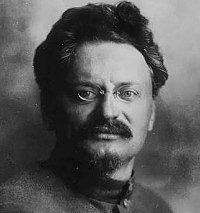
Leon Trotsky
Russian revolutionary, Marxist theorist, and political leader who participated in the Russian Revolutions of 1905 and 1917. He helped organize the October Revolution, founded and led the Red Army, and held senior positions in the early Soviet government. Following Vladimir Lenin's death, he became Joseph Stalin's principal political opponent and was expelled from the Soviet Union in 1929. He founded the Fourth International in 1938 and was assassinated in Mexico in 1940.
Born on November 7, 1879
Died on August 21, 1940
Age at death: 61
Profession: Revolutionary Leader, Politician, Writer
Place of Birth: Yanovka, Kherson Governorate, Russian Empire
Place of Death: Coyoacán, Mexico City, Mexico
Leon Trotsky, born Lev Davidovich Bronstein on November 7, 1879, was a Russian revolutionary, Marxist theorist, politician, military leader, and writer. He played a central role in the October Revolution of 1917 and the establishment of Soviet power. Following the revolution, he served as People's Commissar for Foreign Affairs and later as People's Commissar for Military and Naval Affairs, overseeing the organization of the Red Army during the Russian Civil War. After Vladimir Lenin's death in 1924, Trotsky opposed the growing political authority of Joseph Stalin and helped organize the Left Opposition. Expelled from the Soviet Union in 1929, he continued his political and literary activities from Turkey, France, Norway, and Mexico. He founded the Fourth International in 1938 and developed the Marxist political tradition known as Trotskyism. He died on August 21, 1940, after being attacked by a Soviet agent in Mexico City.
Early Life and Education
Leon Trotsky was born on November 7, 1879, corresponding to October 26 in the Julian calendar then used in Russia, in Yanovka, Kherson Governorate, Russian Empire. His birthplace is now known as Bereslavka, in Ukraine. His father, David Leontyevich Bronstein, was a Jewish farmer, and his mother was Anna Lvovna Bronstein. Trotsky was the fifth of eight children.
Although his family was Jewish, religion played a limited role in his upbringing. He grew up speaking Russian and Ukrainian. His younger sister Olga Bronstein later married Bolshevik politician Lev Kamenev.
At approximately nine years old, Trotsky was sent to Odessa to continue his education with relatives. He attended a German-language school, where he developed an interest in literature, languages, and history.
In 1896, he moved to Nikolayev, now Mykolaiv, to complete his secondary education. During this period, he became interested in mathematics and encountered socialist political ideas.
Early Revolutionary Activities and Siberian Exile
In 1897, Leon Trotsky helped establish the South Russian Workers' Union in Nikolayev. The organization distributed political literature and sought to organize industrial workers against the Russian imperial government.
Through his involvement in revolutionary circles, he became increasingly interested in Marxism. In January 1898, he was arrested by the Tsarist authorities for his political activities.
After approximately two years in prison, he was sentenced to exile in Siberia. During his imprisonment, he married fellow revolutionary Aleksandra Sokolovskaya, with whom he had two daughters, Nina and Zinaida.
In 1902, Trotsky escaped from Siberia using a false passport bearing the surname Trotsky, which he subsequently adopted as his political name.
He travelled to Western Europe and met Vladimir Lenin in London. He joined the editorial circle of Iskra, a socialist newspaper associated with Lenin, Georgi Plekhanov, and Julius Martov. He also wrote under the pseudonym Pero, meaning Pen.
Bolsheviks, Mensheviks and the 1905 Revolution
In 1903, Leon Trotsky attended the Second Congress of the Russian Social Democratic Labour Party, where disagreements over party organization led to the division between the Bolsheviks and Mensheviks.
Trotsky initially sided with the Mensheviks against Lenin's organizational proposals. However, disagreements with Menshevik leaders soon led him to pursue an independent political position, seeking to reunite the competing factions.
Following Bloody Sunday in January 1905, Trotsky returned to Russia and participated in the revolutionary movement against the Tsarist government.
He became chairman of the Saint Petersburg Soviet, an organization representing workers during the 1905 Revolution. Following the suppression of the revolutionary movement, he was arrested and sentenced to exile.
In 1907, he escaped while being transported to Siberia and returned to Europe. His experiences during the revolution contributed to his theory of permanent revolution, which he developed in writings including Results and Prospects.
Political Journalism and Exile in Europe
Between 1907 and 1914, Leon Trotsky lived primarily in Vienna, where he participated in socialist political activities and continued writing.
In 1908, he began publishing the Russian-language newspaper Pravda, meaning Truth, with support from associates including Adolf Joffe and Viktor Kopp. The publication sought to appeal to Russian workers while maintaining independence from the Bolshevik and Menshevik factions.
Trotsky continued publishing his Vienna-based Pravda until 1912. That year, the Bolsheviks established a separate newspaper with the same name in Saint Petersburg.
During the First World War, Trotsky opposed the conflict and criticized socialist parties that supported their respective governments. He worked as a journalist in several European countries before eventually travelling to the United States.
The Russian Revolution of 1917
Following the February Revolution of 1917, which overthrew the Russian monarchy, Leon Trotsky returned to Russia in May.
He joined the Bolshevik Party in July 1917 and became chairman of the Petrograd Soviet in September.
As chairman of the Military Revolutionary Committee, Trotsky coordinated military preparations for the Bolshevik seizure of power in Petrograd.
On October 25, 1917, according to the Julian calendar then used in Russia, corresponding to November 7 in the Gregorian calendar, the Bolsheviks overthrew the Provisional Government led by Alexander Kerensky.
During the uprising, Bolshevik forces occupied strategic locations in Petrograd and took control of the Winter Palace. The revolution established a government headed by Vladimir Lenin, with Trotsky among its principal leaders.
Foreign Affairs and the Treaty of Brest-Litovsk
After the October Revolution, Leon Trotsky became People's Commissar for Foreign Affairs in the new Soviet government.
One of his principal responsibilities was negotiating Russia's withdrawal from the First World War. He led the Soviet delegation during peace negotiations with Germany and the Central Powers at Brest-Litovsk.
Trotsky opposed accepting Germany's extensive territorial demands. He adopted the position known as "neither war nor peace," under which Russia would stop fighting without signing a formal peace agreement.
Vladimir Lenin, however, argued that the Soviet government needed peace to preserve its position while confronting severe economic and military difficulties.
After Germany resumed its military advance in February 1918, the Bolshevik leadership accepted Lenin's proposal to sign the treaty. The Treaty of Brest-Litovsk was signed on March 3, 1918, by a Soviet delegation headed by Grigori Sokolnikov.
Under the agreement, Soviet Russia relinquished control over extensive territories. The districts of Kars, Ardahan, and Batum, which Russia had acquired from the Ottoman Empire following the war of 1877–1878, were also returned to Ottoman control under the treaty's provisions.
Trotsky resigned as People's Commissar for Foreign Affairs following the dispute and was appointed to oversee military affairs.
Formation of the Red Army and the Russian Civil War
In March 1918, Leon Trotsky became People's Commissar for Military and Naval Affairs. He took responsibility for organizing the Red Army during the Russian Civil War.
Trotsky introduced military discipline, recruitment procedures, and centralized command structures. He also employed former officers of the imperial Russian army under political supervision to provide professional military expertise.
The Red Army fought the anti-Bolshevik White Armies, foreign intervention forces, and other armed groups opposing the Soviet government.
Trotsky travelled extensively between military fronts in an armored train, coordinating military operations and addressing troops.
During the civil war, the Bolshevik government also relied on the Cheka, a political security organization established in December 1917. The period was marked by executions, imprisonment, political repression, and violence by competing forces.
The Bolsheviks consolidated their control over most of the former Russian Empire by the early 1920s. In December 1922, the Union of Soviet Socialist Republics was formally established.
Conflict with Stalin and the Left Opposition
Following the civil war, Leon Trotsky became increasingly involved in disputes over the political and economic direction of the Soviet state.
Joseph Stalin had become General Secretary of the Communist Party in 1922. After Vladimir Lenin died on January 21, 1924, the struggle over the party's leadership intensified.
Trotsky opposed the expansion of party bureaucracy and argued for greater internal party democracy. He also criticized Stalin's doctrine of socialism in one country, maintaining that the survival of socialism in the Soviet Union depended on international revolutionary developments.
In 1923, Trotsky and his supporters organized the Left Opposition. Stalin subsequently strengthened his position through alliances with other party leaders, including Grigory Zinoviev and Lev Kamenev, before turning against them as well.
Trotsky was removed from his senior military responsibilities in January 1925. In October 1926, he lost his position in the Politburo, and in November 1927, he was expelled from the Communist Party.
In January 1928, he was deported internally to Alma-Ata, now Almaty, in Kazakhstan.
Exile in Turkey, 1929–1933
In January 1929, the Soviet authorities ordered Leon Trotsky's expulsion from the country. He arrived in Turkey in February 1929 with his companion Natalia Sedova and their son Lev Sedov.
Trotsky spent much of his Turkish exile on Büyükada, one of the Princes' Islands near Istanbul. Turkish authorities provided security because of concerns about possible assassination attempts.
During his stay in Turkey, he continued writing political analyses, corresponding with supporters abroad, and developing his criticism of Stalin's leadership.
He completed important works including My Life: An Attempt at an Autobiography and The History of the Russian Revolution.
His years in exile also brought personal difficulties. His daughter Nina Nevelson died of tuberculosis in 1928. His other daughter, Zinaida Volkova, died by suicide in Berlin in January 1933.
In February 1932, Soviet authorities deprived Trotsky of his Soviet citizenship.
He left Turkey on July 17, 1933, after receiving permission to reside in France.
France, Norway and Mexico
Leon Trotsky lived in France from 1933 until 1935, continuing his political writings and maintaining contact with revolutionary socialist organizations.
Facing restrictions from French authorities, he moved to Norway in 1935. His political activities eventually resulted in further restrictions and pressure to leave the country.
On January 9, 1937, Trotsky arrived in Mexico, where President Lázaro Cárdenas had granted him political asylum.
He initially stayed at the home of artists Diego Rivera and Frida Kahlo in Coyoacán, Mexico City, before moving to another residence in the same district.
Trotsky continued criticizing the Soviet government and the Moscow Trials, during which Stalin's political opponents were prosecuted on accusations of conspiracy and treason.
His son Lev Sedov, who had assisted his political activities in exile, died in Paris in February 1938 following surgery. His other son, Sergei Sedov, had been arrested in the Soviet Union and was executed during the Stalinist purges.
Foundation of the Fourth International
In September 1938, Leon Trotsky and his supporters established the Fourth International at a founding conference held near Paris.
The organization brought together revolutionary socialist groups that rejected Stalin's control of the Communist International and the political direction of the Soviet Communist Party.
Trotsky argued that an independent international revolutionary organization was necessary to oppose capitalism, fascism, and Stalinist political repression.
Its founding program, commonly known as the Transitional Program, connected immediate working-class demands with broader socialist political objectives.
The organization continued after Trotsky's death but experienced internal divisions, particularly over the political character of the Soviet Union and the socialist governments established in Eastern Europe after the Second World War.
Trotskyism and the Theory of Permanent Revolution
Leon Trotsky's political ideas became the basis of Trotskyism, a Marxist current associated with the theory of permanent revolution and opposition to Stalinism.
According to his theory, countries with limited capitalist development could experience socialist revolutions led by the working class, even where the tasks traditionally associated with bourgeois democratic revolutions had not been completed.
Trotsky maintained that such revolutions could not be considered secure within national borders alone. He therefore argued that the development of international socialist revolutions was necessary for the survival of a workers' state.
He opposed Stalin's theory of socialism in one country and criticized the suppression of political opposition within the Soviet Union.
At the same time, Trotsky defended the social and economic foundations created by the October Revolution, including state ownership of major industries. He called for a political revolution against the Soviet bureaucracy rather than the restoration of capitalism.
In The Revolution Betrayed, published in 1936, he examined the Soviet political system and described the development of a privileged bureaucratic ruling layer.
Trotskyist political organizations subsequently developed in different countries, including France, Britain, the United States, Sri Lanka, Argentina, Bolivia, and Brazil. These movements differed in their interpretations of Trotsky's ideas and their approaches to political organization.
Assassination in Mexico
While living in Mexico, Leon Trotsky faced threats from Soviet intelligence agents and supporters of Stalin.
On May 24, 1940, a group of armed attackers, including Mexican painter David Alfaro Siqueiros, entered Trotsky's residence in Coyoacán and fired numerous shots. Trotsky and Natalia Sedova survived the attack.
On August 20, 1940, Spanish-born Soviet agent Ramón Mercader, who had gained access to Trotsky's household using a false identity, attacked him in his study.
Mercader struck Trotsky in the head with an ice axe. Seriously wounded, Trotsky was taken to a hospital in Mexico City.
Leon Trotsky died from his injuries on August 21, 1940, at the age of 60.
Mercader was arrested and later sentenced to twenty years in prison in Mexico. His connection to Soviet intelligence was subsequently established, and he was later honored by the Soviet government.
Trotsky was buried in the grounds of his residence in Coyoacán. The property was later converted into a museum dedicated to his life and political activities.
Personal Life and Family
Leon Trotsky married Aleksandra Sokolovskaya, a fellow revolutionary, while imprisoned in 1900. They had two daughters, Nina Nevelson and Zinaida Volkova.
After escaping from Siberia, Trotsky began a relationship with revolutionary activist Natalia Sedova, who became his lifelong companion. They had two sons, Lev Sedov and Sergei Sedov.
Natalia accompanied Trotsky through his years of political exile and survived the assassination attempt that killed him.
Major Books
1906 - Results and Prospects1909 - 1905
1920 - Terrorism and Communism
1924 - Lessons of October
1928 - The Third International After Lenin
1930 - My Life: An Attempt at an Autobiography
1930 - The Permanent Revolution
1930–1932 - The History of the Russian Revolution
1936 - The Revolution Betrayed
1938 - The Transitional Program
1940 - In Defense of Marxism (Writings Collected and Published Posthumously)
Selected Political Writings and Essays
The Bankruptcy of Individual TerrorismThe Intelligentsia and Socialism
Why Marxists Oppose Individual Terrorism
The Main Lesson of the Third Congress
On the Tactics of the Communist International
Report on the Fourth World Congress
Letter to Comrade McKay
On the Paris Commune
Is the Time Ripe for the Slogan of the United States of Europe?
Perspectives and Tasks in the East
Lessons of October
The Third International After Lenin
Socialism in One Country?
The Progressive Character of Catalan Nationalism
Spanish Communism and the Catalan Federation
The National Question in Catalonia
In Defense of the Russian Revolution
The Permanent Revolution: Results and Prospects
Nationalism and Economic Life
A Contribution to the Discussion on the Fundamental Theoretical Views of the International Communist League
War and the Fourth International
If America Should Go Communist
Centrist Combinations and Marxist Tactics
Centrist Alchemy or Marxism?
On the South African Theses
Terrorism and the Stalinist Regime in the Soviet Union
On the Ninetieth Anniversary of the Communist Manifesto
Lenin and Imperialist War
For Grynszpan: Against Fascist Pogrom Gangs and Stalinist Scoundrels
Marxism in Our Time
Once Again on the Crisis of Marxism
Political and Military Career
1897 - Co-founded the South Russian Workers' Union1898 - Arrested for Revolutionary Activities
1900–1902 - Exiled to Siberia
1905 - Chairman of the Saint Petersburg Soviet
1908–1912 - Publisher of Pravda in Vienna
1917 - Joined the Bolshevik Party
1917 - Chairman of the Petrograd Soviet
1917 - Chairman of the Military Revolutionary Committee
1917–1918 - People's Commissar for Foreign Affairs
1918–1925 - People's Commissar for Military and Naval Affairs
1918–1925 - Chairman of the Revolutionary Military Council
1923 - Helped Organize the Left Opposition
1927 - Expelled from the Communist Party
1928 - Exiled to Alma-Ata
1929 - Expelled from the Soviet Union
1929–1933 - Exile in Turkey
1933–1935 - Exile in France
1935–1936 - Exile in Norway
1937–1940 - Exile in Mexico
1938 - Founded the Fourth International
Source: Biyografiler.com
Frequently asked questions about Leon Trotsky
Who is Leon Trotsky?, Leon Trotsky biography, Leon Trotsky life story, Leon Trotsky age, Leon Trotsky facts, Leon Trotsky birthplace, Leon Trotsky photos, Leon Trotsky videos, Leon Trotsky career
Related Biographies

Lamine Yamal
Professional footballer

Kylian Mbappe
Professional footballer

Brad Pitt
Actor

Erling Haaland
Professional footballer

Keanu Reeves
Actor

Leonardo DiCaprio
Actor

Louis Büchner
Physician, Philosopher, Writer

Louis Daguerre
Painter, Photographer

Louis de Broglie
Physicist, Researcher

Louis De Funes
Actor, Comedian, Screenwriter

Louis Douzette
Painter

Louise Glück
Poet

Jensen Huang
Entrepreneur, CEO, Engineer

Lilly Wachowski
Film Director, Screenwriter
Leonardo DiCaprio
Actor

Liam Neeson
Actor
Erling Haaland
Professional footballer

Kristrun Frostadottir
Politician, Economist