
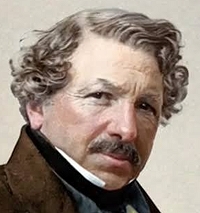
Louis Daguerre
French artist and inventor who developed the daguerreotype, an early photographic process publicly introduced in 1839 that produced permanent images on silver-coated copper plates.
Born on November 18, 1787
Died on July 10, 1851
Age at death: 64
Profession: Painter, Photographer
Place of Birth: Cormeilles-en-Parisis, Val-d'Oise, France
Place of Death: Bry-sur-Marne, France
Louis Daguerre, whose full name was Louis-Jacques-Mandé Daguerre, was a French painter, theatrical set designer, and one of the pioneers of photography. He developed the photographic process known as the daguerreotype, publicly introduced in 1839. The method made it possible to record detailed, permanent images on light-sensitive metal plates. His earlier work in theater and the Diorama provided experience with perspective, optics, and controlled lighting.
Early Life and Education
Louis Daguerre was born on November 18, 1787, in Cormeilles-en-Parisis, in the present-day Val-d'Oise department of France. His father was Louis Jacques Daguerre, and his mother was Anne Antoinette Hauterre.
He developed an interest in drawing and painting at an early age. He later moved to Paris, where he began working with theatrical scenery painters. His training included perspective drawing, architectural representation, and techniques for creating the illusion of depth on painted surfaces.
Daguerre worked in the artistic environment associated with panorama painter Pierre Prévost. The use of light, shadow, and large-scale painted scenery in theatrical productions became a central part of his early professional experience.
Theater and the Diorama
During the early nineteenth century, Louis Daguerre worked as a theatrical scenery painter in Paris. He designed stage settings and contributed to productions at the Paris Opera, developing techniques involving perspective, lighting, and changes of scenery.
In 1822, he opened the Diorama in Paris with painter Charles Marie Bouton. The Diorama was a public entertainment venue where large paintings were displayed using specially controlled lighting. Changes in illumination made the same landscape or architectural scene appear under different weather conditions or at different times of day.
The performances used painted translucent surfaces, curtains, and carefully arranged light sources. A rotating auditorium allowed spectators to view different scenes without leaving their seats. Daguerre created landscapes, architectural interiors, and other elaborate compositions for the presentations.
His experience with optical effects and the camera obscura encouraged his interest in producing images directly through the action of light rather than through painting alone.
Early Experiments in Photography
During the early nineteenth century, researchers in Europe were attempting to preserve images formed by the camera obscura. This optical device projects an inverted image through a small opening or lens onto a surface. The challenge was to record the image permanently using light-sensitive chemicals.
French inventor Nicéphore Niépce had already experimented with photographic methods using light-sensitive substances. His photograph View from the Window at Le Gras, produced around 1826 or 1827, is generally recognized as the oldest surviving permanent camera photograph.
After learning about Niépce's experiments, Louis Daguerre contacted him to discuss possible improvements. On December 14, 1829, they signed a partnership agreement to develop methods of recording permanent photographic images.
Niépce's process, known as heliography, used a light-sensitive bitumen coating and required extremely long exposure times. Daguerre experimented with alternative chemicals and metal surfaces to reduce exposure time and improve image detail.
Nicéphore Niépce died on July 5, 1833. Daguerre continued their research, while Niépce's son, Isidore Niépce, inherited his father's contractual interests.
Development of the Daguerreotype
During the 1830s, Louis Daguerre developed a photographic method using polished copper plates coated with silver. The silver surface was exposed to iodine vapor, forming a light-sensitive layer of silver iodide. The prepared plate was then placed inside a camera and exposed to light.
Daguerre discovered that mercury vapor could develop the invisible latent image formed during exposure. The resulting photograph was initially fixed using a salt solution. Later improvements introduced sodium thiosulfate as a more effective fixing agent.
The process produced a direct positive image on a reflective silver surface. Daguerreotypes could reproduce exceptionally fine details, but each plate contained a single original image. Unlike later negative-positive photographic systems, the technique did not allow multiple identical prints to be produced directly from one negative.
By 1837, Daguerre had developed a workable procedure for producing and fixing photographs. A still-life composition from that year is among the earliest surviving examples of his technique. In 1838, he began demonstrating the process to selected artists and scientists.
The Public Announcement of Photography in 1839
The French physicist, astronomer, and politician François Arago helped introduce Louis Daguerre's invention to the scientific community. On January 7, 1839, Arago announced the existence of the daguerreotype process at the French Academy of Sciences. The full technical procedure was not disclosed at that meeting.
On August 19, 1839, Arago presented the details of the invention at a joint meeting of the French Academy of Sciences and the Academy of Fine Arts in Paris. The announcement explained how photographic images could be created, developed, and preserved.
The French government acquired the rights to the process in exchange for lifetime annual pensions. Daguerre received 6,000 francs per year, while Isidore Niépce received 4,000 francs. The technique was made broadly available for public use, although patent restrictions applied in Britain.
August 19, 1839, became a widely recognized date in the history of photography. It is also commemorated internationally as World Photography Day.
One of the Earliest Photographs of People
One of Louis Daguerre's best-known photographs is Boulevard du Temple, taken in Paris around 1838. The image shows a city street lined with buildings and is among the earliest surviving photographs in which human figures can be identified.
Because the camera required several minutes of exposure, moving pedestrians and vehicles generally did not appear in the final image. Near the sidewalk, however, a man apparently having his shoes polished remained in place long enough to be recorded. The figure of the shoeshiner can also be distinguished.
The photograph demonstrates both the detailed images obtainable through the daguerreotype and the technical limitations imposed by long exposure times.
The Spread of the Daguerreotype
Following its public introduction in 1839, the daguerreotype spread rapidly throughout Europe and the United States. It became especially popular for portrait photography, allowing people to obtain detailed likenesses without commissioning painted portraits.
Early daguerreotypes required relatively long exposures. Improvements in camera lenses, chemical sensitization, and photographic equipment gradually reduced the time needed to produce portraits.
Because the photographic surface was delicate, daguerreotypes were commonly protected beneath glass and enclosed in decorative cases to prevent scratching and damage.
During the 1840s, photographic studios using the process opened in major European and American cities. Besides portraits, photographers recorded architecture, urban scenes, monuments, and objects.
Meanwhile, British inventor William Henry Fox Talbot developed the calotype, a negative-positive process that allowed multiple prints to be made from one photographic negative. As newer photographic technologies became available, the daguerreotype gradually declined in use.
Personal Life
Louis Daguerre married Louise Georgina Arrow-Smith. She remained his wife throughout his later artistic and photographic career.
Following the public introduction of the daguerreotype, Daguerre continued his artistic activities while spending increasing amounts of time in Bry-sur-Marne, near Paris. There, he worked on painting and projects associated with the Diorama.
Death
Louis Daguerre died on July 10, 1851, in Bry-sur-Marne, France, at the age of 63. He was buried in the town's cemetery.
His name appears among the 72 scientists and engineers commemorated on the Eiffel Tower in Paris. His photographic process is represented in museum collections and historical studies of nineteenth-century photography.
Major Works and Developments
- 1822 – Diorama: Illuminated visual entertainment system developed with Charles Marie Bouton
- 1829 – Partnership with Nicéphore Niépce to develop permanent photographic images
- 1837 – Early daguerreotype still-life photograph
- c. 1838 – Boulevard du Temple: Early photographic view of a Paris street containing human figures
- 1839 – Public introduction of the daguerreotype process
- 1839 – Historique et description des procédés du daguerréotype et du diorama: Publication describing the daguerreotype and Diorama techniques
Source: Biyografiler.com
Frequently asked questions about Louis Daguerre
Who is Louis Daguerre?, Louis Daguerre biography, Louis Daguerre life story, Louis Daguerre age, Louis Daguerre facts, Louis Daguerre birthplace, Louis Daguerre photos, Louis Daguerre videos, Louis Daguerre career

Lamine Yamal
Professional footballer

Kylian Mbappe
Professional footballer

Brad Pitt
Actor

Erling Haaland
Professional footballer

Keanu Reeves
Actor

Leonardo DiCaprio
Actor

Louis Büchner
Physician, Philosopher, Writer

Louis Daguerre
Painter, Photographer

Louis de Broglie
Physicist, Researcher

Louis De Funes
Actor, Comedian, Screenwriter

Louis Douzette
Painter

Louise Glück
Poet

Jensen Huang
Entrepreneur, CEO, Engineer

Lilly Wachowski
Film Director, Screenwriter
Leonardo DiCaprio
Actor

Liam Neeson
Actor
Erling Haaland
Professional footballer

Kristrun Frostadottir
Politician, Economist