
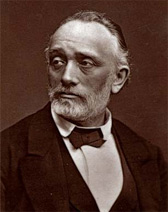
Louis Büchner
German physician and materialist philosopher known for his 1855 book Force and Matter (Kraft und Stoff) and for helping establish the German Freethinkers' League in 1881.
Born on March 29, 1824
Died on May 1, 1899
Age at death: 75
Profession: Physician, Philosopher, Writer
Place of Birth: Darmstadt, Germany
Place of Death: Darmstadt, Germany
Louis Büchner, also known as Ludwig Büchner, was born Friedrich Karl Christian Ludwig Büchner on March 29, 1824, in Darmstadt, Germany. He was a German physician, philosopher, and writer associated with nineteenth-century scientific materialism and atheism. His book Kraft und Stoff (Force and Matter), published in 1855, presented a materialist explanation of nature and human consciousness. Alongside Jacob Moleschott and Carl Vogt, he became a representative of scientific materialism. In 1881, he helped establish the German Freethinkers' League to promote secular thought and freedom from religious authority.
Early Life and Education
Louis Büchner belonged to a family with several members active in literature, science, and politics. His elder brother Georg Büchner was a playwright and revolutionary writer, while his sister Luise Büchner became a writer and advocate for women's education.
Beginning in 1842, he studied physics, chemistry, botany, mineralogy, philosophy, and medicine at the University of Giessen. He received his medical doctorate in 1848 with a dissertation concerning the nervous system. He subsequently continued his medical studies at the universities of Strasbourg, Würzburg, and Vienna. At Würzburg, he studied under pathologist Rudolf Virchow.
During the Revolutions of 1848, Büchner participated in political activities supporting liberal and democratic reform. His involvement included journalism and support for the political campaign of natural scientist Carl Vogt.
Academic Career and Force and Matter
In 1854, Louis Büchner qualified as a private lecturer at the University of Tübingen, where he taught medical and forensic subjects. His academic career was interrupted following the publication of his book Kraft und Stoff (Force and Matter) in 1855.
The book argued that matter and force are inseparable and that natural phenomena can be explained through physical laws without invoking supernatural causes. Büchner rejected the existence of an independent immaterial soul and regarded consciousness as dependent on the physiological activity of the brain.
His arguments provoked opposition from religious and academic circles. As a consequence of the controversy, he lost his authorization to teach at Tübingen in 1855. He returned to Darmstadt, where he practiced medicine while continuing to publish philosophical and scientific works.
Kraft und Stoff appeared in numerous editions and was translated into several languages. Its accessible presentation brought materialist philosophy to readers outside universities and specialist scientific communities.
Materialism, Darwinism, and Philosophy
Louis Büchner defended a form of naturalistic, largely mechanistic materialism. He maintained that matter and force were the foundations of existence and that mental activity could not be separated from physical processes. His approach differed from dialectical materialism, emphasizing explanations based on natural sciences rather than historical dialectics.
His philosophy developed alongside the work of Jacob Moleschott and Carl Vogt, who also sought to interpret biological and psychological phenomena through material processes.
Following the publication of Charles Darwin's evolutionary theory, Büchner became an advocate of Darwinism. In Sechs Vorlesungen über die Darwinsche Theorie (1868), he explained evolution and its implications for the understanding of human origins. He continued discussing evolution, heredity, religion, and society in his later publications.
German Freethinkers' League
On April 10, 1881, Louis Büchner participated in founding the Deutscher Freidenkerbund (German Freethinkers' League) in Frankfurt am Main. The organization brought together advocates of secularism, religious criticism, and freedom of thought. Among those associated with its foundation was socialist politician Wilhelm Liebknecht.
The organization promoted education and the separation of religious authority from public and intellectual life. Büchner became one of its principal representatives, advocating atheism and a scientific understanding of the natural world.
He also participated in public lectures and educational activities. During 1872–1873, he traveled to North America, where he delivered lectures, and subsequently continued speaking in German cities.
Political Activities and Later Career
Louis Büchner was involved in workers' education and liberal political organizations. In 1863, he helped establish a workers' educational association in Darmstadt. From 1884 to 1890, he served in the Second Chamber of the parliament of the Grand Duchy of Hesse, representing the Ober-Ingelheim constituency as a member of the German Free-minded Party.
Alongside political work and medical practice, he continued publishing books and essays on science, materialism, evolution, and religious criticism.
His writings reached readers in the Ottoman Empire. In 1911, Kraft und Stoff was translated into Turkish as Madde ve Kuvvet by Baha Tevfik and Ahmed Nebil. The translation became the subject of philosophical and religious debates among Ottoman intellectuals.
Personal Life and Death
Louis Büchner married Sophie Thomas in 1860. They had four children, including Georg Büchner, who later became an industrial executive and politician.
Louis Büchner died on May 1, 1899, in Darmstadt, Germany, at the age of 75. His works continued to be published and translated after his death, including the posthumous collection Im Dienste der Wahrheit (In the Service of Truth), issued in 1900.
Major Books
- 1855 – Kraft und Stoff (Force and Matter)
- 1857 – Natur und Geist (Nature and Spirit)
- 1862 – Aus Natur und Wissenschaft (From Nature and Science)
- 1868 – Sechs Vorlesungen über die Darwinsche Theorie (Six Lectures on Darwin's Theory)
- 1869 – Der Mensch und seine Stellung in der Natur (Man and His Place in Nature)
- 1884 – Der Fortschritt in Natur und Geschichte im Lichte der Darwinschen Theorie (Progress in Nature and History in the Light of Darwin's Theory)
- 1887 – Tatsachen und Theorien aus dem naturwissenschaftlichen Leben der Gegenwart (Facts and Theories from Contemporary Natural Science)
- 1889 – Das künftige Leben und die moderne Wissenschaft (The Future Life and Modern Science)
- 1890 – Die Darwinsche Theorie von der Entstehung und Umwandlung der Lebewelt (Darwin's Theory of the Origin and Transformation of Living Organisms)
- 1890 – Fremdes und Eigenes aus dem geistigen Leben der Gegenwart (Reflections on Contemporary Intellectual Life)
- 1894 – Darwinismus und Sozialismus (Darwinism and Socialism)
- 1900 – Im Dienste der Wahrheit (In the Service of Truth; posthumous)
Source: Biyografiler.com
Frequently asked questions about Louis Büchner
Who is Louis Büchner?, Louis Büchner biography, Louis Büchner life story, Louis Büchner age, Louis Büchner facts, Louis Büchner birthplace, Louis Büchner photos, Louis Büchner videos, Louis Büchner career
Related Biographies

Lamine Yamal
Professional footballer

Kylian Mbappe
Professional footballer

Brad Pitt
Actor

Erling Haaland
Professional footballer

Keanu Reeves
Actor

Leonardo DiCaprio
Actor

Louis Büchner
Physician, Philosopher, Writer

Louis Daguerre
Painter, Photographer

Louis de Broglie
Physicist, Researcher

Louis De Funes
Actor, Comedian, Screenwriter

Louis Douzette
Painter

Louise Glück
Poet

Jensen Huang
Entrepreneur, CEO, Engineer

Lilly Wachowski
Film Director, Screenwriter
Leonardo DiCaprio
Actor

Liam Neeson
Actor
Erling Haaland
Professional footballer

Kristrun Frostadottir
Politician, Economist