
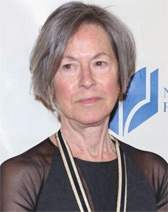
Louise Glück
American poet and 2020 Nobel Prize in Literature laureate, known for her autobiographical themes and restrained poetic language exploring family relationships, loss, trauma, and human experience.
Born on April 22, 1943
Died on October 13, 2023
Age at death: 80
Profession: Poet
Place of Birth: New York City, USA
Place of Death: Cambridge, Massachusetts, USA
Louise Glück, born Louise Elisabeth Glück on April 22, 1943, in New York City, was an American poet, essayist, and university professor. She was the daughter of Daniel Glück and Beatrice Grosby Glück and grew up in a Jewish family on Long Island. She attended George W. Hewlett High School before studying poetry at Sarah Lawrence College and Columbia University. Her first collection, Firstborn, was published in 1968. Over a literary career spanning more than five decades, she received the Pulitzer Prize for Poetry, the National Book Award, and the 2020 Nobel Prize in Literature.
Early Life and Education
Louise Glück developed an interest in literature and poetry during childhood. As a teenager, she experienced anorexia nervosa and underwent approximately seven years of psychoanalytic treatment. The illness interrupted her formal education, but she continued attending poetry courses. At Columbia University, she studied with poets Stanley Kunitz and Léonie Adams, who helped her develop her writing.
Her first poems appeared in literary magazines during the 1960s. Her debut collection, Firstborn (1968), explored family conflict, emotional isolation, and personal relationships. Following its publication, she experienced a period of writer's block. She began teaching at Goddard College in Vermont in 1971 and subsequently returned to writing poetry.
Literary Career
Her second collection, The House on Marshland, appeared in 1975, followed by Descending Figure in 1980. That year, a fire destroyed her home in Vermont, causing her to lose most of her possessions. Personal loss and family experiences subsequently appeared in several of her works.
In The Triumph of Achilles (1985), Louise Glück drew on Greek mythology to examine desire, suffering, and human relationships. Her collection Ararat (1990) addressed family tensions and grief. The Wild Iris (1992), which uses the voices of flowers, a gardener, and a divine presence to explore mortality and renewal, won the Pulitzer Prize for Poetry in 1993.
Her later books included Meadowlands (1996), Vita Nova (1999), and The Seven Ages (2001). Following the September 11, 2001 terrorist attacks, Glück wrote October, published in 2004. This six-part poem examined destruction, suffering, and survival.
She subsequently published Averno (2006), A Village Life (2009), and Faithful and Virtuous Night (2014). The latter received the National Book Award for Poetry. Her final poetry collection, Winter Recipes from the Collective, appeared in 2021.
Poetic Style and Academic Career
Louise Glück was frequently described as an autobiographical poet, although her writing was not limited to direct accounts of her life. Her poems addressed childhood, family relationships, trauma, desire, death, and nature. She often used classical mythology and natural imagery to examine personal experiences and broader questions about human existence. Her writing was characterized by precise language, restrained expression, and changing narrative perspectives.
She taught at several American universities, including Stanford University and Yale University. In 2004, she joined Yale as Rosenkranz Writer-in-Residence. She also served as a judge for the Yale Series of Younger Poets and mentored emerging writers. She was elected to the American Philosophical Society and received fellowships from the Guggenheim Foundation and the National Endowment for the Arts.
Awards and Nobel Prize
Louise Glück served as United States Poet Laureate from 2003 to 2004. Her awards included the Bollingen Prize in 2001 and the Gold Medal for Poetry from the American Academy of Arts and Letters in 2015. She was also awarded the 2015 National Humanities Medal, presented by President Barack Obama at a White House ceremony in September 2016.
In 2020, she received the Nobel Prize in Literature. The Swedish Academy recognized her poetic voice for expressing individual human experience through austere language. She was the first American woman to receive the literature prize since Toni Morrison in 1993.
Personal Life
Louise Glück married twice. Her first marriage was to Charles Hertz Jr. in 1967. In 1977, she married writer John Dranow. Both marriages ended in divorce. She had one son, Noah Dranow, born in 1973.
Death
Louise Glück died of cancer on October 13, 2023, at her home in Cambridge, Massachusetts, at the age of 80.
Major Awards
- 1993 – Pulitzer Prize for Poetry
- 2001 – Bollingen Prize
- 2003–2004 – United States Poet Laureate
- 2014 – National Book Award for Poetry
- 2015 – Gold Medal for Poetry
- 2015 – National Humanities Medal (presented in 2016)
- 2020 – Nobel Prize in Literature
Source: Biyografiler.com
Frequently asked questions about Louise Glück
Who is Louise Glück?, Louise Glück biography, Louise Glück life story, Louise Glück age, Louise Glück facts, Louise Glück birthplace, Louise Glück photos, Louise Glück videos, Louise Glück career
Related Biographies

Lamine Yamal
Professional footballer

Kylian Mbappe
Professional footballer

Brad Pitt
Actor

Erling Haaland
Professional footballer

Keanu Reeves
Actor

Leonardo DiCaprio
Actor

Louis Büchner
Physician, Philosopher, Writer

Louis Daguerre
Painter, Photographer

Louis de Broglie
Physicist, Researcher

Louis De Funes
Actor, Comedian, Screenwriter

Louis Douzette
Painter

Louise Glück
Poet

Jensen Huang
Entrepreneur, CEO, Engineer

Lilly Wachowski
Film Director, Screenwriter
Leonardo DiCaprio
Actor

Liam Neeson
Actor
Erling Haaland
Professional footballer

Kristrun Frostadottir
Politician, Economist