
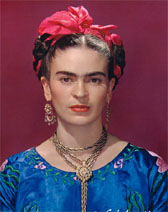
Frida Kahlo
The Painter Who Turned Pain Into Identity
Born on July 6, 1907
Died on July 13, 1954
Age at death: 47
Profession: Painter
Place of Birth: Coyoacán, Mexico
Place of Death: Mexico City, Mexico
Frida Kahlo, born as Magdalena Carmen Frida Kahlo y Calderón, was a Mexican painter whose works, although often associated with Surrealism, reflected a sharp and painful realism. She lived a stormy life marked by illness, physical suffering, emotional intensity, relationships, and extraordinary artistic talent. Pablo Picasso once stated that “we do not know how to paint human faces like hers.” Of her approximately seventy known works, fifty were purchased by the singer and art collector Madonna, who is known for her deep admiration for Kahlo. Renowned especially for her self-portraits, Frida’s life was brought to the screen in the 2002 film Frida, directed by Julie Taymor and starring Salma Hayek. Kahlo remains one of the rare artists who became famous during her lifetime and sold most of her paintings while still alive.
Frida Kahlo was born on July 6, 1907, in Coyoacán, Mexico, as the third of four daughters of Hungarian Jewish photographer Wilhelm Kahlo and Matilde Calderón González, who was of indigenous Mexican origin. In later years, Kahlo would declare her birth date not as July 6, 1907, but as July 7, 1910—the year of the Mexican Revolution—because she wanted her life to begin symbolically with the birth of modern Mexico. The family lived in Coyoacán in a house whose exterior walls were painted cobalt blue, later known as the “Blue House.” Shortly after Frida’s birth, her mother became ill and was unable to breastfeed her, so an indigenous wet nurse was hired. Although it was believed this would not affect Kahlo, she later portrayed the wet nurse in one of her paintings as a mythical embodiment of her Mexican identity.
Kahlo described her mother as gentle and intelligent, yet also cruel, calculating, and fanatically religious. Her relationship with her father, however, was always strong. In her diary, she wrote that Mr. Kahlo was a perfect symbol of compassion and diligence and that he approached all of Frida’s problems with understanding. At the age of six, Kahlo contracted polio, which caused one of her legs to become thinner than the other. At the time, polio often resulted in death due to respiratory failure. Kahlo survived, though she was left with permanent physical differences. She wore long skirts throughout her life to conceal this condition and was deeply hurt by being called “Frida the Wooden Leg.”
Despite having three sisters, Kahlo was raised much like a boy and formed friendships mostly with male classmates. She was a successful student and, influenced by the long-term effects of her illness, decided to pursue medical studies. When she was accepted into the medical preparatory program at the National Preparatory School in Mexico City, a historic first occurred: she became one of the first female students admitted to an institution previously reserved exclusively for men and regarded as a symbol of prestige in Mexico. During her time there, Kahlo broadened her intellectual horizons through art, literature, and philosophy. Among her classmates were future prominent figures such as Alejandro Gómez Arias, José Gómez Robleda, and Alfonso Villa.
On September 17, 1925, Kahlo’s life changed forever. While returning home from school by bus with her boyfriend Alejandro Gómez Arias, the vehicle collided with a tram. The accident resulted in the deaths of many passengers, and Kahlo was gravely injured. A thick metal handrail pierced her abdomen, passed through her body, and exited near her pelvis, severely damaging her spine. She suffered a dislocated shoulder, fractures in several ribs, multiple breaks in her right leg, and severe injuries to her spinal column. Doctors doubted she would survive, and she was initially left unattended after the crash. Later, Kahlo described the accident in her own words:
“In my time, buses were not at all reliable; they had only recently come into use and were very popular. The trams were nearly empty. Alejandro Gómez Arias and I boarded the bus… A short time later, the bus collided with the train on the Xochimilco line. It was a strange crash—not violent, but heavy and slow. It shook everyone. It shook me the most.”
“We had first boarded another bus, but when I realized I had forgotten my little umbrella, we got off to look for it, and that is how I ended up on the bus that destroyed me. The accident happened at an intersection… It is not true that one realizes the collision and cries. Not a single tear fell from my eyes.”
“The iron handrail pierced me like a sword pierces a bull.”
When she was taken by ambulance to the Red Cross Hospital, doctors discovered that her spine was broken in three places, her collarbone and third and fourth ribs were fractured, her right leg was broken in eleven places, her pelvis was fractured in three locations, and her left shoulder was dislocated. The metal rod had entered through the left side of her abdomen and exited through her genitals. Doctors doubted she would survive and stated that they would have to piece her body back together. After a month in the hospital, Kahlo was discharged on October 17, 1925, though it was believed she would remain bedridden for months.
Despite her immense suffering, Kahlo rarely showed her pain. Her life became a cycle of corsets, hospitals, and surgeries. She endured constant pain in her spine and right leg and underwent thirty-two operations throughout her life. In 1954, the leg weakened by childhood polio was amputated due to gangrene. During this time, her father’s photography business declined, forcing him to sell valuable household items to cover her medical expenses. To support his daughter emotionally, he built her a special bed, while her mother placed a mirror above it. Confronted with her reflection and broken body, Kahlo began painting herself, marking the beginning of her lifelong focus on self-portraiture.
As her condition improved, Kahlo became deeply involved in artistic and political circles. By 1929, she had joined the Mexican Communist Party. She sought out the famous muralist Diego Rivera to hear his opinion of her work. Their meeting led to love and marriage on August 21, 1929. Kahlo later wrote about this union:
“I fell in love with Diego Rivera, and my family did not approve at all, because Diego was a communist, and my relatives compared him to a very, very, very fat Breughel. They said it was like the marriage of an elephant and a white dove. Despite everything, we were married on August 21, 1929. Except for my father—who said to Diego, ‘Do not forget that my daughter is ill and will suffer from health problems throughout her life. She is intelligent but not beautiful. Do not forget this. Nevertheless, if you still wish to marry her, I give my consent’—no one else attended the wedding.”
Their marriage was passionate and turbulent. Kahlo suffered miscarriages and endured Rivera’s infidelities. They divorced in 1939 but remarried in 1940, returning to the Blue House. Despite all the suffering, Rivera remained central to Kahlo’s life, and she expressed this in one of her most famous reflections:
“Beginning Diego… Constructive Diego… My child Diego… Painter Diego… My father Diego… My son Diego… My lover Diego… My husband Diego… My friend Diego… My mother Diego… I am Diego… Diego is the universe.”
Despite her declining health, Kahlo painted relentlessly. She held her first solo exhibition in Mexico in 1953, attending the opening while lying in a hospital bed. That same year, her right leg was amputated. Frida Kahlo died on July 13, 1954, due to pulmonary embolism. Her final completed work, *Viva la Vida*, remains a powerful affirmation of life in the face of suffering.
Source: Biyografiler.com
Frequently asked questions about Frida Kahlo
Who is Frida Kahlo?, Frida Kahlo biography, Frida Kahlo life story, Frida Kahlo age, Frida Kahlo facts, Frida Kahlo birthplace, Frida Kahlo photos, Frida Kahlo videos, Frida Kahlo career
Related Biographies



Lamine Yamal
Professional footballer

Erling Haaland
Professional footballer

Kylian Mbappe
Professional footballer

Austin Abrams
Actor

Bad Bunny
Rapper, Songwriter

Sam Altman
Entrepreneur, Investor, CEO


Hongjoong
Singer, Rapper, Songwriter, Composer

Ludacris
Rapper, Actor

Kwon Eunbi
Singer

Sarah Wayne Callies
Actress, Screenwriter, Producer, Director

LaTavia Roberson
Singer, Actress, Entrepreneur
Bad Bunny
Rapper, Songwriter

Margot Robbie
Actress
Kylian Mbappe
Professional footballer

Neymar
Professional footballer

Pedro Sanchez
Politician

Ronaldinho
Professional footballer