
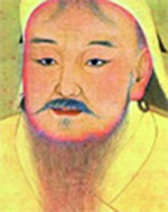
Genghis Khan
Founder and Supreme Ruler of the Mongol Empire
Born on ?? ??, 1162
Died on 1227
Age at death: 65
Profession: Military Commander, Emperor
Place of Birth: Mongolia
Place of Death: During the Tangut campaign (exact location unknown)
Genghis Khan, the Great Mongol Emperor, was born in 1162 in Mongolia. His childhood name was Temujin. According to tradition, the name Temujin is associated with the Chinese term “Cheng-sze,” meaning “Perfect Warrior.” Legends state that Temujin was born with his hand clenched into a fist, and when it was opened, it was said to contain a clot of blood. Upon hearing this, his father Yesugei Bahadur declared that his son would become a great warrior and would cause much bloodshed across the earth.
Yesugei Bahadur was the leader of the Kiyat Tatar clan, which had gained significant power and prestige in Mongolia during the 12th and 13th centuries. Temujin’s mother Ulun Hatun was a devoted woman who raised her children according to ancient Turkic traditions. When Temujin was only ten years old, his father died. After his death, the unity of the people under Yesugei’s rule collapsed, leaving Ulun Hatun and her children abandoned and struggling to survive.
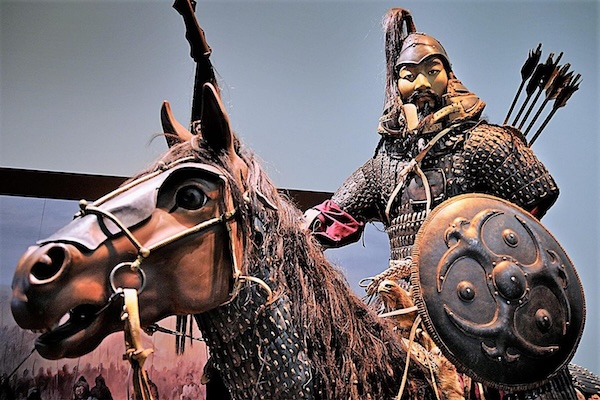
Growing up under these harsh conditions, Temujin became a tall, strong, and energetic young man. He could remain on horseback all day and use a bow with great skill. Together with his brothers, Temujin decided to reunite his father’s people and gather all rightful followers around them.
At that time, Mongolia was divided into many feudal territories. Two powerful rulers dominated the land: the Kereyit Khan Tughrul Khan and the Naiman Khan Buyruk Khan. There was also a third rival group known as the Merkit, who were long-standing enemies of Yesugei Bahadur’s lineage.
Alarmed by the growing power of Yesugei’s sons, the Merkit launched a surprise night raid on Temujin’s camp. They kidnapped his mother and his wife and plundered all his possessions. Temujin barely escaped with his life and took refuge on Mount Burkhan Khaldun. To resist the Merkit and rescue his family, he sought help from his father’s old ally, Tughrul Khan. Tughrul sent a large army to Temujin’s aid, enabling him to defeat the Merkit and rescue his family.
As Temujin’s power continued to grow, uprisings began among other tribes. During these conflicts, his ally Tughrul Khan was killed, and the Kereyit tribe came under Temujin’s rule. Having united many clans under his authority, Temujin still needed to defeat his strongest rival, the Naiman Khanate ruled by Buyruk Khan, to become the sole ruler of Mongolia. The fierce war that began in 1204 lasted for a year. Temujin emerged victorious and secured his dominance.
In 1206, at a grand kurultai held on the banks of the Onon River, Temujin was proclaimed khagan with the title “Genghis.” From that moment on, he was known as Genghis Khan. According to tradition, nine banners were raised during the ceremony.
Until the age of fifty, Genghis Khan fought numerous battles against various Mongolian tribes. Although he occasionally suffered defeats, he never lost determination. His greatest achievements, however, began after this period.
Genghis Khan first turned his attention to China. In 1211, he laid siege to Beijing. After prolonged and bloody battles, a treaty was signed with the Chinese ruler, and he married a Chinese princess, his second marriage. Hostilities resumed a few months later and continued until 1215, when Beijing was captured. The Chinese emperor acknowledged Genghis Khan’s supremacy and agreed to pay tribute.
The most powerful Islamic state in the west at that time was ruled by Sultan Muhammad. Alarmed by Genghis Khan’s growing power, Sultan Muhammad sent an embassy led by Seyyid Bahaeddin Razi. Genghis Khan, believing that friendship and trade would be beneficial, responded by sending a delegation led by Mahmud Yalavach. Thus, a friendship and trade agreement was established between the Mongols and the Khwarazmians.
Following this agreement, a Mongol trade caravan of 450 people set out in 1218. However, in the city of Otrar, the local governor Kayir Khan Inalchik seized the caravan, looted its goods, and executed all its members. Only one survivor escaped and informed Genghis Khan. When he demanded the surrender of Kayir Khan Inalchik, his envoys were also killed. This incident became the direct cause of the Mongol invasions of Islamic lands.
Determined to take revenge, Genghis Khan launched a massive campaign. Reaching Otrar, he left his sons Chagatai and Ogedei to continue the siege while he advanced further. Cities that surrendered without resistance were spared, while others faced total destruction.
After devastating campaigns across Transoxiana, Bukhara, Samarkand, Khorasan, and Urgench, Genghis Khan secured Mongol dominance over vast Islamic territories. These conquests cemented his reputation as a ruthless yet extraordinarily effective ruler.
In 1225, Genghis Khan returned to Mongolia and divided his empire among his four sons. In 1227, during a campaign against the Tangut state, he fell ill and died. His funeral was conducted according to ancient Turkic traditions, and the location of his grave remains unknown.
The exact cause of his death is uncertain. Some accounts claim that Genghis Khan died from illness, while others suggest he fell from his horse. According to legend, horses were driven repeatedly over his grave, and all who knew its location were killed to preserve secrecy.
Beyond his military achievements, Genghis Khan was also a lawmaker. He established a legal code known as the Law of Genghis Khan, which regulated the legal and military affairs of the Mongol Empire. These laws, drawn from ancient oral traditions, were strict and uncompromising, often prescribing death for crimes such as theft, betrayal, or disobedience.
The military genius and strategic brilliance of Genghis Khan ensured his place in history as one of the greatest commanders the world has ever known.
Source: Biyografiler.com
Frequently asked questions about Genghis Khan
Who is Genghis Khan?, Genghis Khan biography, Genghis Khan life story, Genghis Khan age, Genghis Khan facts, Genghis Khan birthplace, Genghis Khan photos, Genghis Khan videos, Genghis Khan career

Lamine Yamal
Professional footballer

Kylian Mbappe
Professional footballer

Erling Haaland
Professional footballer

Sam Altman
Entrepreneur, Investor, CEO

Austin Abrams
Actor

Bad Bunny
Rapper, Songwriter


Hongjoong
Singer, Rapper, Songwriter, Composer

Ludacris
Rapper, Actor

Kwon Eunbi
Singer

Sarah Wayne Callies
Actress, Screenwriter, Producer, Director

LaTavia Roberson
Singer, Actress, Entrepreneur

Pedro Sanchez
Politician

Adam Sandler
Actor

Cillian Murphy
Actor
Lamine Yamal
Professional footballer
Austin Abrams
Actor

Brad Pitt
Actor