
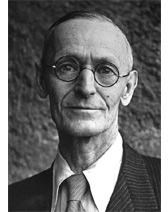
Hermann Hesse
The spiritual rebel of modern literature
Born on July 2, 1877
Died on August 9, 1962
Age at death: 85
Profession: Writer, Essayist, Poet
Place of Birth: Calw, Württemberg, Germany
Place of Death: Montagnola, Ticino, Switzerland
Hermann Hesse was a German writer and one of the most influential literary figures of the 20th century. In his works, he explored the individual’s struggle to escape the rigid patterns of civilization in order to rediscover the true self, calling readers to take responsibility for saving their own lives. He elevated Eastern mysticism, was deeply interested in Buddhism, and became one of the most widely read authors during the rise of Buddhism and Zen Buddhism in the United States in the 1960s. Through his novels, short stories, essays, poems, political articles, and cultural criticism, he reached more than 100 million readers worldwide and was awarded the Nobel Prize in Literature in 1946. A committed humanist and outspoken opponent of war, his most important novels include Knulp, Demian, Siddhartha, and Steppenwolf.
Hermann Hesse was born on July 2, 1877, in Calw, Württemberg, Germany. His father, Johannes Hesse, was born in Estonia in 1847, and his mother, Marie Gundert, was born in 1842. Both were members of the Christian missionary organization known as the Basel Mission. The family lived in Calw in the house overseen by his grandfather Hermann Gundert, where missionary activities were carried out. In 1880, the family moved to Basel, Switzerland, for six years before returning to Calw.
After enrolling at the Latin School in Göppingen, Hesse entered the Evangelical Theological Seminary in 1891. However, his rebellious nature soon dominated, and after only one year he ran away from the school. During this turbulent period, marked by severe conflicts with his parents, Hesse attempted suicide and was admitted to an institution in Bad Boll under the supervision of Christoph Friedrich Blumhardt. He was treated by Lang, a student of Carl Jung, which intensified his interest in psychology and Jungian thought, greatly enriching his inner world.
At the end of 1892, Hesse applied to the Gymnasium in Cannstatt to continue his education. The restrictions of the education system and the religious pressure imposed by his missionary father deeply troubled him. In his search for an independent path, he began working in a bookshop. After a brief three-day apprenticeship, he found factory work in the summer of 1894, where he spent fourteen months soldering. The mechanical nature of the work depressed him, and he sought spiritual escape. In October 1895, he returned to bookselling at the Heckenhauer bookshop, where he immersed himself in philology, theology, and law.
Despite a grueling twelve-hour daily workload, Hesse continued studying at home and spent his Sundays reading rather than socializing. He was particularly interested in Johann Wolfgang von Goethe, Gotthold Ephraim Lessing, Friedrich Schiller, and Greek mythology. In 1896, his poem “Madonna” was published. By 1898, he had become financially independent and drew inspiration from German Romantics such as Clemens Brentano, Joseph von Eichendorff, Friedrich Hölderlin, and Novalis. That year he published his poetry collection Romantic Songs, followed in 1899 by One Hour After Midnight, though neither attracted much attention.
In the autumn of 1899, Hesse changed jobs and moved to Basel to work in a bookstore specializing in antiquarian books, living with an intellectual family who encouraged his development. Due to an eye condition, he was exempted from military service, and during this period he began suffering from severe headaches that would persist throughout his life. In 1901, he traveled to Italy, a long-held dream, while his poems and essays began appearing in newspapers and gained considerable attention.
A major turning point came when publisher Samuel Fischer read Hesse’s novel Peter Camenzind, enabling him to focus entirely on writing as a free and independent author. In 1904, Hesse married Maria Bernoulli and settled near Lake Constance in Gaienhofen. His second novel, Beneath the Wheel, was published in 1906, followed by Gertrude in 1910, which failed to meet expectations and led Hesse to describe his relationship with writing as troubled.
Deeply interested in Buddhism and influenced by Arthur Schopenhauer, Hesse also explored Theosophy. His fascination with India intensified through Schopenhauer’s works. Marital discord led him to travel alone to Sri Lanka and Indonesia, journeys that left a lasting spiritual and religious imprint on his writing. After returning, the couple moved to Bern in 1912, but their problems persisted and were later reflected in the novel Rosshalde.
At the outbreak of World War I, Hesse volunteered for military service but was rejected due to health issues. Instead, he worked in the care of prisoners of war. After publishing the article “O Friends, Not These Tones” in the Neue Zürcher Zeitung on November 3, 1914, he faced harsh criticism from the German press, with only Theodor Heuss and French writer Romain Rolland publicly supporting him.
The year 1916 was especially devastating: Hesse lost his father, his son fell ill, and his wife developed schizophrenia. Undergoing psychotherapy, he completed the novel Demian, which he published in 1919 under the pseudonym Emil Sinclair, shortly after the armistice. That same year, his marriage ended in divorce, and Hesse settled alone near Minusio in Ticino, close to Locarno.
Alongside writing, Hesse began painting. After publishing Klingsor’s Last Summer in 1920, he released Siddhartha, a profound expression of his devotion to Indian and Buddhist philosophy. In 1924, he married Ruth Wenger, the daughter of Swiss writer Lisa Wenger. Following novels such as Kurgast, The Nuremberg Trip, and Steppenwolf, his biography was written by his friend Hugo Ball.
After separating from Wenger, Hesse married Ninon Dolbin Ausländer, a Jewish woman. His opposition to Nazism led to his exclusion from the German press. In 1931, he published Narcissus and Goldmund, followed by The Glass Bead Game in 1932. In 1933, due to his anti-Nazi views, he was forced into exile, supported by Bertolt Brecht and Thomas Mann. His lifelong humanist stance and opposition to war culminated in receiving the Nobel Prize in Literature in 1946 for The Glass Bead Game.
Hermann Hesse died on August 9, 1962, and was buried in the San Abbondio cemetery in Montagnola, where his friend and biographer Hugo Ball is also interred.
Books:
1904 – Peter Camenzind
1906 – Beneath the Wheel
1910 – Gertrude
1912–1913 – Rosshalde
1915 – Knulp
1919 – Demian
1922 – Siddhartha
1927 – Steppenwolf
1930 – Narcissus and Goldmund
1932 – Journey to the East
1943 – The Glass Bead Game
My Youthful Years
Klingsor’s Last Summer
You Shall Not Kill
The Peach Tree
A Guest at the Spa, The Nuremberg Journey
Neither Faith nor Love Follows the Path of Reason
Youth Is a Beautiful Thing
Childhood of a Magician
Small Worlds
Hermann Lauscher
Fairy Tales
Selected Poems 1896–1962
Source: Biyografiler.com
Frequently asked questions about Hermann Hesse
Who is Hermann Hesse?, Hermann Hesse biography, Hermann Hesse life story, Hermann Hesse age, Hermann Hesse facts, Hermann Hesse birthplace, Hermann Hesse photos, Hermann Hesse videos, Hermann Hesse career
Related Biographies

Lamine Yamal
Professional footballer

Erling Haaland
Professional footballer

Andrew Garfield
Actor

Sam Altman
Entrepreneur, Investor, CEO

Kylian Mbappe
Professional footballer

Khabib Nurmagomedov
Professional Boxer

Hoyt Richards
Model, Actor

Dieter Schwarz
Businessperson, Entrepreneur

Giovanni Ferrero
Businessperson

Cynthia Erivo
Singer, Actress, Songwriter, Producer

Mike Markkula
Businessperson, Entrepreneur

Carol Burnett
Actress, Singer
Lamine Yamal
Professional footballer

Scott Bessent
Politician, Investor
Sam Altman
Entrepreneur, Investor, CEO
Erling Haaland
Professional footballer
Kylian Mbappe
Professional footballer

Tom Holland
Actor