
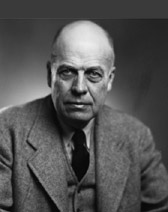
Edward Hopper
Iconic chronicler of American loneliness and urban silence
Born on July 22, 1882
Died on May 15, 1967
Age at death: 85
Profession: Painter
Place of Birth: Nyack, New York, United States
Place of Death: New York City, United States
Edward Hopper was an American painter and printmaker who portrayed the quiet tension, loneliness, and psychological depth of modern American life through his art. Alongside many significant works, he is the creator of Nighthawks, one of the most recognizable paintings of 20th-century art, depicting an iconic late-night diner scene.
Born on July 22, 1882, in Nyack, New York, a small shipbuilding town along the Hudson River, Edward Hopper was the younger of two children in an educated middle-class family. His parents supported his intellectual and artistic interests, and by the age of five, Hopper had already begun to show notable drawing talent. During his elementary and high school years, he experimented with various techniques and developed an early interest in Impressionism and pastoral subjects. One of his earliest signed works is a painting of a rowboat dated 1895.
Before fully committing to fine art, Hopper briefly considered becoming a naval architect. After graduating in 1899, he first took correspondence courses in illustration and later enrolled at the New York School of Art. There, he studied under Impressionist painter William Merritt Chase and realist artist Robert Henri, a leading figure of the Ashcan School. Henri’s emphasis on portraying contemporary urban life with honesty and expressive power had a lasting influence on Hopper’s artistic vision.
After completing his education, Edward Hopper began working as an illustrator for an advertising agency in 1905. Although he found the work creatively restrictive, he continued in order to earn a living while producing his own art. His trips to Paris in 1906, 1909, and 1910, as well as a visit to Spain in 1910, were crucial in shaping his personal style. Despite the rise of Cubism and Fauvism in Europe, Hopper was particularly influenced by the use of light in the works of Claude Monet and Edouard Manet. Notable works from this period include Paris Bridge (1906), Louvre and Boat Landing (1907), and Summer Interior (1909).
Upon returning to the United States, Hopper continued his illustration career while exhibiting his paintings. He participated in the Independent Artists Exhibition in 1910 and the Armory Show in 1913. At the Armory Show, his 1911 painting Sailing became his first work to be sold and was exhibited alongside works by Paul Gauguin, Henri de Toulouse-Lautrec, Paul Cézanne, and Edgar Degas. That same year, he moved into an apartment near Washington Square in Greenwich Village, where he would live for most of his life.
During the 1910s, Edward Hopper spent his summers traveling through New England, drawing inspiration from its landscapes. Paintings such as Squam Light (1912) and Road in Maine (1914) emerged from this period. Despite his continued productivity, recognition of his personal work remained limited until the early 1920s. In 1920, at the age of 37, he gained attention with his first solo exhibition at the Whitney Studio Club, organized by art patron Gertrude Vanderbilt Whitney.
In 1923, Hopper reunited with his former classmate, painter Josephine Nivison, and they married in 1924. The couple became inseparable. Josephine insisted on being the sole model for all of Hopper’s female figures, and she appears in many of his paintings. She also encouraged his shift from oil painting to watercolor and shared her connections within the art world. A successful exhibition at the Rehn Gallery, where all of his watercolors were sold, enabled Edward Hopper to abandon commercial illustration entirely.
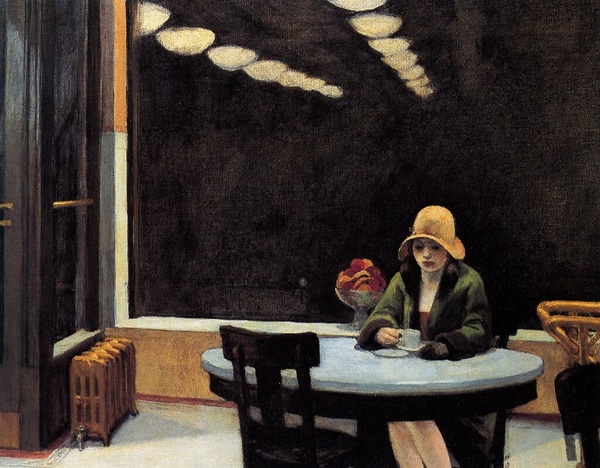
One of the defining works of Hopper’s artistic maturity was House by the Railroad (1925). In 1930, it became the first painting by Hopper to be acquired by the Museum of Modern Art in New York, which later organized a retrospective exhibition of his work. Other significant paintings from this period include Automat (1927), depicting a solitary woman, and Two Lights, Maine (1929), inspired by the Maine coastline.
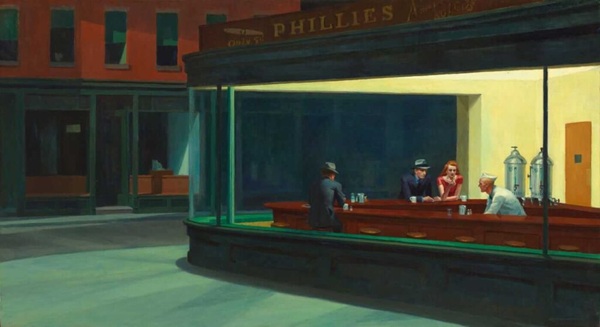
Completed in 1939, New York Movie portrays a young usher standing pensively in a cinema lobby. In January 1942, Hopper finished his most famous painting, Nighthawks. Depicting three customers and a waiter in a brightly lit diner on a quiet street, the work is celebrated for its sharp composition, dramatic lighting, and enigmatic atmosphere, and is widely regarded as Hopper’s most representative creation. The painting was soon acquired by the Art Institute of Chicago.
Although Hopper’s popularity declined with the rise of Abstract Expressionism in the mid-20th century, critical acclaim for his work continued. In 1950, he was honored with a major retrospective at the Whitney Museum of American Art, and in 1952, he represented the United States at the Venice Biennale. Despite declining health, he continued to produce notable works such as Hotel Window (1955), New York Office (1963), and Sun in an Empty Room (1963).
Edward Hopper died on May 15, 1967, at the age of 84, in his home near Washington Square in New York City. He was buried in his hometown of Nyack. His wife, Josephine Hopper, passed away approximately one year later, and she bequeathed both of their artistic estates to the Whitney Museum of American Art.
Today, Edward Hopper is regarded as one of the most influential figures of American modernism. Through his silent spaces, isolated figures, and masterful use of light and shadow, he captured the emotional depth of everyday life. His work has left a lasting impact across painting, cinema, and photography, and continues to endure as a visual poetry of American loneliness.
Loneliness and Isolation in Edward Hopper’s Paintings
Automat (1927), painted by Edward Hopper, depicts a quiet moment in which a young woman sits alone, drinking coffee. In Hopper’s work, loneliness is not merely a theme but a fundamental element that defines the spirit of his paintings. Figures are often solitary, and even in crowded settings, invisible distances separate them, powerfully reflecting the alienation of the individual in modern urban life.
Hopper’s use of expansive empty spaces, sharp contrasts of light and shadow, and static compositions intensifies this sense of solitude. His environments feel both familiar and foreign, as if they are places once inhabited but now abandoned. These silent narratives convey a wordless melancholy. By drawing viewers into the inner worlds of his characters, Edward Hopper transformed his personal perception of loneliness into a universal visual language.
Among Hopper’s many iconic works that express loneliness and the stillness of everyday life, Nighthawks (1942) stands at the forefront. The painting portrays four figures seated in a diner late at night. Though physically close, they remain emotionally disconnected; no gazes meet, and no words are exchanged. In this work, Hopper visualized the anxiety, alienation, and isolation felt in wartime America through architectural rigidity and dramatic illumination.
Source: Biyografiler.com
Frequently asked questions about Edward Hopper
Who is Edward Hopper?, Edward Hopper biography, Edward Hopper life story, Edward Hopper age, Edward Hopper facts, Edward Hopper birthplace, Edward Hopper photos, Edward Hopper videos, Edward Hopper career
Related Biographies

Lamine Yamal
Professional footballer

Erling Haaland
Professional footballer

Kylian Mbappe
Professional footballer

Keanu Reeves
Actor

Austin Abrams
Actor

Bad Bunny
Rapper, Songwriter


Hongjoong
Singer, Rapper, Songwriter, Composer

Ludacris
Rapper, Actor

Kwon Eunbi
Singer

Sarah Wayne Callies
Actress, Screenwriter, Producer, Director

LaTavia Roberson
Singer, Actress, Entrepreneur

Pedro Sanchez
Politician
Lamine Yamal
Professional footballer

Claudia Sheinbaum
President, Politician, Scientist, Academic
Erling Haaland
Professional footballer

Leonardo DiCaprio
Actor
Keanu Reeves
Actor