
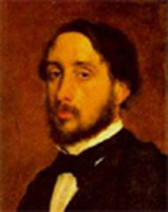
Edgar Degas
Master of Modern Figure Painting and Ballet Scenes
Born on July 19, 1834
Died on September 27, 1917
Age at death: 83
Profession: Painter, Sculptor
Place of Birth: Paris, France
Place of Death: Paris, France
Edgar Degas, whose full name was Hilaire Germain Edgar Degas, was one of the most influential artists of the 19th century. Although closely associated with Impressionism, he maintained a distinctive artistic position, combining classical discipline with modern subjects. He is best known for his profound studies of movement, particularly in ballet dancers, women at work, and horse racing scenes.
Edgar Degas was born on July 19, 1834, in Paris. His father, Auguste Degas, was a wealthy banker who managed the Paris branch of the family banking firm Degas Padre e Figli, which also operated in Naples and New Orleans. His mother, Célestine Musson, was an American woman whom his father met and married after moving from Naples to Paris. Edgar was their first child. His father was deeply interested in the arts and strongly supported Edgar’s artistic ambitions.
Degas lost his mother at the age of thirteen. After her death, his father raised the children alone and ensured they received the best possible education. In 1845, at the age of eleven, Edgar entered Lycée Louis-le-Grand. He graduated in 1853 with distinction in literature.
In November 1853, Edgar Degas enrolled in the Faculty of Law in Paris. However, his passion for art led him to abandon legal studies. In 1855, he entered the École des Beaux-Arts in Paris. In 1856, he traveled to Italy to study the works of Renaissance masters and remained there for three years. During this period, he obsessively copied classical and Renaissance artworks. When he visited Rome in 1857, he filled 28 sketchbooks, and by 1860 he had accumulated nearly 700 copies of works from the Renaissance and Classical periods.
Returning to Paris in 1859, Degas began producing large-scale historical and mythological paintings. Although he used strong color effects and emphasized movement, his approach was more restrained and disciplined than that of academic painters of his time. Deeply influenced by great French and Italian masters, he devoted much of his life to understanding their technical methods through careful imitation.
In 1868, Edgar Degas abandoned historical painting and turned toward portraits and scenes from everyday life, including horse racing. His growing interest in ballet dancers and opera also dates from this period. By 1870, he ceased exhibiting at the official Salon and focused intensively on ballet rehearsals and performances.
Following the Franco-Prussian War and the suppression of the Paris Commune, Degas joined the National Guard alongside his close friend Edouard Manet. In 1873, together with Manet, Camille Pissarro, Alfred Sisley, Berthe Morisot, Paul Cézanne, and others, he co-founded the Société Anonyme des Artistes Peintres, Sculpteurs, Graveurs, etc., an association that would later become central to the Impressionist movement.
In 1874, Degas’s father died in Naples, leaving behind substantial debts. Despite this setback, Degas’s career flourished. By the 1880s, he produced numerous works depicting dancers, milliners, and laundresses. His paintings sold well, and he eventually amassed a considerable fortune.
Edgar Degas primarily focused on the human figure rather than landscapes. Women, ballet dancers, and scenes of daily labor dominate his oeuvre. He also created several small sculptures of dancers and horses. His nude drawings are considered exceptionally accomplished, and his portraits rank among the greatest achievements in art history. Although Degas’s works often appear spontaneous and effortless, they are in fact the result of meticulous planning, drawing, and compositional rigor.
Degas’s reputation grew significantly in the 1870s through exhibitions with the Impressionist groups. Unlike some of his contemporaries, he did not suffer severe financial anxiety due to his family’s wealth. He often retained his works until circumstances required their sale, offering them either directly to visitors at his studio or through prominent art collectors.
After 1885, as his eyesight deteriorated, Edgar Degas increasingly abandoned oil painting in favor of pastel. Among his most celebrated works are The Ballet Rehearsal Room on the Rue Le Peletier (1872; Louvre Museum, Paris), The Dance Class (1872; Metropolitan Museum of Art, New York), Two Laundresses (1884; Louvre Museum, Paris), and Rehearsal on Stage (1878–1879; Metropolitan Museum of Art, New York).
In his final years, Degas became increasingly isolated and was abandoned by many of his friends. Nevertheless, by the time of his death, his works were already displayed in major European museums.
Edgar Degas died on September 27, 1917, in Paris at the age of eighty-three. He was buried in the Montmartre Cemetery, leaving behind a legacy that profoundly shaped modern art.
Source: Biyografiler.com
Frequently asked questions about Edgar Degas
Who is Edgar Degas?, Edgar Degas biography, Edgar Degas life story, Edgar Degas age, Edgar Degas facts, Edgar Degas birthplace, Edgar Degas photos, Edgar Degas videos, Edgar Degas career
Related Biographies

Lamine Yamal
Professional footballer

Erling Haaland
Professional footballer

Kylian Mbappe
Professional footballer

Keanu Reeves
Actor

Austin Abrams
Actor

Bad Bunny
Rapper, Songwriter


Hongjoong
Singer, Rapper, Songwriter, Composer

Ludacris
Rapper, Actor

Kwon Eunbi
Singer

Sarah Wayne Callies
Actress, Screenwriter, Producer, Director

LaTavia Roberson
Singer, Actress, Entrepreneur

Pedro Sanchez
Politician
Lamine Yamal
Professional footballer

Claudia Sheinbaum
President, Politician, Scientist, Academic
Erling Haaland
Professional footballer

Leonardo DiCaprio
Actor
Keanu Reeves
Actor