
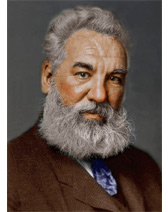
Alexander Graham Bell
Scottish-born inventor and scientist who received the first successful United States patent for the telephone in 1876. He also developed the photophone, contributed to sound recording technology, and conducted research into aviation and hydrofoil boats.
Born on March 3, 1847
Died on August 2, 1922
Age at death: 75
Profession: Inventor, Scientist, Entrepreneur
Place of Birth: Edinburgh, Scotland, United Kingdom
Place of Death: Beinn Bhreagh, Baddeck, Nova Scotia, Canada
Alexander Graham Bell (March 3, 1847 – August 2, 1922) was a Scottish-born inventor, scientist, engineer, and educator who is credited with developing and patenting the first practical telephone. On March 7, 1876, he received United States Patent No. 174,465 for an apparatus capable of transmitting speech electrically. Three days later, on March 10, he successfully transmitted intelligible words to his assistant Thomas A. Watson. Bell's experiments grew out of his investigations into acoustics, speech production, and methods of teaching deaf students. After the telephone's invention, he continued working on communication technologies, including the Photophone, a device that transmitted speech through a beam of light, and the Graphophone, an improved sound-recording instrument developed with collaborators. He also conducted research into aviation, hydrofoil boats, and medical technology. Bell was a founding member of the National Geographic Society and served as its president from 1898 to 1903.
Early Life and Family Background
Alexander Graham Bell was born on March 3, 1847, in Edinburgh, Scotland. His father, Alexander Melville Bell, was an educator and researcher specializing in elocution, phonetics, and the mechanics of speech. His mother, Eliza Grace Symonds Bell, was a pianist who experienced significant hearing loss.
Bell was the second of three sons. His older brother, Melville James Bell, was born in 1845, while his younger brother, Edward Charles Bell, was born in 1848.
He was originally named Alexander Bell. At the age of eleven, he adopted Graham as an additional middle name, a change connected with his family's acquaintance with Alexander Graham, a former student of his father.
Bell grew up in a household where speech, language, and vocal expression were regular subjects of study. His father and grandfather were both involved in teaching elocution, and their professional interests influenced his early education.
His mother's hearing difficulties also encouraged him to examine the relationship between sound vibrations and human perception.
Childhood Interest in Sound and Mechanical Inventions
From childhood, Alexander Graham Bell demonstrated an interest in mechanical devices and scientific experimentation.
At the age of twelve, he constructed a device that helped remove husks from wheat. The machine was developed for a local flour mill and used rotating paddles and brushes to separate grain from its covering.
He also experimented with methods of transmitting and reproducing sounds.
Bell observed that his mother could sometimes understand his speech when he directed his voice toward her forehead or communicated through physical vibrations. He also learned to use the manual alphabet to communicate with her.
These experiences contributed to his interest in the physical properties of sound and the mechanisms through which speech could be understood.
As a teenager, Bell and his brother Melville experimented with mechanical devices intended to imitate the human voice.
They were influenced by demonstrations of speech-producing machines and by the work of British scientist Charles Wheatstone, who had investigated electrical communication and mechanical speech.
Bell subsequently began studying anatomy, acoustics, and the movements involved in producing different speech sounds.
Education and Early Teaching Career
Alexander Graham Bell attended the Royal High School of Edinburgh but left formal secondary education before completing the full course.
He subsequently studied privately and attended lectures at the University of Edinburgh and University College London.
His education combined instruction from family members with independent scientific study.
At approximately sixteen years of age, he began working as a student-teacher at Weston House Academy in Elgin, Scotland, where he taught music and elocution.
During this period, he continued studying the mechanics of speech and the movement of air through the vocal organs.
He later worked alongside his father, who had developed a system called Visible Speech.
The system used written symbols to describe the physical positions of the lips, tongue, and other organs involved in producing speech.
It was intended to assist with pronunciation and speech instruction, including the education of deaf students.
Scientific Influences and Experiments in Acoustics
During the 1860s, Alexander Graham Bell became interested in the research of German physicist Hermann von Helmholtz, particularly his investigations into hearing, sound frequencies, and the production of musical tones.
Bell read Helmholtz's On the Sensations of Tone, which examined the physical principles underlying music and hearing.
His study of Helmholtz contributed to his investigations into whether different sounds could be transmitted through electrical circuits.
He was also familiar with the work of Charles Wheatstone, whose research concerned electricity, telegraphy, and mechanical devices.
Bell initially experimented with apparatuses that produced or reproduced speech through mechanical means.
He gradually shifted toward electrical methods, investigating how a vibrating diaphragm might vary an electric current and reproduce sound at another location.
Family Tragedies and Immigration to Canada
During the late 1860s, tuberculosis affected the Bell family.
His younger brother Edward Charles Bell died in 1867, followed by his older brother Melville James Bell in 1870.
Concerned about the health of their remaining son, Bell's parents decided to leave Britain.
In July 1870, the family emigrated to Canada and settled near Brantford, Ontario.
The change allowed Bell to continue his scientific studies while living with his parents in a rural environment.
He established a small experimental workspace and conducted investigations into sound transmission, resonance, and the movement of vibrating objects.
Bell also maintained an interest in methods of teaching speech to deaf people, which soon led to professional opportunities in the United States.
Moving to Boston and Teaching Deaf Students
In April 1871, Alexander Graham Bell traveled to Boston, Massachusetts, to demonstrate his father's Visible Speech system.
He began instructing teachers at the Boston School for Deaf Mutes, where his methods attracted interest among educators.
He subsequently taught at institutions including the Clarke School for the Deaf in Northampton, Massachusetts, and the American School for the Deaf in Hartford, Connecticut.
In 1872, Bell established his own school in Boston to train teachers in speech instruction for deaf students.
His professional work involved studying the physiological production of speech and teaching students to recognize and reproduce different sounds.
In 1873, he became Professor of Vocal Physiology and Elocution at Boston University.
While continuing his educational work, he conducted experiments that eventually led to the telephone.
Research into the Harmonic Telegraph
During the early 1870s, Alexander Graham Bell investigated the possibility of improving telegraph communication.
Conventional electrical telegraph systems transmitted messages using coded signals, typically associated with Morse Code.
Bell proposed a system in which several messages could travel simultaneously along the same wire by using different electrical frequencies.
He called the arrangement a harmonic telegraph.
His experiments involved vibrating metal reeds, electromagnets, and electrical circuits intended to respond to different musical tones.
In 1874, he began recognizing that the principles of the harmonic telegraph might also be applied to transmitting the human voice.
To transmit speech rather than discrete tones, he needed a method of producing electrical variations corresponding to the continuous vibrations of sound.
His financial supporters included attorney Gardiner Greene Hubbard and businessman Thomas Sanders, both of whom were interested in the commercial possibilities of electrical communication.
Collaboration with Thomas Watson
In 1874, Alexander Graham Bell began working with Thomas A. Watson, a young electrical mechanic employed at a Boston workshop.
Watson helped construct experimental devices, modify electrical components, and test different arrangements for transmitting sound.
Bell contributed his knowledge of acoustics and speech, while Watson assisted with the mechanical and electrical construction of the apparatus.
During their experiments, they observed that vibrating reeds could produce varying electrical effects.
On June 2, 1875, Watson accidentally produced a sound that Bell heard through a receiving instrument connected by a wire.
The observation suggested that complex vibrations might be transmitted electrically without relying solely on coded telegraph signals.
Bell and Watson subsequently worked on a transmitter capable of converting the vibrations of speech into electrical variations.
The Telephone Patent of 1876
On February 14, 1876, a patent application was filed on behalf of Alexander Graham Bell at the United States Patent Office.
On the same day, American inventor Elisha Gray filed a patent caveat describing a related approach to transmitting sounds electrically.
The competing filings became the subject of extensive later discussion concerning the development and ownership of telephone technology.
Bell received United States Patent No. 174,465 on March 7, 1876.
The patent, titled Improvement in Telegraphy, covered methods and apparatuses for transmitting vocal and other sounds through electrical variations corresponding to sound vibrations.
Bell's patent was followed by further experiments intended to demonstrate that intelligible speech could be transmitted through a working instrument.
The First Successful Telephone Call
On March 10, 1876, Alexander Graham Bell successfully transmitted an intelligible sentence using his experimental telephone.
While working in his laboratory in Boston, he spoke into the transmitting apparatus, addressing his assistant Thomas A. Watson, who was located in another room.
The words recorded in Bell's laboratory notebook were:
Watson heard Bell's voice through the receiving instrument and came to him.
The experiment demonstrated that spoken language could be transmitted electrically through a wire and reproduced at a distance.
According to a widely repeated account, Bell had accidentally spilled battery acid and called Watson for assistance. The laboratory record confirms the transmitted sentence, although the precise circumstances have been presented differently in historical accounts.
Bell's achievement resulted from years of experimental work involving sound, electricity, and speech production.
His patent and practical demonstrations established his position in the development of the telephone, although several inventors had previously investigated electrical speech transmission.
Other Inventors and Telephone Patent Disputes
The development of the telephone occurred during a period when several researchers were investigating methods of transmitting sound electrically.
Among them were Elisha Gray, Antonio Meucci, and Johann Philipp Reis.
Gray developed apparatuses related to harmonic telegraphy and electrical sound transmission. His patent filing on February 14, 1876, led to later disputes about the technical similarities between his work and Bell's invention.
Meucci had investigated electrical communication devices during the nineteenth century and filed a patent caveat in the United States in 1871.
Reis had demonstrated an experimental electrical telephone in Germany in 1861, although his apparatus did not provide the same practical speech transmission achieved by Bell and Watson.
Bell's telephone patents were challenged in numerous legal proceedings. However, the fundamental patent remained legally enforceable, and his telephone company retained the rights necessary to commercialize the technology.
The history of the telephone therefore involves contributions from several inventors, with Bell receiving the central United States patent in 1876 and demonstrating a working instrument capable of transmitting intelligible speech.
Public Demonstrations and the Expansion of Telephone Communication
After the successful experiment in March 1876, Alexander Graham Bell began demonstrating the telephone publicly.
He presented the apparatus at the Centennial International Exhibition in Philadelphia in June 1876.
Among those who observed the demonstrations were Emperor Pedro II of Brazil and British physicist William Thomson, later known as Lord Kelvin.
The telephone attracted attention as a device capable of transmitting speech directly rather than through coded messages.
Bell subsequently traveled to Britain and other locations to demonstrate his invention and explain its technical principles.
During these years, he worked with investors and engineers to improve the reliability of the telephone and establish its commercial applications.
Founding the Bell Telephone Company
On July 9, 1877, the Bell Telephone Company was established in Boston to develop and commercialize the telephone.
The company's original shareholders included Alexander Graham Bell, Gardiner Greene Hubbard, Thomas Sanders, and Thomas A. Watson.
Hubbard became the company's first president and played a major role in organizing its business operations.
The company licensed telephone technology and developed commercial telephone services.
During the late 1870s, telephone exchanges began operating in American cities, allowing subscribers to communicate with one another through centralized switching systems.
The first commercial telephone exchange opened in New Haven, Connecticut, in January 1878.
In September 1878, Emma Nutt began working in Boston as the first female telephone operator.
The business expanded through the creation of regional telephone companies and the development of networks connecting households, businesses, and public institutions.
Later reorganizations contributed to the establishment of American Telephone and Telegraph Company (AT&T), which developed into one of the principal telecommunications companies in the United States.
The Photophone: Transmitting Speech Through Light
In 1880, Alexander Graham Bell began working with inventor Charles Sumner Tainter on an apparatus capable of transmitting speech without an electrical conducting wire.
The device, called the Photophone, used a beam of light to carry variations corresponding to sound waves.
In the transmitting apparatus, speech caused a reflective surface to vibrate. These vibrations altered the intensity of a light beam directed toward a distant receiver.
The receiving apparatus used selenium, a material whose electrical properties change when exposed to light, to convert variations in the beam into electrical signals and reproduce sound.
On June 21, 1880, Tainter transmitted speech from the roof of the Franklin School in Washington, D.C., to Bell's laboratory approximately 213 meters away.
During the demonstration, Tainter called out to Bell, asking him to indicate whether he could hear the transmitted message. Bell responded by appearing at the window and waving his hat.
The experiment demonstrated that speech could be transmitted through modulated light rather than through a conventional electrical wire.
The photophone depended on an unobstructed beam of light and was vulnerable to environmental conditions, limiting its immediate commercial applications.
Its operating principle nevertheless anticipated later methods of optical communication, although modern fiber-optic systems use different light sources, materials, and electronic equipment.
Bell considered the photophone among his most significant inventions.
The Volta Prize and Volta Laboratory
In 1880, the French government awarded Alexander Graham Bell the Volta Prize in recognition of his work on the telephone.
The award carried a financial prize of 50,000 French francs.
Bell used part of the prize money to establish and support scientific research facilities in Washington, D.C.
Working with Charles Sumner Tainter and his cousin Chichester Alexander Bell, he developed the Volta Laboratory and its associated research organization.
The laboratory concentrated on sound recording, acoustic instruments, and methods of reproducing and storing speech.
Research conducted there resulted in patents for recording equipment and mechanical improvements to existing sound-reproduction systems.
Bell also supported the establishment of a fund and organization dedicated to research and education concerning deafness and hearing.
Development of the Graphophone
During the early 1880s, Alexander Graham Bell, Charles Sumner Tainter, and Chichester Alexander Bell investigated improvements to the phonograph developed by Thomas Edison in 1877.
Their research led to the Graphophone, a sound-recording device using wax-coated recording surfaces and improved methods of cutting and reproducing sound grooves.
The apparatus was intended to produce clearer recordings and make sound recording more practical for repeated use.
The Volta Laboratory's recording experiments generated several patents and contributed to the commercial development of recorded sound.
The Graphophone became associated with businesses that later participated in the development of the Columbia Phonograph Company and the recorded-music industry.
Bell continued exploring sound reproduction and communication, although much of the commercial development was undertaken by companies formed around the relevant patents.
Work in Deaf Education
Despite his work on the telephone and other inventions, Alexander Graham Bell continued teaching and researching methods of communication for deaf people.
His mother, Eliza Grace Symonds Bell, had significant hearing loss, and his wife, Mabel Gardiner Hubbard, had become deaf during childhood following an illness.
Bell supported teaching methods that emphasized speech production, lip-reading, and the use of spoken language.
He worked with educational institutions and participated in national discussions about the education of deaf children.
In 1887, he met Helen Keller, who was then a young child with both hearing and vision loss.
He assisted the Keller family in identifying educational opportunities and helped connect them with institutions and teachers, including Anne Sullivan.
Bell maintained a friendship with Keller and supported her education in later years.
Debate Over Sign Language and Oral Education
Alexander Graham Bell was a prominent advocate of oral education, an approach that emphasized teaching deaf children to speak and read lips.
His views differed from those of educators who supported sign language as a principal means of instruction.
One of his intellectual opponents was Edward Miner Gallaudet, who defended the use of sign language and instruction by deaf teachers.
During the late nineteenth century, disputes between advocates of oral and manual education affected schools for deaf students in the United States and Europe.
Bell's support for oral methods contributed to changes in educational policy at some institutions, where sign language was restricted or discouraged.
Deaf historians and organizations have subsequently criticized these restrictions, particularly their effects on access to language, education, and Deaf cultural communities.
Bell also researched the inheritance of deafness and examined patterns of marriage among deaf individuals.
His 1883 paper, Memoir Upon the Formation of a Deaf Variety of the Human Race, raised questions about hereditary deafness and marriage.
These views have been examined in historical studies of eugenics and disability. Scholars distinguish his documented positions, including his opposition to certain coercive measures, from the broader eugenics movement with which some of his research became associated.
The Volta Bureau
In the 1880s, Alexander Graham Bell helped establish the Volta Bureau in Washington, D.C.
The institution was devoted to collecting and distributing information about deafness, hearing, speech, and methods of education.
It developed research collections, published educational materials, and supported professionals working with deaf and hard-of-hearing people.
The organization eventually became associated with the Alexander Graham Bell Association for the Deaf and Hard of Hearing.
Bell contributed financially to its operations and continued advocating the approaches to education that he had developed earlier in his career.
Research into Medical Technology
In 1881, after United States President James A. Garfield was shot by an assassin, Alexander Graham Bell developed an experimental device intended to locate metal objects inside the human body.
The instrument used electromagnetic principles to detect the presence of metal.
Bell hoped that it could assist physicians in locating the bullet lodged in Garfield's body.
He conducted tests and attempted to use the device during the president's treatment.
The attempt was unsuccessful. The instrument's sensitivity was affected by metal components associated with the patient's bed and by limitations in the available equipment.
Garfield died on September 19, 1881, following complications from his injuries.
Bell continued refining the instrument, which became part of the historical development of electromagnetic methods for locating metallic foreign objects in medicine.
National Geographic Society
In January 1888, Alexander Graham Bell participated in the establishment of the National Geographic Society in Washington, D.C.
The organization was founded to support the study and dissemination of geographical knowledge.
Bell's father-in-law, Gardiner Greene Hubbard, served as the society's first president.
After Hubbard's death, Bell became president in 1898 and held the position until 1903.
During his presidency, the society expanded its educational activities and developed new approaches to presenting geographical information to a wider audience.
Bell supported the use of photographs and illustrated articles in National Geographic Magazine.
His son-in-law, Gilbert Hovey Grosvenor, subsequently became closely associated with the magazine's editorial development.
Bell remained involved with the society after completing his term as president.
Aviation Experiments
During the final decades of the nineteenth century, Alexander Graham Bell began experimenting with aircraft structures and flight.
He initially investigated kites and lightweight frameworks, seeking designs that combined structural strength with relatively low weight.
His research included large tetrahedral kites assembled from numerous triangular cells.
Bell believed that interconnected tetrahedral structures could support the development of flying machines.
In 1907, he helped establish the Aerial Experiment Association (AEA), an organization dedicated to developing powered aircraft.
Its members included Glenn Curtiss, John Alexander Douglas McCurdy, Frederick Walker Baldwin, and Thomas Selfridge.
The association's experimental aircraft included the Red Wing, White Wing, June Bug, and Silver Dart.
On February 23, 1909, McCurdy piloted the Silver Dart at Baddeck, Nova Scotia, completing the first controlled, powered flight of a heavier-than-air aircraft in Canada.
Bell provided financial and organizational support to the association, and his wife Mabel also contributed funding for its work.
Hydrofoil Research and the HD-4
Alexander Graham Bell also investigated the design of fast boats and methods of reducing resistance between a vessel and the water.
Working with Frederick Walker Baldwin, he developed hydrofoil boats supported by underwater lifting surfaces.
As a hydrofoil gains speed, its underwater surfaces generate lift, raising the hull partly or almost entirely out of the water and reducing drag.
Bell and Baldwin carried out experiments at Bell's estate in Baddeck, Nova Scotia.
Their best-known experimental craft was the HD-4.
On September 9, 1919, the HD-4 reached approximately 70.86 miles per hour (114.04 kilometers per hour) on Bras d'Or Lake.
The performance established a water-speed record for a hydrofoil boat at the time.
Bell continued studying hydrofoils and boat construction during his later years.
Marriage and Family
On July 11, 1877, Alexander Graham Bell married Mabel Gardiner Hubbard, the daughter of Gardiner Greene Hubbard and Gertrude Mercer McCurdy.
Mabel had lost her hearing following scarlet fever during childhood. She had been one of Bell's students before their marriage.
The couple had four children. Their daughters were Elsie May Bell, born in 1878, and Marian Hubbard Bell, known as Daisy, born in 1880.
Their sons, Edward and Robert, were born in 1881 and 1883 respectively, but both died during infancy.
Elsie later married Gilbert Hovey Grosvenor, who became editor of National Geographic Magazine. Marian married botanist David Grandison Fairchild.
The Bell family lived in the United States and spent increasing amounts of time in Canada.
In 1888, Bell acquired property near Baddeck, Nova Scotia, where he established the estate known as Beinn Bhreagh.
The estate became a residence and experimental site for his aviation, marine engineering, and other scientific projects.
Death
Alexander Graham Bell died on August 2, 1922, at his estate, Beinn Bhreagh, near Baddeck, Nova Scotia, Canada. He was 75 years old.
He was buried on the property overlooking Bras d'Or Lake.
Following his death, telephone services in parts of North America were temporarily interrupted as a tribute to his contributions to telecommunications.
His wife, Mabel Gardiner Hubbard, died on January 3, 1923, approximately five months after him.
Principal Inventions and Scientific Projects
1875 – Harmonic Telegraph: Experiments involving the transmission of multiple electrical signals through one wire
1876 – Telephone: First successful United States patent for a practical electrical speech-transmission apparatus
1880 – Photophone: Transmission of speech through a modulated beam of light, developed with Charles Sumner Tainter
1881 – Electromagnetic Metal Detector: Experimental instrument developed to locate metal objects inside the body
1880s – Graphophone: Improvements to sound recording and playback, developed with Charles Sumner Tainter and Chichester Alexander Bell
1890s–1900s – Tetrahedral Kites: Experiments with lightweight structural frameworks for flight
1907–1909 – Aerial Experiment Association: Development of experimental powered aircraft
1919 – HD-4: Hydrofoil boat that established a water-speed record
Selected Awards and Honors
1876 – United States Patent No. 174,465, Improvement in Telegraphy
1877 – Elected Fellow of the American Academy of Arts and Sciences
1880 – Volta Prize, awarded by the French government
1882 – Naturalized as a United States citizen
1898–1903 – President of the National Geographic Society
1914 – Edison Medal, awarded by the American Institute of Electrical Engineers
Selected Historical Dates
1847 – Born in Edinburgh, Scotland
1863 – Began teaching music and elocution
1867 – Younger brother Edward died of tuberculosis
1870 – Older brother Melville died; Bell emigrated to Canada with his parents
1871 – Began teaching deaf students and training instructors in Boston
1872 – Opened a school for speech instruction in Boston
1873 – Became Professor of Vocal Physiology and Elocution at Boston University
1874 – Began investigating electrical transmission of speech
1875 – Conducted experiments with Thomas A. Watson on the harmonic telegraph and telephone
February 14, 1876 – Telephone patent application filed
March 7, 1876 – Received United States Patent No. 174,465
March 10, 1876 – Successfully transmitted intelligible speech by telephone
1877 – Married Mabel Gardiner Hubbard; Bell Telephone Company established
1878 – Commercial telephone exchanges expanded in the United States
1880 – Received the Volta Prize and developed the Photophone
1881 – Developed an electromagnetic instrument to detect metallic objects
1888 – Participated in founding the National Geographic Society
1898 – Became president of the National Geographic Society
1907 – Helped establish the Aerial Experiment Association
1909 – Silver Dart completed its first powered flight in Canada
1919 – HD-4 hydrofoil established a water-speed record
1922 – Died in Nova Scotia, Canada
Source: Biyografiler.com
Frequently asked questions about Alexander Graham Bell
Who is Alexander Graham Bell?, Alexander Graham Bell biography, Alexander Graham Bell life story, Alexander Graham Bell age, Alexander Graham Bell facts, Alexander Graham Bell birthplace, Alexander Graham Bell photos, Alexander Graham Bell videos, Alexander Graham Bell career
Related Biographies

Lamine Yamal
Professional footballer

Kylian Mbappe
Professional footballer

Erling Haaland
Professional footballer

Keanu Reeves
Actor

Brad Pitt
Actor

Ronaldinho
Professional footballer

Chris Hansen
Journalist, Presenter

Elizabeth Holmes
Entrepreneur, CEO

Antonio Meucci
Inventor, Engineer

Antonio da Correggio
Painter

Antonio Costa
Politician, Lawyer, Former Prime Minister

Antony Blinken
Politician, Diplomat, Lawyer

Susie Wiles
Political Consultant

Stephen Miller
Consultant

Nayib Bukele
Politician, Business Leader
Keanu Reeves
Actor
Lamine Yamal
Professional footballer
Brad Pitt
Actor