
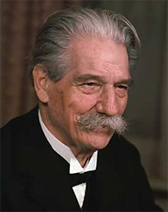
Albert Schweitzer
German-born French theologian, physician, philosopher, and musician who founded a hospital in Lambaréné, developed the ethical philosophy of Reverence for Life, and received the 1952 Nobel Peace Prize.
Born on January 14, 1875
Died on September 4, 1965
Age at death: 90
Profession: Philosopher, Doctor, Musician
Place of Birth: Kaysersberg, Alsace, German Empire (now France)
Place of Death: Lambaréné, Gabon
Albert Schweitzer (January 14, 1875 – September 4, 1965) was a physician, Protestant theologian, philosopher, organist, and musicologist born in Alsace when the region belonged to the German Empire. He studied theology, philosophy, and music before undertaking medical training to provide healthcare in Africa. In 1913, he established a hospital in Lambaréné, in what is now Gabon, and devoted much of his later life to its development. He received the Nobel Peace Prize for 1952 in recognition of his humanitarian work and ethical philosophy of "Reverence for Life." His major publications include The Quest of the Historical Jesus, J. S. Bach: The Musician-Poet, and The Philosophy of Civilization.
Early Life and Family Background
Albert Schweitzer was born on January 14, 1875, in Kaysersberg, Alsace, a region that had become part of the German Empire following the Franco-Prussian War. He grew up in the nearby village of Gunsbach, where his father, Louis Schweitzer, served as a Protestant pastor.
His family enjoyed a comparatively comfortable standard of living, and he received educational and musical opportunities that were unavailable to some other children in the village.
In his autobiographical writings, Schweitzer recalled a childhood confrontation with a boy whose family was poorer than his own. After defeating the boy in a physical contest, he was told that the outcome might have been different if his opponent had been able to eat meat soup twice a week, as Schweitzer did.
The remark troubled him. He subsequently became more conscious of differences in wealth and living conditions among the children around him.
He also recalled refusing certain comforts, including warm clothing, because his schoolmates could not afford similar possessions. His decisions sometimes caused disagreements with his parents, who did not always understand his determination to avoid privileges unavailable to other children.
These childhood experiences formed part of the account he later gave of his developing concern for the suffering of others.
Education and Early Interest in Music
Albert Schweitzer began receiving piano lessons from his father at approximately five years old. He developed an interest in church music and learned to play the organ while still a child.
His early academic performance was uneven, but he demonstrated considerable aptitude for music.
While attending school in Mulhouse, he studied with organist Eugène Münch, who introduced him more extensively to the works of Johann Sebastian Bach.
Schweitzer returned to serious organ study in adolescence and gradually developed the technical skills required to perform major works of the classical organ repertoire.
In 1893, he traveled to Paris, where relatives arranged an introduction to French organist and composer Charles-Marie Widor.
Widor initially agreed to hear the young musician as a courtesy but became interested in his abilities and accepted him as a pupil.
Schweitzer subsequently returned to Paris for lessons whenever his academic commitments permitted, studying organ performance and interpretation with Widor, particularly at the Church of Saint-Sulpice.
Their professional relationship developed into a lasting friendship and later contributed to Schweitzer's writings about Bach and organ performance.
University Education and Theology
In 1893, Albert Schweitzer entered the University of Strasbourg to study Protestant theology and philosophy.
He continued his musical education while studying the history of Christianity, biblical interpretation, and European philosophy.
In 1899, he completed a doctorate in philosophy with research concerning the religious philosophy of Immanuel Kant. The following year, he completed advanced theological studies.
Schweitzer became a pastor at Saint-Nicolas Church in Strasbourg in 1899 and later taught theology at the university.
From 1903 to 1906, he served as director of the Collegium Wilhelmitanum, also known as the St. Thomas Theological College, which provided accommodation and education for Protestant theology students.
His theological research increasingly concentrated on the historical interpretation of Jesus and the development of modern biblical scholarship.
The Quest of the Historical Jesus
One of Albert Schweitzer's principal theological works was The Quest of the Historical Jesus, first published in German in 1906 as Von Reimarus zu Wrede: Eine Geschichte der Leben-Jesu-Forschung.
The book examined earlier attempts by scholars to reconstruct the life of Jesus Christ using historical and critical methods.
Schweitzer argued that many interpretations had presented Jesus according to the intellectual assumptions and religious expectations of the scholars who produced them.
He examined the work of theologians and historians including Hermann Samuel Reimarus, David Friedrich Strauss, and William Wrede, questioning approaches that separated Jesus from the historical and religious environment of first-century Judaism.
His own interpretation emphasized the apocalyptic expectations present in the teachings of Jesus and the importance of understanding them within their historical setting.
The work challenged established theological interpretations and generated debate among Protestant scholars. Some regarded its conclusions as incompatible with traditional Christian doctrine, while others considered its historical method a contribution to biblical research.
Although the book was controversial, Schweitzer maintained that religious belief should not depend on avoiding historical investigation.
The work appeared in English in 1910 and subsequently became widely studied in historical Jesus scholarship.
Musicology and Research on Johann Sebastian Bach
Alongside his theological work, Albert Schweitzer developed a career as an organist and musicologist.
At the suggestion of Charles-Marie Widor, he wrote a study of Johann Sebastian Bach intended partly to help French organists understand the composer's music and its relationship to Lutheran religious traditions.
The resulting book, J. S. Bach: The Musician-Poet, was published in French in 1905. Schweitzer later expanded and revised the study for a two-volume German edition published in 1908.
His analysis examined Bach's use of musical motifs, religious symbolism, textual interpretation, and compositional structure.
Schweitzer argued that Bach's music was closely connected with religious expression and that an understanding of its theological context was essential to its interpretation.
He also studied organ construction and performance practices, participating in discussions about preserving the tonal characteristics of historical European organs.
His organ recitals in France, Germany, and other European countries established his reputation as an interpreter of Bach. The proceeds from many of his later concerts were used to finance medical work in Africa.
Decision to Study Medicine
Although Albert Schweitzer had established careers in theology and music, he decided to pursue medical training so that he could provide direct assistance to people without adequate healthcare.
He later explained that, during the 1890s, he had resolved to devote his life to practical humanitarian service after reaching the age of thirty.
In 1904, he read an appeal published by the Paris Evangelical Missionary Society describing the shortage of medical personnel at its mission in Lambaréné, in French Equatorial Africa.
The appeal led him to decide that he would qualify as a physician and work at the mission.
In 1905, at the age of thirty, he began studying medicine at the University of Strasbourg while continuing some of his theological teaching and musical activities.
He withdrew from the directorship of the theological college but maintained connections with the university and the Protestant Church.
After completing his medical examinations in 1912, he pursued further clinical work and training in tropical medicine in Paris.
He completed his medical doctorate in 1913 with a dissertation examining the psychiatric interpretation of Jesus.
Some representatives of the missionary society initially questioned whether Schweitzer's liberal theological views were compatible with its religious requirements. After discussions concerning the nature of his medical work, the society agreed to support his mission.
Marriage to Hélène Bresslau
In 1912, Albert Schweitzer married Hélène Bresslau, whom he had known for several years.
Hélène had worked in social welfare and trained as a nurse. She shared her husband's intention to establish medical services in Africa and assisted with preparations for the mission.
The couple raised money for medical equipment, medicines, transportation, and hospital facilities.
Schweitzer organized organ concerts and lectures to help finance the project, receiving support from friends and acquaintances in European musical and academic circles.
In March 1913, the couple departed for French Equatorial Africa.
Founding the Hospital in Lambaréné
Albert Schweitzer and Hélène Bresslau arrived in Lambaréné in April 1913.
The town was situated beside the Ogooué River in the territory that later became the independent country of Gabon.
They initially worked with limited facilities and equipment. A building previously used for storing poultry served as one of the first treatment spaces.
Schweitzer treated patients suffering from infectious diseases, injuries, tropical illnesses, and other medical conditions. Hélène assisted with nursing, anesthesia, and the organization of daily hospital activities.
Patients traveled from surrounding communities, sometimes covering considerable distances by river or on foot.
The medical work required the cooperation of African assistants, workers, and local residents, who contributed to the construction and operation of the hospital.
Schweitzer continued practicing music during his time in Lambaréné. He had brought a specially adapted piano with an organ keyboard attachment, allowing him to practice organ music despite the absence of a conventional church organ.
His daily routine combined medical treatment, hospital administration, writing, and music.
World War I and Internment in France
When World War I began in 1914, Albert Schweitzer and his wife were considered German nationals living in a French colony.
French authorities initially placed them under supervision and temporarily restricted their activities.
They were later permitted to resume medical work, but their position remained uncertain as the war continued.
In 1917, the couple were transported to France and detained in internment camps because of their German citizenship.
They were held at facilities including Garaison in the Pyrenees and Saint-Rémy-de-Provence.
The experience affected their health, particularly Hélène's, whose respiratory condition worsened during the period.
After their release in 1918, they returned to Alsace. Schweitzer worked in Strasbourg as a hospital physician and pastor while continuing his writing and musical activities.
The Philosophy of Civilization and Reverence for Life
During the war years, Albert Schweitzer developed an ethical philosophy that he called "Reverence for Life."
He argued that ethical responsibility should extend beyond human relationships to other forms of living existence.
His philosophy emphasized the obligation to avoid unnecessary harm and to preserve life wherever possible.
These ideas became central to The Philosophy of Civilization, published in two volumes in 1923.
The first volume examined what Schweitzer considered the weakening of ethical values within modern civilization. The second developed his philosophical approach to the relationship between human conduct and living beings.
Schweitzer connected his philosophy with his medical work, religious beliefs, and opposition to unnecessary suffering.
Return to Africa and Expansion of the Hospital
After several years in Europe, Albert Schweitzer decided to return to Lambaréné.
He traveled throughout Europe giving organ recitals and lectures, using the proceeds to pay debts and obtain funds for the hospital.
In 1924, he returned to Gabon without his wife, whose health prevented her from immediately accompanying him.
The original hospital buildings had deteriorated during his absence, requiring extensive repairs and reconstruction.
With assistance from medical personnel and local workers, Schweitzer reorganized the hospital and began developing new facilities.
In 1927, a larger hospital complex was established at a new site near the Ogooué River.
Over subsequent decades, the institution expanded to include buildings for patient accommodation, treatment, surgery, and the care of people with infectious diseases.
Schweitzer continued returning periodically to Europe to lecture, publish books, and raise funds, but Lambaréné remained the center of his medical activities.
His approach to hospital administration later attracted criticism, particularly concerning sanitation, working conditions, and paternalistic attitudes toward African patients and staff. Supporters argued that maintaining facilities resembling local village environments allowed patients to remain close to their families during treatment.
Nobel Peace Prize
In 1952, Albert Schweitzer was selected to receive the Nobel Peace Prize for his humanitarian work and his philosophy of Reverence for Life.
The award recognized his efforts to provide medical assistance in Africa and his ethical arguments concerning respect for human life.
The prize was formally awarded in 1953. Schweitzer later delivered his Nobel lecture in Oslo in 1954, addressing the need for peace and the dangers of modern warfare.
He used the financial award to support the establishment of facilities for patients with leprosy at Lambaréné.
Campaign Against Nuclear Weapons
During the 1950s, Albert Schweitzer became increasingly concerned about the effects of nuclear weapons testing.
He warned that radioactive fallout threatened human health and future generations, particularly through the contamination of food, water, and the environment.
In April 1957, he delivered an internationally broadcast appeal calling attention to the dangers of radioactive fallout.
The following year, he issued further statements concerning the threat of nuclear war, later published under the title Peace or Atomic War?.
His anti-nuclear activities brought him into contact with scientists and public figures campaigning for international arms control.
Final Years and Death
Albert Schweitzer continued working at the hospital in Lambaréné during his final years, although advancing age increasingly limited his medical activities.
His wife, Hélène Bresslau, died in 1957. Their daughter, Rhena Schweitzer Miller, later participated in the administration and development of the hospital.
Schweitzer remained in Gabon after the country gained independence from France in 1960.
He died on September 4, 1965, in Lambaréné, Gabon, at the age of 90.
He was buried in the grounds of the hospital, beside his wife.
Selected Publications
1899 – The Religious Philosophy of Kant
1905 – J. S. Bach: The Musician-Poet
1906 – The Quest of the Historical Jesus
1908 – J. S. Bach (Expanded two-volume German edition)
1911 – The Mysticism of Paul the Apostle (Studies developed during this period; published in 1930)
1921 – On the Edge of the Primeval Forest
1923 – The Philosophy of Civilization (Two volumes)
1930 – The Mysticism of Paul the Apostle
1931 – Out of My Life and Thought
1936 – Indian Thought and Its Development
1958 – Peace or Atomic War?
Major Dates and Honors
1875 – Born in Kaysersberg, Alsace
1893 – Entered the University of Strasbourg
1899 – Completed his doctorate in philosophy and became a pastor
1903 – Became director of the St. Thomas Theological College
1905 – Published his French study of Bach and began medical training
1906 – Published The Quest of the Historical Jesus
1912 – Married Hélène Bresslau and completed his medical examinations
1913 – Established a hospital in Lambaréné
1917–1918 – Interned in France during World War I
1923 – Published The Philosophy of Civilization
1924 – Returned to Lambaréné
1927 – Established a larger hospital complex
1952 – Awarded the Nobel Peace Prize
1954 – Delivered his Nobel lecture in Oslo
1957 – Broadcast an international appeal against nuclear weapons testing
1965 – Died in Lambaréné, Gabon
Source: Biyografiler.com
Frequently asked questions about Albert Schweitzer
Who is Albert Schweitzer?, Albert Schweitzer biography, Albert Schweitzer life story, Albert Schweitzer age, Albert Schweitzer facts, Albert Schweitzer birthplace, Albert Schweitzer photos, Albert Schweitzer videos, Albert Schweitzer career
Related Biographies

Lamine Yamal
Professional footballer

Erling Haaland
Professional footballer

Kylian Mbappe
Professional footballer

Keanu Reeves
Actor

Bad Bunny
Rapper, Songwriter

Ronaldinho
Professional footballer

Aleksey Navalni
Lawyer, Politician

Aleksey Nikolayevich Tolstoy
Novelist, Poet, Writer

Alessandra Ambrosio
Model, Actress

Alessandro Safina
Singer

Alessandro Volta
Physicist, Chemist, Inventor

Alexander Albon
Formula 1 Driver

Alan Rickman
Actor, Film Director

Patrick Stewart
Actor

Albert Pike
Poet, Soldier, Lawyer

Alberto Ginastera
Composer
Aleksey Navalni
Lawyer, Politician

Albert Uderzo
Illustrator, Cartoonist