
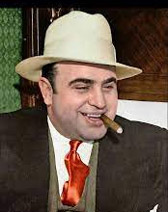
Al Capone
Italian-American organized crime boss known as Scarface who led the Chicago Outfit during Prohibition. He was convicted of federal income tax evasion in 1931 and imprisoned at Alcatraz.
Born on January 17, 1899
Died on January 25, 1947
Age at death: 48
Profession: Organized Crime Leader
Place of Birth: Brooklyn, New York City, United States
Place of Death: Palm Island, Miami Beach, Florida, United States
Al Capone (January 17, 1899 – January 25, 1947), born Alphonse Gabriel Capone, was an Italian-American gangster who led the Chicago Outfit from 1925 until his imprisonment in 1931. Known by the nickname Scarface, he controlled an extensive criminal organization involved in illegal alcohol distribution, gambling, prostitution, extortion, and bribery during Prohibition in the United States. His organization became associated with violent conflicts between rival Chicago gangs, particularly the Saint Valentine's Day Massacre of 1929. Despite investigations into his criminal activities, federal authorities ultimately secured his conviction for income tax evasion in October 1931. Sentenced to eleven years in prison, he served time at the federal penitentiaries in Atlanta and Alcatraz. His health deteriorated because of advanced syphilis, and he died in Florida in 1947 at the age of 48.
Early Life and Family Background
Al Capone was born on January 17, 1899, in Brooklyn, New York City. His parents, Gabriele Capone and Teresa Raiola, were Italian immigrants who had arrived in the United States from southern Italy in 1893.
His father worked as a barber, while his mother was a seamstress. The family was Roman Catholic and had nine children. Among his brothers were James Capone, also known as Richard Hart, Ralph Capone, and Frank Capone, who later became involved in different aspects of public life and organized crime.
Capone grew up in a working-class immigrant neighborhood. He attended a Catholic elementary school but left formal education at approximately fourteen years old after a confrontation with a teacher.
He subsequently worked in a candy store, a bowling alley, and other local businesses. During his adolescence, he became associated with neighborhood street gangs.
Early Criminal Activities in New York
As a teenager, Al Capone became involved with groups including the Junior Forty Thieves, the Bowery Boys, and eventually the Five Points Gang, a criminal organization operating in New York City.
He came under the influence of gangster Johnny Torrio, who had connections with criminal organizations involved in gambling, prostitution, and protection rackets.
Capone also worked for Frankie Yale, a Brooklyn gangster who operated the Harvard Inn, a bar and entertainment establishment on Coney Island.
While working at the Harvard Inn, Capone became involved in an altercation with Frank Galluccio, who attacked him with a knife after Capone made an offensive remark to Galluccio's sister.
The attack left three scars on the left side of Capone's face. These injuries later gave rise to his nickname, Scarface, although he reportedly disliked the name.
In later years, Capone sometimes claimed that the scars were the result of military service. He had never served in the United States armed forces.
His activities in New York increasingly involved criminal associates engaged in intimidation, debt collection, and violence.
Move to Chicago and Partnership with Johnny Torrio
Around 1919–1920, Al Capone moved to Chicago at the invitation of Johnny Torrio, who had become involved in the criminal operations of Giacomo Colosimo, also known as Big Jim Colosimo.
Colosimo controlled a network of gambling establishments, brothels, and other illegal businesses in Chicago. Torrio was one of his principal associates.
In May 1920, Colosimo was murdered. The killing has frequently been attributed to criminal associates of Torrio, but the identity of the murderer was never conclusively established. Claims that Capone personally carried out the murder remain unproven.
Following Colosimo's death, Torrio assumed control of much of the organization, with Capone becoming an increasingly important lieutenant.
The introduction of national Prohibition in January 1920 created extensive opportunities for criminal organizations willing to manufacture, transport, and distribute alcoholic beverages illegally.
Torrio and Capone expanded their operations into bootlegging while maintaining interests in gambling, prostitution, and other rackets.
Rise to Leadership of the Chicago Outfit
During the early 1920s, Al Capone became one of the principal figures in the organization that developed into the Chicago Outfit.
In 1922, Torrio attempted to negotiate arrangements among Chicago criminal groups to divide illegal markets and reduce violent competition.
These agreements were repeatedly undermined by disputes over territory and the distribution of alcohol.
One major conflict involved the North Side Gang, which was associated with Dean O'Banion, Hymie Weiss, and later Bugs Moran.
O'Banion was murdered in his Chicago flower shop on November 10, 1924. The killing intensified the conflict between Torrio's organization and the North Side Gang.
In January 1925, Torrio was seriously wounded in a shooting carried out by rival gang members. Following his recovery and a period of imprisonment, he withdrew from direct leadership and eventually retired from Chicago's criminal operations.
Capone assumed control of the organization in 1925, becoming its principal leader at approximately twenty-six years old.
Prohibition, Bootlegging and Criminal Revenue
Under Al Capone, the Chicago Outfit expanded its involvement in illegal alcohol production, distribution, gambling, and commercial extortion.
The organization operated breweries, transportation networks, drinking establishments, and gambling businesses, often using threats and violence to protect its commercial interests.
Capone's criminal organization was estimated by contemporary accounts to generate annual revenue approaching $100 million during the late 1920s. Such figures were estimates rather than independently audited financial records.
Its distribution operations extended beyond Chicago and involved suppliers and criminal associates in other parts of the United States and Canada.
Capone's organization maintained relationships with other criminal groups, including Detroit's Purple Gang, which participated in alcohol smuggling during Prohibition.
He also had contacts with organized crime figures such as Meyer Lansky, whose activities included gambling and illegal alcohol distribution.
The Outfit's financial resources enabled it to employ large numbers of associates, acquire property, and influence some public officials through bribery and intimidation.
Capone eventually established his Chicago headquarters at the Lexington Hotel on Michigan Avenue, where he maintained offices and living quarters.
Political Influence and the Cicero Elections
In 1924, Al Capone expanded his organization's influence in Cicero, a municipality adjoining Chicago.
The Outfit supported local political candidates and used intimidation and violence during municipal elections.
Capone's brother Frank Capone was killed by police officers in Cicero on April 1, 1924, during the period of election-related violence.
Afterward, the organization increased its control over local gambling establishments and illegal alcohol distribution.
Capone maintained contacts with politicians and law enforcement officials, and his associates used bribery to reduce police interference.
Chicago Mayor William Hale Thompson, who served multiple terms in office, was frequently accused of maintaining a political environment favorable to organized crime.
Although the precise extent of individual arrangements remains disputed, corruption within municipal government and law enforcement assisted the operations of major Chicago criminal organizations.
Gang Warfare in Chicago
As competing criminal organizations fought over the lucrative alcohol trade, Al Capone became involved in a series of violent conflicts.
Members of the North Side Gang attempted to assassinate him on several occasions.
On September 20, 1926, gunmen associated with the North Side Gang attacked the Hawthorne Hotel in Cicero, where Capone was present.
The attackers fired hundreds of bullets into the building. Capone survived, although the incident demonstrated the intensity of the conflict between the rival groups.
Hymie Weiss, one of the principal leaders of the North Side Gang, was killed in October 1926. Leadership of the organization subsequently passed to Bugs Moran.
The conflict continued through the late 1920s as the gangs competed for illegal breweries, distribution routes, and gambling revenue.
Saint Valentine's Day Massacre
On February 14, 1929, seven men associated with the North Side Gang were murdered inside a garage at 2122 North Clark Street in Chicago.
The killings became known as the Saint Valentine's Day Massacre.
Several attackers entered the building, with some reportedly dressed as police officers, and opened fire using automatic weapons and other firearms.
The victims included members and associates of Bugs Moran's organization, although Moran himself was not present.
Authorities suspected that the massacre had been organized by associates of Al Capone as part of the ongoing conflict over Chicago's illegal alcohol trade.
Capone was in Florida at the time and was never convicted in connection with the killings. The precise responsibility for the murders was not conclusively established in court.
The massacre intensified public criticism of organized crime and increased pressure on federal and local authorities to investigate Capone's activities.
The Chicago Crime Commission subsequently identified Capone as Public Enemy Number One, a designation that became closely associated with his public image.
Public Image, Wealth and Charitable Activities
During the late 1920s and the beginning of the Great Depression, Al Capone frequently appeared in newspapers and was widely recognized throughout the United States.
He presented himself publicly as a businessman who supplied products and services demanded by consumers despite government restrictions.
He spent money on expensive clothing, automobiles, hotels, and entertainment and maintained a residence on Palm Island, near Miami Beach, Florida, which he purchased in 1928.
Capone also contributed money to charitable activities. In 1930, an organization associated with him operated a soup kitchen in Chicago that provided meals to unemployed and impoverished residents.
These activities generated favorable publicity, but they did not alter the organization's involvement in extortion, bribery, and violent crime.
Public reactions to Capone were divided between fascination with his wealth and notoriety and concern over the violence associated with organized crime.
Federal Investigations and Arrests
Federal authorities investigated Al Capone for violations of Prohibition laws and other offenses during the late 1920s.
In March 1929, he appeared before a federal grand jury in Chicago. Investigators also examined whether he had attempted to avoid appearing by falsely claiming illness.
On May 17, 1929, Capone and a bodyguard were arrested in Philadelphia for carrying concealed weapons.
He received a one-year prison sentence and served approximately nine months before being released for good behavior in March 1930.
Federal investigators continued gathering evidence concerning his financial activities.
The United States Treasury Department developed a case based on Capone's failure to report substantial income derived from illegal businesses.
The investigation involved Treasury agents and prosecutors working to establish the extent of his taxable income despite the absence of reliable business records.
At the same time, federal Prohibition agents, including Eliot Ness and his investigative team, worked to disrupt the Outfit's illegal alcohol operations.
Income Tax Evasion Trial and Conviction
In June 1931, Al Capone was indicted on federal income tax evasion charges.
Initially, he attempted to negotiate a plea agreement that he believed would result in a comparatively short prison sentence. The presiding judge rejected the assumption that the court would be bound by the proposed arrangement.
Capone subsequently pleaded not guilty and proceeded to trial.
His trial began in October 1931 in federal court in Chicago. Prosecutors introduced financial evidence intended to demonstrate that Capone had received substantial income without paying the taxes legally required.
On October 17, 1931, the jury found Capone guilty of five counts relating to federal income tax evasion and the failure to file tax returns.
On October 24, 1931, he was sentenced to eleven years in federal prison, a $50,000 fine, court costs, and payment of outstanding taxes and interest.
The conviction was based on financial offenses rather than the murders, extortion, and illegal alcohol operations with which his organization was associated.
His legal team challenged the conviction through appeals, but the sentence remained in effect.
Imprisonment in Atlanta and Alcatraz
In May 1932, Al Capone entered the federal penitentiary in Atlanta, Georgia.
During his early imprisonment, reports suggested that he enjoyed privileges and maintained a degree of communication with criminal associates outside the prison.
In August 1934, he was transferred to Alcatraz Federal Penitentiary in San Francisco Bay, California.
The institution had been established to hold prisoners considered especially difficult to manage or likely to maintain criminal activities while incarcerated.
At Alcatraz, Capone was subject to stricter supervision, and his contact with the outside world was considerably restricted.
During his imprisonment, he participated in prison work assignments and played music with other inmates.
He was involved in several confrontations with prisoners, including an attack by fellow inmate James Lucas in 1936.
Capone's physical and mental health deteriorated substantially during his time at Alcatraz.
Neurosyphilis and Deteriorating Health
Al Capone had contracted syphilis earlier in his life, and the infection progressed without effective treatment.
During his imprisonment, he developed neurosyphilis, a complication affecting the nervous system and potentially causing cognitive impairment and neurological symptoms.
By the late 1930s, he was experiencing serious physical and mental difficulties.
In January 1939, he was transferred from Alcatraz to another federal correctional institution in California. He later completed the remaining portion of his sentence at the federal penitentiary in Lewisburg, Pennsylvania.
On November 16, 1939, Capone was released after serving approximately seven years and six months of his eleven-year sentence.
He subsequently received medical care at a hospital in Baltimore before returning to his Florida residence.
During the 1940s, he received penicillin treatment for syphilis. The treatment could not reverse the neurological damage already caused by the disease.
Although he had once commanded a criminal organization with extensive financial and political influence, Capone was no longer capable of returning to leadership after his release.
Personal Life and Family
Al Capone married Mae Josephine Coughlin on December 30, 1918, in Brooklyn, New York.
The couple had one son, Albert Francis Capone, known as Sonny, who was born on December 4, 1918, and died in 2004.
Because Capone was nineteen years old at the time of the marriage, parental consent was required under the applicable marriage rules.
Mae Capone remained married to him throughout his imprisonment and declining health.
After his release from federal prison, she cared for him at their home on Palm Island in Florida.
Final Years and Death
After returning to Florida in 1939, Al Capone lived largely outside public view.
His activities were limited by the continuing effects of neurosyphilis. He spent time with his family and occasionally received visitors but did not resume control of the Chicago Outfit.
In January 1947, he suffered a stroke and subsequently developed pneumonia.
Al Capone died on January 25, 1947, at his residence on Palm Island, Florida, at the age of 48, following cardiac complications.
He was initially buried at Mount Olivet Cemetery in Chicago. In 1950, his remains were transferred to Mount Carmel Cemetery in Hillside, Illinois, where other members of his family were also buried.
Selected Historical Events
1899 – Born in Brooklyn, New York City
1918 – Married Mae Josephine Coughlin
1919–1920 – Moved to Chicago and joined Johnny Torrio's criminal organization
1920 – National Prohibition began in the United States
1924 – Chicago gang conflict intensified following the murder of Dean O'Banion
1925 – Assumed leadership of the Chicago Outfit
1926 – Survived the Hawthorne Hotel shooting
1929 – Saint Valentine's Day Massacre took place in Chicago
1929 – Imprisoned in Philadelphia for carrying concealed weapons
1930 – Released from prison and designated Public Enemy Number One by the Chicago Crime Commission
1931 – Convicted of federal income tax evasion
1932 – Entered the federal penitentiary in Atlanta
1934 – Transferred to Alcatraz Federal Penitentiary
1939 – Released from federal prison
1947 – Died in Florida at the age of 48
Source: Biyografiler.com
Frequently asked questions about Al Capone
Who is Al Capone?, Al Capone biography, Al Capone life story, Al Capone age, Al Capone facts, Al Capone birthplace, Al Capone photos, Al Capone videos, Al Capone career

Lamine Yamal
Professional footballer

Erling Haaland
Professional footballer

Keanu Reeves
Actor

Kylian Mbappe
Professional footballer

Bad Bunny
Rapper, Songwriter

Leonardo DiCaprio
Actor

Andre Gide
Novelist, Essayist

Andreas Papandreu
Former Prime Minister, Politician, Economist

Andrea Mantegna
Painter

Andrea del Verrocchio
Sculptor, Painter

Andrea del Sarto
Painter

Andrea Bargnani
Former Professional Basketball Player

Amy Ryan
Actress

Andy Garcia
Actor, Film Director

Ali Larter
Actress, Former Model

Andy Serkis
Actor, Film Director

Ursula von der Leyen
Politician, Physician

John Healey
Politician