
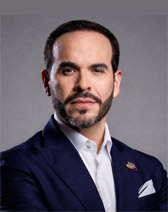
Abelardo de la Espriella
President of Colombia since August 7, 2026; known as El Tigre and for a hard-line security platform and right-wing populist political style
Born on July 31, 1978
Age: 48
Profession: Lawyer, Businessperson, Politician, President
Place of Birth: Bogotá, Colombia
Abelardo de la Espriella, full name Abelardo Gabriel de la Espriella Otero, was born on July 31, 1978, in Bogotá, Colombia. A Colombian lawyer, businessman, media personality and politician, Abelardo de la Espriella built a national profile through high-profile criminal litigation before transforming his public visibility into a political movement. Running through Defensores de la Patria, he won the 2026 Colombian presidential election in a closely contested runoff against Iván Cepeda and took office as President of Colombia on August 7, 2026.
Early Life and Family Background
Although Abelardo de la Espriella was born in Bogotá, he spent most of his childhood and adolescence in Montería, in the department of Córdoba, on Colombia's Caribbean coast. He has frequently emphasized the importance of Montería and the Caribbean region in shaping his personality, cultural identity and political outlook.
His father, Abelardo de la Espriella Juris, was a lawyer, magistrate and notary who was also involved in regional public life. His mother, María Eugenia Otero Aldana, was likewise connected to the legal profession. The family environment therefore exposed Abelardo de la Espriella to law, public affairs and political debate from an early age.
He attended La Salle School of Montería and left the city as a teenager to continue his education in Bogotá. His early life combined the social and cultural environment of Colombia's Caribbean region with the professional ambitions associated with the capital.
Legal Education
Abelardo de la Espriella studied law at Sergio Arboleda University, graduating from its School of Law. He later pursued postgraduate studies in criminal sciences, criminology and administrative law at institutions including Externado University of Colombia and University of Rosario.
He continued his academic training in Spain, completing advanced legal studies at Nebrija University. In 2012 he obtained a master's-level qualification in law from the university. He later received honorary doctorates in recognition of his legal career.
De La Espriella Lawyers
In 2002, Abelardo de la Espriella founded De La Espriella Lawyers Enterprise, the law firm that became the principal platform for his professional prominence. The firm expanded within Colombia and later established operations connected to the United States.
His legal practice became especially associated with criminal law, politically sensitive litigation and cases receiving extensive television and newspaper coverage. Rather than maintaining the low public profile typical of many attorneys, Abelardo de la Espriella deliberately developed a recognizable media persona and became one of Colombia's best-known lawyers.
High-Profile Legal Career
Throughout his career, Abelardo de la Espriella represented clients involved in some of Colombia's most controversial legal disputes. His professional record included politicians, businessmen, celebrities and individuals accused of serious criminal conduct.
Among the cases associated with his legal career were matters involving figures such as David Murcia Guzmán and businessman Álex Saab, as well as cases connected with victims including Natalia Ponce de León and the family of Rosa Elvira Cely. His willingness to take cases from opposing sides of Colombia's political and social conflicts contributed to both his reputation and the controversy surrounding him.
Critics sometimes described him as a lawyer willing to defend highly controversial clients and linked his professional history to figures associated with paramilitary structures or corruption investigations. Supporters presented the same career as evidence of a lawyer prepared to take difficult cases and operate under intense public pressure.
Media Personality and Business Activities
Abelardo de la Espriella gradually expanded beyond legal practice into journalism, television commentary, writing, music and consumer businesses. His highly recognizable public style combined luxury imagery, conservative rhetoric, religious references and aggressive political language.
He also developed the De La Espriella Style brand, which was associated with products including menswear, wine, rum and coffee. Among the products connected with the brand were Fratellone, Ron Defensor and Hope Coffee.
This combination of law, business and media transformed Abelardo de la Espriella into a celebrity figure before he entered electoral politics. His nickname El Tigre became an increasingly important part of his public branding, particularly during his presidential campaign.
Life in the United States
Abelardo de la Espriella lived for extended periods in Miami, Florida, where he developed business activities and raised his family. His four children were born in the United States.
In 2023, Abelardo de la Espriella became a naturalized citizen of the United States. He publicly celebrated obtaining American citizenship and described the country as an important part of his personal and business life.
His American citizenship later became a political issue during the 2026 presidential campaign. Opponents questioned whether holding another citizenship was compatible with the symbolism of the presidency, while supporters emphasized that Colombian law did not prevent his candidacy on that basis.
Political Outlook
Long before formally becoming a presidential candidate, Abelardo de la Espriella used television appearances, newspaper columns and social media to promote conservative and nationalist political positions. He advocated stronger security policies, private property protections, lower taxation, reduced government bureaucracy and a more market-oriented economy.
His social positions frequently emphasized religion, traditional family structures and opposition to progressive cultural politics. His rhetoric also contained strong criticism of the Colombian left and particularly of the administration of Gustavo Petro.
International media variously described Abelardo de la Espriella as right-wing, hard-right, radical-right or far-right. His own political messaging instead emphasized patriotism, security, individual liberty, private enterprise and opposition to what he portrayed as an ineffective political establishment.
Defensores de la Patria
In 2024, Abelardo de la Espriella established Defensores de la Patria as the political vehicle that would eventually carry his presidential campaign. The organization began as a citizens' movement rather than a conventional long-established party.
He also developed ties with the conservative Movimiento de Salvación Nacional, while maintaining the image of a political outsider who had never previously occupied elected office.
The movement's branding centered heavily on Abelardo de la Espriella's personality. Campaign slogans portrayed him as a forceful alternative to Colombia's traditional political class and as a leader capable of restoring authority after years of security problems, drug trafficking and conflict with illegal armed organizations.
2026 Presidential Campaign
Abelardo de la Espriella entered the 2026 presidential race on a platform dominated by public security, economic liberalization and institutional restructuring. He promised a much more aggressive confrontation with criminal organizations, drug-trafficking networks and illegal armed groups.
He argued that peace negotiations pursued under Gustavo Petro had failed to produce sufficient security improvements and said armed organizations should disarm or face military pressure. His campaign also advocated strengthening the armed forces and police, reducing coca cultivation and restoring greater state control over rural territories affected by criminal groups.
Economically, Abelardo de la Espriella proposed reducing the size of the state, lowering or simplifying taxes, encouraging private investment and reviving oil and natural-gas exploration. During the campaign he discussed reducing parts of the government structure by as much as 40 percent.
Comparisons with Trump, Bukele and the Latin American Right
During the campaign, Abelardo de la Espriella was frequently compared with Donald Trump, Nayib Bukele and other contemporary right-wing leaders. His admiration for strong security policies in El Salvador and his personal and political connections in the United States made these comparisons particularly prominent.
He developed close relations with sectors of the American Republican political establishment and received public support from Donald Trump during the Colombian presidential race.
Supporters considered Abelardo de la Espriella an outsider capable of challenging established political elites and criminal organizations. Critics argued that some of his rhetoric and proposals risked weakening civil liberties, institutional checks and Colombia's peace framework. These competing interpretations contributed to an exceptionally polarized election.
2026 Presidential Election
In the first round of the presidential election held on May 31, 2026, Abelardo de la Espriella unexpectedly finished first, ahead of left-wing senator Iván Cepeda. Neither candidate secured the majority required to win outright, forcing a runoff on June 21.
The second round became one of the closest presidential contests in modern Colombian politics. Abelardo de la Espriella received approximately 49.66 percent of the vote, while Iván Cepeda received about 48.70 percent. The official count gave De la Espriella a winning margin of roughly a quarter of a million votes.
After completing the national count and reviewing electoral claims, the National Electoral Council of Colombia formally proclaimed Abelardo de la Espriella President-elect on June 24, 2026. José Manuel Restrepo was elected Vice President on the same ticket.
The result represented a major political change following the left-wing presidency of Gustavo Petro. It was particularly unusual because Abelardo de la Espriella reached the presidency without previously holding elected office.
Inauguration as President
Abelardo de la Espriella took office as President of Colombia on August 7, 2026, beginning the constitutional 2026–2030 presidential term. José Manuel Restrepo was sworn in as Vice President.
In a major departure from Colombian tradition, the inauguration was held in Cali rather than Bogotá. It was the first presidential inauguration of its kind held outside the capital and was conducted under extensive military and police protection.
The location carried significant political symbolism. Southwestern Colombia has been severely affected by armed groups, drug trafficking, illegal mining and territorial conflict. Holding the inauguration there reinforced the security-centered message that had defined Abelardo de la Espriella's presidential campaign.
Security Policy
In his inaugural address, Abelardo de la Espriella made public order one of his administration's principal priorities. He promised a more forceful campaign against drug trafficking, illegal armed organizations and organized crime.
His government rejected the broad continuation of the previous administration's peace-dialogue strategy and signaled that armed organizations unwilling to surrender could become military targets. He also proposed stronger measures against coca cultivation and greater investment in the security forces.
The approach represents one of the sharpest policy breaks with the administration of Gustavo Petro. Supporters argue that stronger state authority is necessary in regions where armed groups control communities and illegal economies. Critics warn that a military-centered strategy could increase violence and weaken opportunities for negotiated demobilization.
Economic Agenda
Abelardo de la Espriella's economic program combines fiscal conservatism with policies intended to increase private investment. His administration has advocated public-spending restraint, tax simplification and reductions in bureaucratic structures.
He has also supported renewed development of Colombia's oil and gas sector after the previous government restricted new exploration contracts. His political program includes the possibility of new exploration, greater private-sector participation and forms of environmentally regulated hydraulic fracturing.
The government presents these measures as necessary to improve growth, investment and fiscal stability. Opponents question whether major spending reductions can be implemented without damaging social programs and public services.
Foreign Policy
Abelardo de la Espriella has advocated a closer strategic relationship with the United States, particularly on security, drug trafficking, investment and regional policy. His relationship with the administration of Donald Trump represents a significant change from several of the diplomatic disputes that characterized the Petro period.
He has also supported rebuilding close relations with Israel and strengthening ties with governments and political movements on the Latin American right.
His foreign-policy rhetoric places strong emphasis on national sovereignty and frequently expresses skepticism toward international institutions when he believes they interfere with domestic security policy. Critics have raised concerns about his confrontational attitude toward some international human-rights mechanisms, while his supporters describe the approach as restoring Colombian sovereignty.
Casa de Nariño and Decentralization of the Presidency
Before taking office, Abelardo de la Espriella announced that he did not intend to work permanently from Casa de Nariño, Colombia's traditional presidential palace. He proposed turning the building into a public museum and said his Bogotá office would instead operate from the Palacio de San Carlos.
He also proposed expanding the physical presence of the presidency beyond Bogotá, with government activity in cities including Barranquilla, Cali and Medellín. He suggested recognizing Barranquilla as an alternative capital as part of a broader decentralization strategy.
However, the Casa de Nariño proposal changed shortly after he took office. By late August and early September 2026, Abelardo de la Espriella had begun conducting presidential business from Casa de Nariño as well as the Palacio de San Carlos and regional government locations. The initial plan to transform the palace exclusively into a museum therefore did not proceed as originally announced.
Political Polarization
Abelardo de la Espriella entered office in one of the most polarized political environments in recent Colombian history. His narrow election victory, hard-line campaign and lack of a large congressional majority created immediate challenges for implementing his program.
Supporters view his presidency as a rejection of left-wing governance, rising insecurity and the traditional political establishment. Critics regard his confrontational rhetoric, legal history and admiration for strong-security governments as possible risks to institutional restraint and civil liberties.
The composition of Congress means that Abelardo de la Espriella must negotiate with political forces outside his own movement to pass major reforms. Consequently, the extent to which his campaign promises can be transformed into legislation remains dependent on coalition-building and relations with Congress.
Personal Life
Abelardo de la Espriella married Yoly Illidge in 2001. The marriage ended in divorce in 2004.
In 2008, he married Ana Lucía Pineda. They have four children: Lucía de la Espriella, Salvador de la Espriella, Filippo de la Espriella and Francesca de la Espriella. All four were born in the United States.
Family and religion have occupied a prominent place in Abelardo de la Espriella's public image. Ana Lucía Pineda also became visible during the 2026 campaign, particularly at appearances emphasizing family life, faith and traditional values.
Books and Writing
Alongside his legal and political career, Abelardo de la Espriella has written newspaper columns, essays and fiction. His books frequently deal with crime, power, human psychology, morality and political conflict.
2018 – Muerte al Tirano2020 – Amores Criminales
2023 – Almas Asesinas
Major Positions and Career Milestones
2002 – Founder of De La Espriella Lawyers Enterprise2024 – Founder and leader of Defensores de la Patria
2026 – Presidential candidate of Defensores de la Patria
May 31, 2026 – Finished first in the first round of the Colombian presidential election
June 21, 2026 – Won the presidential runoff against Iván Cepeda
June 24, 2026 – Formally proclaimed President-elect by the National Electoral Council of Colombia
August 7, 2026–Present – President of Colombia
Source: Biyografiler.com
Frequently asked questions about Abelardo de la Espriella
Who is Abelardo de la Espriella?, Abelardo de la Espriella biography, Abelardo de la Espriella life story, Abelardo de la Espriella age, Abelardo de la Espriella facts, Abelardo de la Espriella birthplace, Abelardo de la Espriella photos, Abelardo de la Espriella videos, Abelardo de la Espriella career
Related Biographies

Lamine Yamal
Professional footballer

Sam Altman
Entrepreneur, Investor, CEO

Kylian Mbappe
Professional footballer

Alice Weidel
Politician, Economist

Erling Haaland
Professional footballer

Giorgia Meloni
Politician, Journalist


Hongjoong
Singer, Rapper, Songwriter, Composer

Ludacris
Rapper, Actor

Kwon Eunbi
Singer

Sarah Wayne Callies
Actress, Screenwriter, Producer, Director

LaTavia Roberson
Singer, Actress, Entrepreneur

Kaia Gerber
Model, Actress

Zohran Mamdani
Politician, Musician
Sam Altman
Entrepreneur, Investor, CEO
Lamine Yamal
Professional footballer

Monica Bellucci
Actress, Model
Kylian Mbappe
Professional footballer