
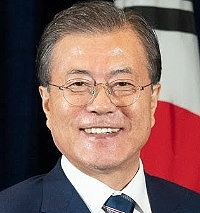
Moon Jae-in
South Korean politician and former human rights lawyer who served as the 12th President of South Korea from May 10, 2017, to May 9, 2022. He previously served as chief of staff to President Roh Moo-hyun and pursued diplomatic engagement with North Korea during his presidency.
Born on January 24, 1953
Age: 73
Profession: Former President, Politician
Place of Birth: Geoje, South Gyeongsang Province, South Korea
Moon Jae-in is a South Korean politician, former human rights lawyer and former president of South Korea. He served as the country's president from May 10, 2017, to May 9, 2022. Before entering electoral politics, he worked as a lawyer defending labor activists, students and people prosecuted for political activities. He later served in the administration of President Roh Moo-hyun, including as presidential chief of staff. Moon won the 2017 presidential election following the impeachment and removal of Park Geun-hye. His presidency included economic and labor reforms, the government's response to the COVID-19 pandemic and diplomatic efforts to improve relations with North Korea. He met North Korean leader Kim Jong-un three times in 2018.
Early Life and Family Background
Moon Jae-in was born on January 24, 1953, on Geoje Island in South Gyeongsang Province, South Korea, during the Korean War. His father was Moon Yong-hyung, and his mother was Kang Han-ok. He was the second of five children and the family's eldest son.
His parents were refugees from Hungnam, a port city in present-day North Korea. They had fled south during the Hungnam evacuation of December 1950, when United Nations forces and large numbers of civilians withdrew from the area during the Korean War.
After arriving in southern Korea, the family settled on Geoje Island before moving to Busan. Moon grew up in financially difficult circumstances. His father worked in different occupations, while his mother contributed to the family's income through small-scale trading.
His parents' experiences as refugees later became a recurring subject in Moon's public discussions of the division of the Korean Peninsula.
Education and Student Activism
Moon Jae-in attended Kyungnam High School in Busan and subsequently enrolled in the law faculty of Kyung Hee University in Seoul.
During his university years, South Korea was governed by President Park Chung-hee, whose administration introduced the Yushin Constitution in 1972. The constitutional system expanded presidential powers and restricted political opposition.
Moon participated in student demonstrations opposing the Yushin system. In 1975, he was arrested, convicted and imprisoned for his involvement in antigovernment protests. He was also expelled from university.
Following his imprisonment, he was conscripted into the South Korean military and served in the Special Forces. In 1976, he participated in the military operation known as Operation Paul Bunyan, conducted after two American officers were killed in the Joint Security Area at Panmunjom.
After completing his military service, Moon resumed his legal studies. He passed the national judicial examination in 1980 and completed his training at the Judicial Research and Training Institute, graduating second in his class.
Despite his examination results, his record of political activism prevented him from being appointed as a judge or prosecutor.
Career as a Human Rights Lawyer
Moon Jae-in began practicing law in Busan. In 1982, he established a law office with Roh Moo-hyun, who later became president of South Korea.
The two lawyers represented workers involved in labor disputes, students prosecuted for political demonstrations and individuals whose civil rights had been restricted under authoritarian governments.
Moon also participated in organizations supporting democratic reforms and legal protections for citizens. His legal work continued during South Korea's transition to a more democratic political system in the late 1980s.
Roh Moo-hyun entered electoral politics in 1988, while Moon initially remained focused on his legal practice and civic activities.
Working with President Roh Moo-hyun
Moon Jae-in helped organize Roh Moo-hyun's presidential election campaign in Busan in 2002. Following Roh's victory, Moon joined the presidential administration in February 2003.
During Roh's presidency, which lasted from February 2003 to February 2008, Moon held several positions at the presidential office, known as the Blue House. He served as senior presidential secretary for civil affairs and later held responsibilities involving civic organizations and political coordination.
In March 2007, he became Roh's presidential chief of staff, serving until February 2008.
He was also involved in preparations for the October 2007 inter-Korean summit between Roh Moo-hyun and North Korean leader Kim Jong-il.
Following Roh's death in May 2009, Moon participated in activities preserving the former president's records and political work. He later chaired the Roh Moo-hyun Foundation.
Entering Electoral Politics
Moon Jae-in became increasingly active in South Korea's liberal political movement after leaving the presidential administration.
In the April 2012 parliamentary election, he won a seat in the National Assembly of South Korea representing the Sasang district of Busan.
Later that year, he became the presidential candidate of the Democratic United Party and competed against Park Geun-hye, the candidate of the conservative Saenuri Party.
Moon advocated reforms to corporate governance, stronger social welfare policies and diplomatic engagement with North Korea. He also called for reducing the political influence of large family-controlled business conglomerates, known in South Korea as *chaebol*.
Park Geun-hye won the December 2012 presidential election, receiving approximately 51.6 percent of the vote compared with Moon's 48 percent.
Moon continued his parliamentary and party activities. In 2015, he became leader of the main opposition party, then known as the New Politics Alliance for Democracy.
The 2017 Presidential Election
In 2016, President Park Geun-hye became involved in a political scandal concerning her relationship with Choi Soon-sil, a longtime confidante accused of interfering in government affairs and obtaining improper benefits.
On December 9, 2016, South Korea's National Assembly voted to impeach Park. The Constitutional Court upheld the impeachment on March 10, 2017, removing her from office.
A presidential election was consequently scheduled for May 9, 2017.
Moon Jae-in ran as the candidate of the Democratic Party of Korea, campaigning on government accountability, employment, economic inequality, reform of the chaebol system and improved relations with North Korea.
He won approximately 41.1 percent of the vote, defeating Hong Joon-pyo of the Liberty Korea Party and Ahn Cheol-soo of the People's Party.
Moon took office on May 10, 2017, without the customary transition period because the presidency had been vacant following Park's removal.
Economic and Social Policies
During his presidency, Moon Jae-in pursued policies aimed at increasing household income, strengthening workers' rights and expanding social welfare programs.
His government raised the statutory minimum wage and introduced measures intended to improve working conditions. Amendments to labor legislation established a maximum 52-hour working week, introduced progressively from July 2018 according to company size.
The administration also expanded child allowances, increased certain pensions and introduced measures intended to improve health insurance coverage.
Moon supported reforms intended to reduce the economic and political influence of large family-controlled conglomerates.
His economic program attracted criticism from some business organizations and opposition politicians, particularly over employment costs and the rapid increase in the minimum wage.
Rising housing prices, especially in Seoul, became a persistent problem during his presidency. In February 2026, Moon publicly acknowledged that his administration had failed to achieve its objectives in housing and real estate policy.
Relations with the United States
On June 30, 2017, Moon Jae-in met United States President Donald Trump at the White House in Washington, D.C.
The two leaders discussed North Korea's nuclear weapons program, the United States–South Korea security alliance and bilateral economic relations.
Moon supported maintaining the military alliance while also seeking opportunities for direct negotiations with Pyongyang.
On September 6, 2017, he met Russian President Vladimir Putin during the Eastern Economic Forum in Vladivostok, Russia. Their discussions included regional security, economic cooperation and North Korea's weapons development.
Following Joe Biden's inauguration as American president in January 2021, Moon continued discussions with Washington concerning security cooperation, technology, public health and relations with North Korea.
Diplomacy with North Korea
Moon Jae-in advocated negotiations between North and South Korea throughout his political career. His parents' background as refugees from North Korea formed part of his personal connection to the peninsula's division.
During the 2017 presidential campaign, he proposed reducing military tensions and restoring channels of communication between Seoul and Pyongyang.
Diplomatic contacts expanded in early 2018, following North Korea's participation in the Winter Olympics in Pyeongchang.
On April 27, 2018, Moon met North Korean leader Kim Jong-un at Panmunjom, within the Korean Demilitarized Zone. The leaders crossed the Military Demarcation Line and signed the Panmunjom Declaration.
The declaration addressed efforts to reduce military tensions, expand cooperation and pursue the denuclearization of the Korean Peninsula.
Moon and Kim met again at Panmunjom on May 26, 2018, and held a third summit in Pyongyang in September of that year.
Moon also supported diplomatic contacts between Kim Jong-un and Donald Trump, including the June 2018 Singapore summit.
Although these meetings produced agreements and confidence-building measures, negotiations over North Korea's nuclear weapons program eventually stalled. Several inter-Korean projects were not implemented, and tensions increased again during the later years of Moon's presidency.
Relations with Turkey
On May 2, 2018, Moon Jae-in received Turkish President Recep Tayyip Erdogan during his official visit to South Korea.
The leaders discussed bilateral trade, investment, defense cooperation and international political developments.
The visit took place during a period of increased diplomatic activity concerning the Korean Peninsula and North Korea's nuclear program.
COVID-19 Pandemic
In early 2020, Moon Jae-in's administration faced the outbreak of COVID-19 in South Korea.
The government expanded diagnostic testing, contact tracing and public health measures intended to limit transmission. South Korea initially relied heavily on testing and targeted restrictions rather than imposing a single nationwide lockdown.
Later phases of the pandemic involved vaccination campaigns, changes to social distancing rules and measures addressing pressure on hospitals.
The administration's response received international attention, although its policies also generated debate over privacy, restrictions on social activities and economic consequences.
Pardon of Park Geun-hye
Former President Park Geun-hye was convicted in corruption-related cases following her removal from office in 2017. Her prison sentences were subsequently consolidated into a 22-year term.
On December 24, 2021, Moon Jae-in's administration announced that Park would receive a special presidential pardon, effective at the end of the month.
Moon explained the decision by referring to national unity and Park's deteriorating health.
Park was released from imprisonment on December 31, 2021.
End of His Presidency
South Korea's constitution limits presidents to one five-year term. Moon Jae-in was therefore ineligible to seek immediate reelection in 2022.
In the March 9, 2022, presidential election, conservative candidate Yoon Suk-yeol defeated Democratic Party candidate Lee Jae Myung.
Moon delivered his farewell address on May 9, 2022, calling for continued efforts to maintain peace on the Korean Peninsula.
His presidential term ended that day. Yoon Suk-yeol took office on May 10, 2022.
Activities After Leaving Office
After leaving the presidency, Moon Jae-in and his wife moved to Pyeongsan Village in Yangsan, South Gyeongsang Province.
In April 2023, Moon opened Pyeongsan Bookstore, a bookshop intended to encourage reading and provide a space for cultural activities. He periodically worked there and participated in discussions with authors and visitors.
In November 2025, he began appearing on a YouTube channel associated with the bookstore, recommending books and discussing literature.
He continued participating in cultural and public events during 2026, including activities associated with the Seoul International Book Fair.
Legal Proceedings After His Presidency
On April 24, 2025, South Korean prosecutors indicted Moon Jae-in on bribery charges connected to the employment of his former son-in-law at an airline during Moon's presidency.
Prosecutors alleged that payments made through the employment arrangement constituted an improper benefit. Moon and his political allies disputed the allegations and criticized the investigation.
Preliminary court proceedings continued in 2026. In October 2026, the Seoul Central District Court scheduled the substantive trial to begin in January 2027.
As of November 2026, the case remained unresolved, and Moon had not been convicted in those proceedings.
Marriage and Family
Moon Jae-in married Kim Jung-sook, born in 1954, in 1981. They met while studying at Kyung Hee University.
Kim Jung-sook studied classical vocal music and later participated in cultural and diplomatic activities as First Lady of South Korea from 2017 to 2022.
The couple have two children, a son named Moon Joon-yong and a daughter named Moon Da-hye.
Moon has published books about his political career and experiences, including Moon Jae-in's Destiny (2011) and a memoir published after his presidency.
Source: Biyografiler.com
Frequently asked questions about Moon Jae-in
Who is Moon Jae-in?, Moon Jae-in biography, Moon Jae-in life story, Moon Jae-in age, Moon Jae-in facts, Moon Jae-in birthplace, Moon Jae-in photos, Moon Jae-in videos, Moon Jae-in career
Related Biographies

Lamine Yamal
Professional footballer

Brad Pitt
Actor

Erling Haaland
Professional footballer

Leonardo DiCaprio
Actor

Kylian Mbappe
Professional footballer

Sam Altman
Entrepreneur, Investor, CEO

Miranda Kerr
Model

Miroslav Klose
Football Manager, Former Professional Footballer

Mischa Maisky
Cellist

Misha Collins
Actor

Mitch McConnell
Politician, Lawyer

Mladen Petric
Former Professional Footballer
Lamine Yamal
Professional footballer

Ursula von der Leyen
Politician, Physician

Hunter Schafer
Actress, Model

M. Stanley Whittingham
Chemist
Erling Haaland
Professional footballer
