
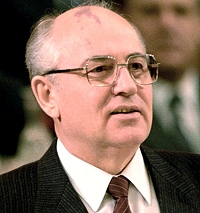
Mikhail Gorbachev
Last General Secretary of the Communist Party of the Soviet Union (1985–1991), the first and only President of the USSR (1990–1991), and recipient of the 1990 Nobel Peace Prize.
Born on March 2, 1931
Died on August 30, 2022
Age at death: 91
Profession: Politician, Head of State
Place of Birth: Privolnoye, Stavropol Territory, Russian SFSR, Soviet Union (now Russia)
Place of Death: Moscow, Russia
Mikhail Gorbachev was a Soviet and Russian politician who led the Soviet Union from 1985 to 1991. He was the last General Secretary of the Communist Party of the Soviet Union and the first and only President of the USSR, holding that office from March 1990 to December 1991. His government introduced Perestroika (restructuring) and Glasnost (openness), reforms intended to change Soviet economic administration and political life. He negotiated nuclear arms control agreements with American presidents Ronald Reagan and George H. W. Bush, oversaw the withdrawal of Soviet troops from Afghanistan, and accepted German reunification. He received the 1990 Nobel Peace Prize. He resigned on December 25, 1991, during the final dissolution of the Soviet Union.
Early Life and Family Background
Mikhail Gorbachev, whose full name was Mikhail Sergeyevich Gorbachev, was born on March 2, 1931, in the village of Privolnoye in the Stavropol Territory of the Russian Soviet Federative Socialist Republic, Soviet Union. His father was Sergey Andreyevich Gorbachev, and his mother was Maria Panteleyevna Gorbacheva. His family had Russian and Ukrainian ancestry and worked in agriculture.
He grew up during the government of Joseph Stalin. His childhood coincided with agricultural collectivization, famine and political repression. Both of his grandfathers were arrested during the Stalinist purges of the 1930s, although they survived and were eventually released.
During World War II, his father served in the Soviet military, and German forces occupied Privolnoye for several months. Gorbachev continued his education after the war while working in agriculture.
Between 1946 and 1950, he helped his father operate a combine harvester during summer harvests. The work earned him official recognition and contributed to his admission to university.
University Education and Communist Party Membership
In 1950, Mikhail Gorbachev entered the Faculty of Law at Moscow State University. During his studies, he became involved in student political activities and discussions about the Soviet legal and political system.
He joined the Communist Party of the Soviet Union in 1952, while still a university student.
At Moscow State University, he met Raisa Maximovna Titarenko, a philosophy student whom he married in 1953.
He graduated with a law degree in 1955 and returned to Stavropol. After a brief period working in the regional prosecutor's office, he transferred to the Komsomol, the Communist youth organization.
Early Political Career in Stavropol
Mikhail Gorbachev became First Secretary of the Stavropol City Komsomol Committee in September 1956. In 1958, he became Second Secretary of the Stavropol Territorial Komsomol Committee, and in March 1961 he was elected its First Secretary.
He subsequently moved into the regular Communist Party administration. In 1966, he became First Secretary of the Stavropol City Communist Party Committee.
On April 10, 1970, he was appointed First Secretary of the Stavropol Territorial Communist Party Committee, making him responsible for party administration across a large agricultural region.
He became a member of the Communist Party's Central Committee in 1971. His responsibilities included regional agriculture, economic planning and party administration.
Rise to the Soviet Leadership
In November 1978, Mikhail Gorbachev moved to Moscow after being appointed a Central Committee secretary responsible for agriculture.
He became a candidate member of the Politburo in 1979 and a full member in 1980.
Following the death of Soviet leader Leonid Brezhnev in 1982, Yuri Andropov became General Secretary. Gorbachev's responsibilities increased during Andropov's leadership.
After Andropov's death in 1984, Konstantin Chernenko became General Secretary. When Chernenko died in March 1985, the Politburo selected Gorbachev as his successor.
On March 11, 1985, he became General Secretary of the Communist Party of the Soviet Union, the highest political position in the Soviet system.
Perestroika and Economic Reforms
After taking office, Mikhail Gorbachev appointed new officials to important government and party positions and introduced changes intended to address economic stagnation.
One of his first major initiatives was a campaign launched in 1985 to reduce alcohol consumption. The government restricted alcohol sales and production, but the campaign also reduced state revenue from alcohol taxes and encouraged illegal production.
Gorbachev subsequently developed Perestroika, meaning restructuring, as a program for changing economic management and government administration.
The reform program sought to give state enterprises more independence in production and financial decisions. The 1987 Law on State Enterprise changed aspects of centralized industrial administration, while the 1988 Law on Cooperatives allowed a greater range of cooperative businesses to operate legally.
These measures introduced limited market-oriented activities without immediately dismantling the centrally planned economy. However, inconsistent pricing, supply problems and conflicts between central planning and enterprise autonomy contributed to continuing shortages and economic uncertainty.
Glasnost and Political Liberalization
Mikhail Gorbachev introduced Glasnost, or openness, to reduce restrictions on public discussion and allow greater scrutiny of the Soviet political system.
Newspapers, television programs and literary publications gained greater freedom to discuss corruption, economic problems and previously censored aspects of Soviet history.
Public debates increasingly addressed the Stalinist purges, forced labor camps and political repression. Formerly prohibited or restricted works began appearing in print.
The 1986 Chernobyl nuclear disaster also exposed problems with government secrecy. Although the initial official response withheld important information, the disaster subsequently became part of wider arguments for greater transparency.
Gorbachev's reforms expanded political competition. In March 1989, elections were held for the new Congress of People's Deputies, with multiple candidates competing for many seats.
In March 1990, the constitutional provision guaranteeing the Communist Party's leading political role was removed, creating the legal basis for a multiparty political system.
Head of State and President of the Soviet Union
On October 1, 1988, Mikhail Gorbachev became Chairman of the Presidium of the Supreme Soviet, assuming the Soviet Union's formal head-of-state role while remaining Communist Party General Secretary.
In May 1989, he was elected Chairman of the reorganized Supreme Soviet.
On March 15, 1990, the Congress of People's Deputies elected him to the newly created office of President of the Soviet Union.
His presidency was created during a period when authority was gradually shifting away from the Communist Party's traditional structures. Gorbachev attempted to introduce new constitutional institutions while maintaining a functioning federal union.
Economic Crisis and Nationality Conflicts
The economic reforms did not resolve the Soviet Union's production difficulties or shortages of consumer goods. Inflationary pressures, distribution failures and declining confidence in the government became increasingly visible.
During the summer of 1989, coal miners organized strikes demanding higher wages and improvements in working and living conditions.
Political movements in Lithuania, Latvia and Estonia increasingly called for the restoration of independence. Nationalist movements and ethnic conflicts also developed in Georgia, Armenia and Azerbaijan.
The Soviet authorities used force in several confrontations, including the suppression of demonstrations in Tbilisi in April 1989 and violence in Vilnius in January 1991. These incidents generated criticism of the central government and its handling of demands for national self-determination.
Relations with Ronald Reagan
In November 1985, Mikhail Gorbachev met United States President Ronald Reagan in Geneva, Switzerland. The leaders discussed nuclear weapons, bilateral relations, regional conflicts and scientific and cultural cooperation.
They met again in Reykjavík, Iceland, in October 1986. Their negotiations considered extensive reductions in nuclear weapons, but disagreements over the American Strategic Defense Initiative prevented a comprehensive agreement.
On December 8, 1987, Gorbachev and Reagan signed the Intermediate-Range Nuclear Forces Treaty (INF Treaty) in Washington, D.C.
The treaty required the United States and the Soviet Union to eliminate specified classes of ground-launched ballistic and cruise missiles with ranges between 500 and 5,500 kilometers. It also introduced inspection and verification procedures.
The agreement marked a departure from earlier arms control treaties that had generally limited the deployment of weapons rather than requiring an entire category to be destroyed.
Afghanistan and Soviet Foreign Policy
Mikhail Gorbachev sought to reduce the Soviet Union's military commitments abroad while addressing the economic costs of the arms race.
Under his government, Soviet troops began withdrawing from Afghanistan in May 1988. The withdrawal was completed on February 15, 1989, ending the Soviet military intervention that had begun in December 1979.
Gorbachev also moved away from the policy of using Soviet military force to preserve communist governments in Eastern Europe.
During 1989, communist governments in Poland, Hungary, East Germany, Czechoslovakia and other Eastern European countries lost their political monopolies or were replaced. The Soviet Union did not intervene militarily to reverse those changes.
The Fall of the Berlin Wall and German Reunification
In November 1989, the opening of the Berlin Wall accelerated political developments in East Germany and negotiations about German reunification.
Initially, the Soviet leadership expressed concerns about the security implications of a unified Germany, particularly its possible membership in NATO.
Mikhail Gorbachev participated in discussions with West German Chancellor Helmut Kohl and other European leaders about the conditions of reunification.
In 1990, the Soviet government accepted the reunification of East and West Germany. The negotiations addressed military arrangements, Soviet troop withdrawal and Germany's international status.
Germany was formally reunited on October 3, 1990.
Relations with George H. W. Bush and START I
After George H. W. Bush became President of the United States in January 1989, Mikhail Gorbachev continued negotiations concerning arms control and international security.
The two leaders met in Malta in December 1989 and held further summits during the following years.
On September 9, 1990, they met in Helsinki, Finland, primarily to discuss Iraq's invasion of Kuwait and the developing Persian Gulf crisis.
On July 31, 1991, Gorbachev and Bush signed START I, the Strategic Arms Reduction Treaty, in Moscow.
The treaty established reductions and limitations on deployed strategic nuclear delivery systems and nuclear warheads. Its implementation subsequently involved the United States and the Soviet successor states that inherited relevant strategic weapons.
1990 Nobel Peace Prize
Mikhail Gorbachev was awarded the Nobel Peace Prize in October 1990.
The Norwegian Nobel Committee recognized his role in changes to international relations and the peace process between East and West.
Gorbachev did not attend the December 1990 Nobel ceremony in Oslo because of the political situation in the Soviet Union. The Soviet ambassador accepted the award on his behalf.
He later delivered his Nobel lecture in Oslo on June 5, 1991.
The August 1991 Coup Attempt
During 1991, Mikhail Gorbachev attempted to preserve the Soviet Union through a new union treaty that would transfer additional powers to the republics.
Conservative officials in the Communist Party, security agencies and armed forces opposed aspects of these reforms. A group of senior officials organized a coup attempt in August 1991.
Gorbachev was at his holiday residence in Foros, Crimea, when the plotters isolated him and his family and cut off external communications.
On August 19, 1991, the self-proclaimed State Committee on the State of Emergency announced that Gorbachev was unable to carry out his duties for health reasons and that Vice President Gennady Yanayev had assumed presidential authority.
Russian President Boris Yeltsin rejected the coup and called for public resistance in Moscow. Demonstrators gathered around the Russian parliament building, and parts of the military refused to support the plotters.
The coup collapsed on August 21, and most of its leaders were arrested.
The Dissolution of the Soviet Union
Mikhail Gorbachev returned to Moscow on August 22, 1991, and resumed his presidential responsibilities.
On August 24, he resigned as General Secretary of the Communist Party. The political influence of the Soviet presidency continued to decline as the republics asserted sovereignty and independence.
On December 8, 1991, the leaders of Russia, Ukraine and Belarus signed the Belavezha Accords, declaring that the Soviet Union had ceased to exist and establishing the Commonwealth of Independent States.
On December 21, eight additional Soviet republics joined the declaration through the Alma-Ata agreements, bringing the number of participating states to eleven.
On December 25, 1991, Gorbachev announced his resignation as President of the Soviet Union in a televised address.
The following day, the Supreme Soviet's Council of Republics formally acknowledged the dissolution of the USSR.
The Gorbachev Foundation and Later Activities
Following his resignation, Mikhail Gorbachev continued participating in political research, international conferences and public discussions.
In December 1991, he established the Gorbachev Foundation, formally known as the International Foundation for Socio-Economic and Political Studies. The organization began its work in 1992, conducting research on political reform, international relations and the history of Perestroika.
In 1993, he helped establish Green Cross International, an organization concerned with environmental protection and the consequences of industrial and military activities.
He published books, participated in international meetings and spoke about arms control, European security and political reform.
1996 Russian Presidential Election and Political Activities
In 1996, Mikhail Gorbachev ran in Russia's presidential election against incumbent President Boris Yeltsin and other candidates.
He received approximately 0.5 percent of the vote in the first round and was eliminated.
He later participated in social democratic political organizations. In 2001, he became involved in founding the Social Democratic Party of Russia. In 2007, he helped establish the Union of Social Democrats.
Gorbachev continued making public statements about Russian politics, democratic institutions and international relations. He criticized some policies of Western governments and also expressed concerns about restrictions on political freedoms in Russia.
Commercial Appearances and Public Activities
In 1997, Mikhail Gorbachev appeared in an international advertising campaign for Pizza Hut. The advertisement referred humorously to public disagreements about his political reforms.
He stated that the income from the commercial would support projects associated with research archives and the study of Perestroika.
He also appeared in advertising campaigns for other companies and continued participating in documentary films and historical interviews.
Honors and Academic Recognition
In addition to the 1990 Nobel Peace Prize, Mikhail Gorbachev received honorary academic degrees and international awards.
He received honorary doctorates from institutions including Carleton University in 1993 and the University of Münster in 2005.
In 2005, he received the Point Alpha Prize in Germany for his contribution to German reunification.
He was also awarded the Order of St. Andrew, Russia's highest state decoration, in 2011.
Marriage and Family
Mikhail Gorbachev met Raisa Maximovna Titarenko while they were students at Moscow State University. Raisa studied philosophy.
They married on September 25, 1953. Following Gorbachev's graduation in 1955, they moved to Stavropol.
Their daughter, Irina Gorbacheva, was born on January 6, 1957.
Raisa Gorbacheva accompanied her husband on official visits and participated in cultural and charitable activities. She died on September 20, 1999, following treatment for leukemia.
Gorbachev did not remarry.
Death
Mikhail Gorbachev died on August 30, 2022, at the age of 91, after a prolonged illness. He had been receiving treatment at the Central Clinical Hospital in Moscow, Russia.
A public farewell ceremony was held in Moscow on September 3, 2022.
He was buried beside his wife, Raisa Gorbacheva, at Novodevichy Cemetery in Moscow.
Source: Biyografiler.com
Frequently asked questions about Mikhail Gorbachev
Who is Mikhail Gorbachev?, Mikhail Gorbachev biography, Mikhail Gorbachev life story, Mikhail Gorbachev age, Mikhail Gorbachev facts, Mikhail Gorbachev birthplace, Mikhail Gorbachev photos, Mikhail Gorbachev videos, Mikhail Gorbachev career
Related Biographies

Lamine Yamal
Professional footballer

Brad Pitt
Actor

Kylian Mbappe
Professional footballer

Erling Haaland
Professional footballer

Leonardo DiCaprio
Actor

Sam Altman
Entrepreneur, Investor, CEO

Michael Emerson
Actor

Mikhail Gorbachev
Politician, Head of State

Mesut Barzani
Politician

Billy Zane
Actor

Bernie Sanders
Politician, Activist

Bernardo Bertolucci
Film Director, Screenwriter
Lamine Yamal
Professional footballer

Jensen Huang
Entrepreneur, CEO, Engineer
Billy Zane
Actor
Mesut Barzani
Politician
Mikhail Gorbachev
Politician, Head of State
Bernie Sanders
Politician, Activist