
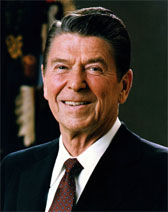
Ronald Reagan
Former Hollywood actor, 33rd Governor of California (1967–1975), and 40th President of the United
Born on February 6, 1911
Died on June 5, 2004
Age at death: 93
Profession: Actor, Politician, Former President
Place of Birth: Tampico, Illinois, United States
Place of Death: Los Angeles, California, United States
Ronald Wilson Reagan was born on February 6, 1911, in Tampico, Illinois, United States, as the second son of Nellie and John Reagan. He graduated from Eureka College in 1932 and worked as a radio sports announcer for five years. In 1937, he began his film career with his first role in Love Is on the Air.
On January 26, 1940, Reagan married actress Jane Wyman. The marriage lasted nine years and ended in divorce. He married for the second time on March 4, 1952, to another actress, Nancy Davis. Between 1942 and 1945, Reagan produced military training films for the United States Army Air Forces. In 1947, he became president of the Screen Actors Guild.
During the production of Casablanca, Reagan was initially considered for the role eventually played by Humphrey Bogart. While still active in Hollywood, Reagan showed early signs of entering politics and was long known for his alignment with the Democratic Party. However, in 1962, he switched his affiliation to the Republican Party.
Despite opposition campaigns led by prominent Hollywood figures, Reagan was elected Governor of California in 1966, defeating Democratic Governor Edmund G. Pat Brown. In the 1980 presidential election, he defeated incumbent President Jimmy Carter and was sworn in as the 40th President of the United States on February 20, 1981.
On March 30, 1981, President Reagan was shot and wounded while leaving a meeting at a hotel in Washington, D.C. The resolution of the Iran hostage crisis on the day of his inauguration, followed by surviving an assassination attempt two months later, reinforced his Hollywood-born “hero” image. On November 6, 1984, Reagan was re-elected by a large margin, defeating former Vice President Walter Mondale. In his second term, he focused on confronting communism and the Soviet Union, increasing military spending and developing the Strategic Defense Initiative, widely known as the “Star Wars” program.
At the same time, Reagan established an unexpected rapport with Soviet leader Mikhail Gorbachev, who came to power in 1985. The end of the Cold War in favor of Washington earned Reagan the reputation of being the leader who “dismantled the Soviet Union.”
After completing his second term, Reagan retired in February 1989, as the Constitution barred him from seeking a third term. He was succeeded by his Vice President, Republican candidate George Bush, marking the first time since World War II that the same political party won the U.S. presidency three consecutive times. Ronald Reagan became the longest-living president in U.S. history.
Diagnosed with Alzheimer’s disease on November 5, 1994, Ronald Wilson Reagan died on June 5, 2004, in Los Angeles, California, at the age of 93.
Major Events of the Reagan Era:
During his presidency, Reagan appointed Sandra Day O’Connor as the first female justice of the United States Supreme Court.
In August 1981, Reagan dismissed more than 11,000 air traffic controllers who went on strike against the Federal Aviation Administration.
In 1982, Reagan supported British Prime Minister Margaret Thatcher during the 74-day war between the United Kingdom and Argentina.
In 1983, the United States invaded a Caribbean nation following a left-wing coup.
Reagan met Soviet leader Mikhail Gorbachev in Geneva in 1985, describing the summit as a “new beginning” in U.S.–Soviet relations.
Following a 1986 bombing at a discotheque in Berlin that killed two American soldiers and one Turkish woman, U.S. warplanes bombed the Libyan cities of Tripoli and Benghazi.
In 1986, the United States and the Soviet Union held a summit in Iceland, discussing arms reduction and Reagan’s Strategic Defense Initiative.
Reagan faced political difficulty after the “Iran-Contra” scandal emerged in November 1986, involving the illegal sale of weapons to Iran and the diversion of approximately $30 million to Nicaragua. Reagan later described the arms sales as a “mistake.”
In 1987, at the U.S.–Soviet summit in Washington, Reagan and Mikhail Gorbachev signed an agreement to eliminate intermediate-range nuclear missiles.
Source: Biyografiler.com
Frequently asked questions about Ronald Reagan
Who is Ronald Reagan?, Ronald Reagan biography, Ronald Reagan life story, Ronald Reagan age, Ronald Reagan facts, Ronald Reagan birthplace, Ronald Reagan photos, Ronald Reagan videos, Ronald Reagan career
Related Biographies

Lamine Yamal
Professional footballer

Erling Haaland
Professional footballer

Kylian Mbappe
Professional footballer

Bad Bunny
Rapper, Songwriter

Austin Abrams
Actor

Brad Pitt
Actor


Hongjoong
Singer, Rapper, Songwriter, Composer

Ludacris
Rapper, Actor

Kwon Eunbi
Singer

Sarah Wayne Callies
Actress, Screenwriter, Producer, Director

LaTavia Roberson
Singer, Actress, Entrepreneur

Winston Churchill
Statesman, Writer, Historian

Satya Nadella
Business Leader

Jensen Huang
Entrepreneur, CEO
Lamine Yamal
Professional footballer

Sydney Sweeney
Actress
Erling Haaland
Professional footballer