
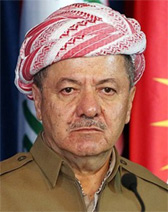
Mesut Barzani
Iraqi Kurdish politician who has led the Kurdistan Democratic Party (KDP) since 1979 and served as President of the Kurdistan Region of Iraq from 2005 to 2017.
Born on August 16, 1946
Age: 80
Profession: Politician
Place of Birth: Mahabad, Iran
Mesut Barzani, also known internationally as Masoud Barzani, is an Iraqi Kurdish politician and president of the Kurdistan Democratic Party (KDP). He served as President of the Kurdistan Region of Iraq from 2005 to 2017 and has led the KDP since 1979. The son of Kurdish political and military leader Mustafa Barzani, he participated in the Kurdish movement's armed and political activities before assuming leadership of the party. His career includes negotiations over Kurdish autonomy, the conflicts between Kurdish political factions in the 1990s, Iraq's federal restructuring after 2003 and the disputed 2017 Kurdish independence referendum.
Early Life and Family Background
Mesut Barzani, whose full name is Masoud Mustafa Barzani, was born on August 16, 1946, in Mahabad, Iran. At the time, Mahabad was the capital of the short-lived Republic of Mahabad, established in January 1946 under Qazi Muhammad. His father, Mustafa Barzani, commanded Kurdish military forces supporting the republic and was a founder of the Kurdistan Democratic Party.
Following the collapse of the republic in December 1946, Mustafa Barzani and several hundred fighters crossed into the Soviet Union in 1947. Mesut Barzani remained with his mother in Iraq, where the family experienced restrictions imposed by the Iraqi authorities.
Mustafa Barzani returned to Iraq in 1958 after the military coup led by Abd al-Karim Qasim overthrew the Hashemite monarchy. The political situation later deteriorated, and fighting between Kurdish forces and successive Iraqi governments resumed during the 1960s.
Early Political Activities and the 1970 Autonomy Agreement
Mesut Barzani joined the Kurdish movement led by his father while still a teenager. He became involved in political and military activities associated with the KDP and the Kurdish uprising against the Iraqi government.
In 1970, he participated in the KDP delegation involved in negotiations with Iraq's Ba'athist government. On March 11, 1970, the Iraqi authorities and Kurdish representatives reached an agreement recognizing Kurdish national rights and providing for autonomy in areas with Kurdish populations.
The parties disagreed over the boundaries of the autonomous region, the status of Kirkuk, population policy and the implementation of the agreement. The Iraqi government introduced its own autonomy arrangements in 1974, but the KDP rejected them. Armed conflict resumed.
The 1975 Algiers Agreement and KDP Reorganization
In March 1975, Iraq and Iran signed the Algiers Agreement, under which Iran agreed to end its support for the Iraqi Kurdish insurgency in exchange for border concessions from Baghdad.
The withdrawal of Iranian assistance weakened Mustafa Barzani's forces and contributed to the collapse of their military campaign. Mustafa Barzani subsequently travelled to the United States, where he received medical treatment.
Mesut Barzani and his brother Idris Barzani participated in efforts to reorganize the KDP following the 1975 defeat. Together with other party members, they established a provisional leadership structure and worked to restore the party's political and military organization.
Following Mustafa Barzani's death on March 1, 1979, Mesut Barzani was elected president of the KDP at its ninth congress. He retained the party leadership in subsequent decades.
The Iran–Iraq War and Kurdish Political Alliances
The outbreak of the Iran–Iraq War in September 1980 created new conditions for Kurdish armed groups operating in northern Iraq. The KDP maintained relations with Iran while continuing to fight the government of Saddam Hussein.
Mesut Barzani and Idris Barzani were involved in efforts to coordinate activities among Kurdish organizations. Idris died on January 31, 1987, after which Mesut continued leading the KDP.
In 1988, the KDP joined other Kurdish parties in the Iraqi Kurdistan Front. During the same period, the Iraqi government conducted the Anfal campaign against Kurdish communities, involving mass killings, forced displacement and chemical weapons attacks. The Iraqi regime's chemical attack on Halabja in March 1988 killed thousands of civilians.
The 1991 Gulf War and Kurdish Self-Government
Following the Gulf War in 1991, Kurdish uprisings broke out in northern Iraq against Saddam Hussein's government. Iraqi military counterattacks forced hundreds of thousands of people to flee towards the Turkish and Iranian borders.
A United States-led international humanitarian operation, supported by the United Kingdom and France, established a protected area in northern Iraq. A no-fly zone was introduced, and the Iraqi government subsequently withdrew much of its administration from the region.
In May 1992, parliamentary elections took place in the Kurdish-controlled areas. The Kurdistan Democratic Party, led by Mesut Barzani, and the Patriotic Union of Kurdistan (PUK), led by Jalal Talabani, emerged as the two largest political parties.
The parties initially agreed to share governmental responsibilities. Disagreements over administration, territorial control, revenue and political authority subsequently intensified.
The Kurdish Civil Conflict and Washington Agreement
In 1994, fighting broke out between the KDP and PUK. The conflict divided territory controlled by the two parties and disrupted the institutions established after the 1992 elections.
In August 1996, Mesut Barzani sought military assistance from Saddam Hussein's government during the KDP's conflict with the PUK. Iraqi government forces entered Erbil on August 31, 1996, enabling the KDP to regain control of the city.
The decision was criticized by the PUK and by opponents of cooperation with Saddam Hussein. It also demonstrated the extent to which Kurdish internal conflicts intersected with the interests of Baghdad and neighboring governments.
United States mediation subsequently brought Barzani and Jalal Talabani into negotiations. In September 1998, the two leaders signed the Washington Agreement, establishing measures intended to end the fighting, restore cooperation and address disputes between their parties.
Implementation proceeded gradually. The KDP and PUK continued administering separate areas for several years, despite the agreement's provisions for political reconciliation.
Iraq After the 2003 Invasion
Following the United States-led invasion of Iraq in March 2003 and the overthrow of Saddam Hussein, Mesut Barzani participated in negotiations concerning the country's new political institutions.
He joined the Iraqi Governing Council and served as its rotating president in 2004. He also took part in discussions about Kurdish representation, federalism, political authority and the distribution of resources between Baghdad and the Kurdistan Region.
The Iraqi Constitution adopted in 2005 recognized the Kurdistan Region as a federal region and affirmed the status of its existing authorities within the new constitutional framework.
President of the Kurdistan Region
In June 2005, Mesut Barzani was elected President of the Kurdistan Region by the regional parliament. He formally assumed office on June 12, 2005.
On July 25, 2009, he won the region's first direct presidential election, receiving approximately 70 percent of the vote.
During his presidency, the regional government expanded its administrative institutions, diplomatic representation and economic relationships with foreign governments and businesses. The region also developed its oil and gas sector, leading to disputes with Baghdad over export authority, contracts and the allocation of federal revenue.
His presidency also faced criticism over the concentration of power within the KDP and the Barzani family, the treatment of opposition parties and the extension of presidential terms. His second elected term was extended by legislation in 2013. When that extension expired in 2015, disagreements over the legality of his continued presidency contributed to a wider political crisis.
Relations with Turkey
Mesut Barzani's relationship with Turkey developed through negotiations over border security, trade, energy infrastructure and the political situation in Iraq.
In September 2012, he attended the fourth ordinary congress of Turkey's Justice and Development Party (AK Party) in Ankara.
During Turkey's Kurdish peace process, Barzani publicly supported attempts to resolve the conflict through negotiations. On November 16, 2013, he travelled to Diyarbakır at the invitation of then-Prime Minister Recep Tayyip Erdogan.
He attended public ceremonies and met Erdoğan during the visit. Kurdish singer Şivan Perwer, who had spent many years outside Turkey, and singer İbrahim Tatlıses also participated in the program.
Relations between Ankara and Erbil also expanded through trade and energy cooperation. Turkey became a major route for exports from the Kurdistan Region, although disputes over oil sales and regional security continued.
The Islamic State Conflict and the Peshmerga
In 2014, the expansion of the Islamic State group (ISIS) across northern Iraq placed substantial pressure on the Kurdistan Region's security forces.
Following the collapse of Iraqi government positions in several northern areas, Kurdish Peshmerga forces extended their control into disputed territories, including Kirkuk.
ISIS attacks on Sinjar in August 2014 caused mass displacement and atrocities against the Yazidi population. The initial withdrawal of some Kurdish forces from Sinjar drew criticism, including from Yazidi survivors and human rights organizations.
Mesut Barzani, as regional president and KDP leader, participated in political and military coordination with the international coalition opposing ISIS. Kurdish forces later carried out operations to retake territory occupied by the organization, including operations around Sinjar.
The 2017 Independence Referendum
On September 25, 2017, the Kurdistan Region held an independence referendum under the leadership of Mesut Barzani. Voting also took place in some disputed territories outside the region's recognized administrative boundaries.
According to the electoral authorities, approximately 92.7 percent of participating voters supported independence. The result was not implemented as a declaration of statehood.
Iraq's federal government rejected the referendum and considered it unconstitutional. Turkey and Iran opposed the vote, while the United States warned against proceeding at that time and supported negotiations within a unified Iraq.
In October 2017, Iraqi federal forces retook control of several disputed areas, including Kirkuk, from Kurdish forces. The regional government also faced restrictions affecting international flights and its economic relations.
The referendum and its consequences generated disagreement within Kurdish politics. Critics argued that the timing and inclusion of disputed territories had increased the risk of confrontation, while Barzani defended the vote as an expression of Kurdish self-determination.
Resignation from the Regional Presidency
On October 29, 2017, Mesut Barzani announced that he would not seek an additional extension of his presidency.
His term ended on November 1, 2017, and the powers of the presidency were redistributed among regional institutions until the office was filled again.
Barzani continued serving as president of the KDP. In 2019, his nephew Nechirvan Barzani was elected President of the Kurdistan Region, while his son Masrour Barzani became the regional prime minister.
Political Activities After 2017
After leaving the regional presidency, Mesut Barzani remained active in discussions concerning relations between Erbil and Baghdad, the internal affairs of the KDP and negotiations among Iraqi Kurdish political parties.
He continued meeting Iraqi political leaders, foreign diplomats and representatives of regional governments. These discussions included federal budget allocations, oil revenue, regional security and the formation of Iraqi governments.
In the October 2024 Kurdistan Region parliamentary elections, the KDP won 39 of the legislature's 100 seats, while the PUK won 23. Neither party secured a majority. Disputes over power-sharing and government formation continued through 2025 and 2026.
Following Iraq's November 2025 parliamentary elections, Barzani participated in discussions concerning the KDP's representation and the formation of federal institutions.
In November 2026, disagreements between the KDP and PUK intensified over the functioning of the regional parliament and government. On November 9, Barzani called for renewed talks with the PUK to resolve the political deadlock. The KDP subsequently declared its willingness to negotiate.
On November 10, 2026, he also met Ali Babacan, leader of Turkey's Democracy and Progress Party, in Pirmam to discuss political developments in Iraq and the wider region.
Family and Publications
Mesut Barzani is married and has eight children. Members of his family have held senior positions in the Kurdistan Region's political institutions and the KDP.
He speaks Kurdish, Arabic and Persian.
Barzani wrote Mustafa Barzani and the Kurdish Liberation Movement, an account of his father's political life and the history of the Kurdish movement. The work was originally written in Arabic in 1986 and was subsequently translated into several languages. An English edition was published in 2003.
His later publications include volumes of Barzani and the Kurdish Liberation Movement, covering developments associated with the Kurdish movement between 1975 and 1990, and writings addressing Iraq's political transformation after 2003.
Source: Biyografiler.com
Frequently asked questions about Mesut Barzani
Who is Mesut Barzani?, Mesut Barzani biography, Mesut Barzani life story, Mesut Barzani age, Mesut Barzani facts, Mesut Barzani birthplace, Mesut Barzani photos, Mesut Barzani videos, Mesut Barzani career
Related Biographies

Lamine Yamal
Professional footballer

Brad Pitt
Actor

Kylian Mbappe
Professional footballer

Erling Haaland
Professional footballer

Leonardo DiCaprio
Actor

Sam Altman
Entrepreneur, Investor, CEO

Michael Emerson
Actor

Mikhail Gorbachev
Politician, Head of State

Mesut Barzani
Politician

Billy Zane
Actor

Bernie Sanders
Politician, Activist

Bernardo Bertolucci
Film Director, Screenwriter
Lamine Yamal
Professional footballer

Jensen Huang
Entrepreneur, CEO, Engineer
Billy Zane
Actor
Mesut Barzani
Politician
Mikhail Gorbachev
Politician, Head of State
Bernie Sanders
Politician, Activist