
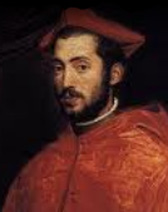
Lodovico Ferrari
Italian mathematician who developed a general algebraic method for solving fourth-degree (quartic) equations. His method was published in 1545 in Gerolamo Cardano's Ars Magna.
Born on February 2, 1522
Died on October 5, 1565
Age at death: 43
Profession: Mathematician
Place of Birth: Bologna, Papal States (present-day Italy)
Place of Death: Bologna, Papal States
Lodovico Ferrari was born on February 2, 1522, in Bologna, then part of the Papal States, now Italy. He was an Italian mathematician who developed an algebraic method for solving fourth-degree equations, also known as quartic equations. His method reduced quartic equations to cubic equations and was published by Gerolamo Cardano in Ars Magna (1545). Ferrari also contributed to the study of cubic equations and participated in a mathematical dispute with Niccolò Tartaglia.
Early Life and Education
Lodovico Ferrari was born in Bologna on February 2, 1522. His father was Alessandro Ferrari. His grandfather, Bartolomeo Ferrari, had moved from Milan to Bologna, and the family experienced financial difficulties.
After his father's death, Ferrari lived with his uncle Vincenzo Ferrari. He received little formal education during his childhood.
In late 1536, at approximately fourteen years of age, he entered the household of mathematician Gerolamo Cardano in Milan as a servant. Cardano recognized his ability and began teaching him mathematics, Latin, and Greek.
Ferrari soon became Cardano's secretary, assistant, and mathematical collaborator.
Mathematical Career
By the age of eighteen, Lodovico Ferrari was teaching mathematics in Milan. In 1541, he succeeded Gerolamo Cardano in a teaching position supported by the Piatti Foundation, after demonstrating his abilities in a public mathematical contest.
During this period, he worked with Cardano on algebraic problems involving quadratic and cubic equations.
Ferrari developed geometric demonstrations related to Cardano's methods and examined problems that required solutions to higher-degree equations.
Solution of Quartic Equations
In approximately 1540, Lodovico Ferrari discovered a general algebraic method for solving fourth-degree equations.
The method involves transforming a quartic equation into a form that can be solved by first solving an associated cubic equation. This cubic equation is known as a resolvent cubic.
A general fourth-degree equation can be written as:
ax⁴ + bx³ + cx² + dx + e = 0, where a ≠ 0.
Ferrari's method made it possible to obtain algebraic solutions to such equations using operations including the extraction of roots.
The method was published in 1545 in Ars Magna, written by Gerolamo Cardano. Cardano acknowledged Ferrari as the discoverer of the quartic solution.
Dispute with Niccolò Tartaglia
The publication of Ars Magna led to a dispute between Gerolamo Cardano and mathematician Niccolò Tartaglia over the disclosure of methods for solving cubic equations.
Tartaglia accused Cardano of publishing mathematical methods that he had previously shared under a promise of confidentiality. Cardano and Ferrari argued that an earlier solution had been discovered independently by Scipione del Ferro.
Lodovico Ferrari defended Cardano and challenged Tartaglia to a public mathematical contest. During 1547 and 1548, they exchanged written challenges involving thirty-one problems each.
On August 10, 1548, the mathematicians met in Milan for a public debate. Ferrari was widely regarded as having gained the advantage, although the participants gave conflicting accounts of the outcome.
Later Career
Following the dispute, Lodovico Ferrari worked as a tax assessor for the governor of Milan, Ferrante Gonzaga. He subsequently entered the service of the Church and accumulated considerable wealth.
He eventually returned to Bologna, where he lived with his widowed sister Maddalena Ferrari.
In 1565, he was appointed professor of mathematics at the University of Bologna. He died later that year, shortly after receiving the appointment.
Death
Lodovico Ferrari died on October 5, 1565, in Bologna, at the age of 43.
Historical accounts attribute his death to arsenic poisoning. Some later narratives accuse his sister Maddalena of poisoning him to obtain his inheritance, but this allegation has not been conclusively established.
Principal Mathematical Contribution
1540 - Developed a general solution method for fourth-degree equations1545 - Quartic solution published in Ars Magna by Gerolamo Cardano
1547–1548 - Mathematical challenges exchanged with Niccolò Tartaglia
1548 - Public mathematical debate in Milan
Source: Biyografiler.com
Frequently asked questions about Lodovico Ferrari
Who is Lodovico Ferrari?, Lodovico Ferrari biography, Lodovico Ferrari life story, Lodovico Ferrari age, Lodovico Ferrari facts, Lodovico Ferrari birthplace, Lodovico Ferrari photos, Lodovico Ferrari videos, Lodovico Ferrari career

Lamine Yamal
Professional footballer

Brad Pitt
Actor

Erling Haaland
Professional footballer

Kylian Mbappe
Professional footballer

Leonardo DiCaprio
Actor

Sam Altman
Entrepreneur, Investor, CEO

Michael Bay
Film Director, Producer

Michael Ballack
Former Professional Footballer

Mia Wasikowska
Actress

Michael Emerson
Actor

Mikhail Gorbachev
Politician, Head of State

Mesut Barzani
Politician

Miuccia Prada
Fashion Designer, Entrepreneur

Lord Byron
Poet, Politician

Abelardo de la Espriella
Lawyer, Businessperson, Politician, President

Tim Burton
Film Director, Producer, Screenwriter

Yao Ming
Professional Basketball Player

Anthony van Dyck
Painter