
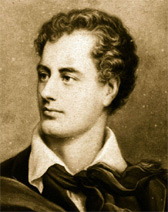
Lord Byron
English Romantic poet known for Childe Harold's Pilgrimage, The Giaour and the unfinished satirical verse epic Don Juan. He supported the Greek War of Independence and died in Greece at the age of 36.
Born on January 22, 1788
Died on April 19, 1824
Age at death: 36
Profession: Poet, Politician
Place of Birth: London, England
Place of Death: Missolonghi, Greece
Lord Byron, whose full name was George Gordon Byron, was born on January 22, 1788, in London, England. He was an English poet, playwright, aristocrat, and politician associated with the Romantic movement. His principal works include Childe Harold's Pilgrimage (1812–1818), The Giaour (1813), Manfred (1817), and the unfinished satirical verse epic Don Juan (1819–1824). In the final year of his life, he supported the Greek War of Independence against the Ottoman Empire and died in Missolonghi, Greece, on April 19, 1824.
Early Life and Education
Lord Byron was the son of Captain John Byron and Catherine Gordon. Born with a clubfoot, he experienced difficulties walking throughout his life. His father died in France in 1791, when Byron was three years old.
He spent much of his childhood with his mother in Aberdeen, Scotland. In 1798, after the death of his great-uncle, he inherited the title of sixth Baron Byron and the family estate at Newstead Abbey in Nottinghamshire.
He attended school in Dulwich and studied at Harrow School from 1801 to 1805. He subsequently entered Trinity College, Cambridge, where he developed an interest in poetry and formed a friendship with John Cam Hobhouse.
His first collection, Fugitive Pieces, was privately printed in 1806. He published Hours of Idleness in 1807 and responded to unfavorable reviews with the satire English Bards and Scotch Reviewers in 1809.
Travels to the Mediterranean and Ottoman Lands
In 1809, Lord Byron took his seat in the British House of Lords and began a journey through southern Europe and the eastern Mediterranean with John Cam Hobhouse.
They traveled through Portugal, Spain, Malta, Albania, and Greece. Byron visited Ioannina and met the Ottoman Albanian ruler Ali Pasha of Tepelena. During his stay in Athens, he wrote poetry inspired by the region and by Teresa Makri, whom he addressed in Maid of Athens, Ere We Part.
In 1810, Byron traveled through the Ottoman Empire, visiting Smyrna (present-day İzmir) and Constantinople (present-day Istanbul). He also visited the ruins of Troy and swam across the Hellespont, now known as the Dardanelles, inspired by the ancient story of Leander.
His experiences in the Mediterranean provided material for several later works, including Childe Harold's Pilgrimage and The Giaour. He returned to England in 1811.
Literary Career and Recognition
On February 27, 1812, Lord Byron delivered his first speech in the House of Lords, defending workers affected by legislation against machine-breaking.
The first two cantos of Childe Harold's Pilgrimage were published in 1812. The poem follows a disillusioned traveler through European landscapes and societies. Its publication brought Byron widespread public recognition.
He subsequently published narrative poems including The Giaour (1813), The Bride of Abydos (1813), The Corsair (1814), and Lara (1814). Several of these works drew on settings and subjects associated with the Ottoman Empire and the eastern Mediterranean.
Between 1816 and 1818, he completed the remaining cantos of Childe Harold's Pilgrimage.
Marriage and Family
On January 2, 1815, Lord Byron married Anne Isabella Milbanke, also known as Annabella. Their daughter, Ada Lovelace, was born on December 10, 1815. She later worked with mathematician Charles Babbage on the Analytical Engine.
The marriage ended in separation in 1816. Byron's relationships and allegations concerning his half-sister Augusta Leigh contributed to the public controversy surrounding his private life. The precise nature of their relationship remains a subject of historical debate.
Byron also had a daughter, Allegra Byron, born in January 1817 to Claire Clairmont. Allegra died in 1822, at the age of five.
Switzerland, Italy and Later Writing
In April 1816, Lord Byron left England permanently. He traveled to Switzerland, where he spent time near Lake Geneva with Percy Bysshe Shelley, Mary Shelley, and Claire Clairmont. During this period, he worked on Childe Harold's Pilgrimage and wrote The Prisoner of Chillon.
He moved to Italy later that year and lived in Venice, Ravenna, Pisa, and Genoa. His works from this period included Manfred (1817), Beppo (1818), and Mazeppa (1819).
In 1819, he began a relationship with Teresa Guiccioli. Through her family, he became involved with members of the Carbonari, a secret political movement associated with Italian constitutional and independence struggles.
His later writings included The Prophecy of Dante, Marino Faliero, Sardanapalus, The Two Foscari, Cain, and The Vision of Judgment.
Don Juan
Lord Byron began writing Don Juan in 1818. The first two cantos were published in 1819, and he continued the work until his departure for Greece.
Written in ottava rima, Don Juan is a satirical narrative poem examining love, politics, war, society, and aristocratic life. Its settings include Spain, the Ottoman Empire, Russia, and England.
Unlike the traditional portrayal of Don Juan as a calculating seducer, Byron depicted his protagonist as a young man frequently pursued and seduced by others.
Sixteen cantos were published during Byron's lifetime. A seventeenth remained unfinished at his death.
Greek War of Independence
In 1823, Lord Byron joined the London Greek Committee, which supported the Greek struggle for independence from Ottoman rule.
He sailed from Genoa in July 1823 and arrived on the island of Cephalonia in August. He provided financial assistance for the Greek fleet and sought cooperation among the different Greek political and military factions.
In January 1824, he arrived in Missolonghi, where he worked with Greek leader Alexandros Mavrokordatos. He financed troops, including Souliot fighters, and participated in preparations for an attack on the Ottoman-held fortress of Lepanto.
The planned military operation was not carried out before his death.
Death and Burial
In April 1824, Lord Byron developed a severe fever. Physicians treated him with bloodletting, a common medical practice of the period, which may have further weakened him. The precise cause of his fatal illness remains uncertain.
He died on April 19, 1824, in Missolonghi, Greece, aged 36.
His body was returned to England and buried in the family vault at the Church of St Mary Magdalene in Hucknall, Nottinghamshire, near Newstead Abbey.
He was not buried in Westminster Abbey, but a memorial stone was unveiled in its Poets' Corner on May 8, 1969.
Selected Works
Poetry and Narrative Poems1806 - Fugitive Pieces
1807 - Hours of Idleness
1809 - English Bards and Scotch Reviewers
1812–1818 - Childe Harold's Pilgrimage (Four Cantos)
1813 - The Giaour
1813 - The Bride of Abydos
1814 - The Corsair
1814 - Lara
1815 - Hebrew Melodies
1816 - The Prisoner of Chillon
1817 - The Lament of Tasso
1818 - Beppo
1819 - Mazeppa
1819–1824 - Don Juan (Unfinished Verse Epic)
1821 - The Prophecy of Dante
1822 - The Vision of Judgment
1823 - The Age of Bronze
Plays and Dramatic Poems
1817 - Manfred
1821 - Marino Faliero
1821 - Sardanapalus
1821 - The Two Foscari
1821 - Cain
1823 - Werner
Portrayals in Film
In the 1988 film Rowing with the Wind, Lord Byron was portrayed by Hugh Grant. The film also depicts Mary Shelley and Percy Bysshe Shelley.
Source: Biyografiler.com
Lord Byron Movies

Don Juan DeMarco
Release Date: April 7, 1995
Director: Jeremy Leven
Writer: Jeremy Leven, Lord Byron
Cast: Marlon Brando, Johnny Depp, Faye Dunaway, Géraldine Pailhas, Talisa Soto, Rachel Ticotin
Frequently asked questions about Lord Byron
Who is Lord Byron?, Lord Byron biography, Lord Byron life story, Lord Byron age, Lord Byron facts, Lord Byron birthplace, Lord Byron photos, Lord Byron videos, Lord Byron career
Related Biographies

Lamine Yamal
Professional footballer

Brad Pitt
Actor

Erling Haaland
Professional footballer

Kylian Mbappe
Professional footballer

Leonardo DiCaprio
Actor

Sam Altman
Entrepreneur, Investor, CEO

Michael Bay
Film Director, Producer

Michael Ballack
Former Professional Footballer

Mia Wasikowska
Actress

Michael Emerson
Actor

Mikhail Gorbachev
Politician, Head of State

Mesut Barzani
Politician

Lord Byron
Poet, Politician

Yao Ming
Professional Basketball Player

Lamine Yamal
Professional footballer

Marlene Dietrich
Actress, Singer

Mette Frederiksen
Politician