
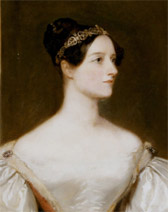
Ada Lovelace
The World’s First Computer Programmer
Born on December 10, 1815
Died on November 27, 1852
Age at death: 37
Profession: Mathematician, Writer
Place of Birth: London, England
Place of Death: London, England
Ada Lovelace, born Augusta Ada Byron and formally titled Augusta Ada King, Countess of Lovelace, was an English mathematician and writer whose ideas laid the conceptual foundations of modern computing. She is best known for her pioneering work on Charles Babbage’s Analytical Engine, an early mechanical general-purpose computer that anticipated the logic of programmable machines.
Through her extensive notes on the Analytical Engine, Ada Lovelace described the first known algorithm intended to be carried out by a machine. This achievement has led to her widespread recognition as the world’s first computer programmer. More importantly, her writings revealed a remarkably advanced understanding of what computation itself could become.
Early Life and Family Background
Ada Lovelace was born on 10 December 1815 in London as the only legitimate child of the poet Lord Byron and Anne Isabella Milbanke. Her parents’ marriage collapsed almost immediately after her birth, and within months Byron left England permanently.
Ada never knew her father, who died in 1824 during the Greek War of Independence. His literary fame and personal notoriety nonetheless cast a long shadow over her life, shaping both public perceptions of her identity and her mother’s approach to her upbringing.
Anne Isabella Milbanke, herself mathematically inclined, was determined that her daughter would be shielded from what she believed to be Byron’s emotional instability. To that end, she insisted on a rigorous education grounded in logic, mathematics, and disciplined reasoning—an unconventional and demanding path for a girl of the British aristocracy in the early nineteenth century.
Childhood, Illness, and Imaginative Discipline
Ada Lovelace’s childhood was marked by recurring illness and extended isolation. She suffered from severe headaches that impaired her vision, and at the age of thirteen she contracted measles, which left her temporarily paralyzed and confined to bed for nearly a year.
These physical limitations did not suppress her intellectual growth. On the contrary, long periods of solitude encouraged deep concentration and imaginative exploration. She developed a distinctive habit of pairing fantasy with structure, refusing to see creativity and discipline as opposing forces.
At the age of twelve, she became fascinated with the idea of human flight. She studied bird anatomy, sketched mechanical wings, and planned a theoretical book she called “Flyology.” This early project foreshadowed her later ability to merge imaginative speculation with systematic analysis.
This balance between poetic vision and mathematical order would become central to her intellectual identity.
Education and Intellectual Formation
Ada Lovelace received a highly unusual education for her time, guided by some of the most respected scientific minds in Britain. Among her tutors were the scientist and writer Mary Somerville and the mathematician Augustus De Morgan.
She demonstrated exceptional aptitude in advanced mathematics, including algebra and calculus. Yet she resisted the notion that mathematics was merely a mechanical or abstract pursuit.
Ada described herself as both an analyst and a metaphysician, insisting that imagination and intuition were essential to genuine scientific understanding. In her view, mathematics was a language capable of expressing ideas far beyond numbers alone.
Collaboration with Charles Babbage
A decisive moment in Ada Lovelace’s intellectual life came in 1833, when she was introduced to Charles Babbage. Babbage was developing the Difference Engine and conceptualizing the more ambitious Analytical Engine, a machine designed to follow programmable instructions.
Unlike many contemporaries who saw Babbage’s work as an elaborate calculating device, Ada immediately grasped its deeper significance. She recognized the Analytical Engine as a symbolic machine capable of manipulating abstract entities according to formal rules.
Babbage was deeply impressed by her insight and famously referred to her as “The Enchantress of Numbers.” Their correspondence evolved into a sustained intellectual partnership grounded in mutual respect and theoretical ambition.
The Analytical Engine and the First Algorithm
Between 1842 and 1843, Ada Lovelace translated an Italian paper on the Analytical Engine written by Luigi Menabrea. While the translation itself was important, the true significance lay in the extensive notes she appended to it.
These notes were longer and more conceptually ambitious than the original article. They explored the machine’s structure, its operational logic, and its potential applications in unprecedented depth.
Most notably, Ada included a detailed procedure for calculating Bernoulli numbers using the Analytical Engine. This method is recognized as the first algorithm explicitly designed to be executed by a machine, marking a foundational moment in the history of computing.
A Vision Beyond Arithmetic
Ada Lovelace’s most original contribution lay not only in technical description but in conceptual foresight. She argued that machines could manipulate symbols, patterns, and relationships—not just numbers.
She speculated that a sufficiently advanced machine might compose music, produce graphics, or explore complex abstract structures, provided it was properly programmed. These ideas anticipated core principles of modern computing more than a century before their realization.
At the same time, she maintained that machines could not originate ideas independently. Her position reflected a nuanced understanding of computation as an extension of human intention rather than a replacement for it.
Marriage and Personal Struggles
In 1835, Ada Lovelace married William King-Noel and later assumed the title Countess of Lovelace. The couple had three children: Byron, Anne, and Ralph.
Despite the demands of aristocratic life, she continued her intellectual pursuits whenever her health allowed. However, chronic illness, financial difficulties linked to gambling schemes, and social pressures increasingly constrained her work in later years.
Death and Burial
Ada Lovelace died on 27 November 1852 at the age of thirty-seven, most likely from uterine cancer, exacerbated by the medical practices of the era. In accordance with her wishes, she was buried beside her father at St. Mary Magdalene Church in Hucknall, Nottinghamshire.
Legacy and Historical Significance
The scope of Ada Lovelace’s contributions has been debated, yet her notes on the Analytical Engine remain foundational texts in the history of computer science. Whether regarded as the first programmer or as the earliest visionary of programmable machines, her intellectual legacy is undisputed.
Her name endures through the Ada programming language developed for the United States Department of Defense and through Ada Lovelace Day, celebrated annually to honor women’s contributions to science and technology. Ada Lovelace stands as a lasting symbol of how imagination, disciplined by logic, can reshape the future of human knowledge.
Source: Biyografiler.com
Frequently asked questions about Ada Lovelace
Who is Ada Lovelace?, Ada Lovelace biography, Ada Lovelace life story, Ada Lovelace age, Ada Lovelace facts, Ada Lovelace birthplace, Ada Lovelace photos, Ada Lovelace videos, Ada Lovelace career

Lamine Yamal
Professional footballer

Kylian Mbappe
Professional footballer

Erling Haaland
Professional footballer

Sam Altman
Entrepreneur, Investor, CEO

Bad Bunny
Rapper, Songwriter

Brad Pitt
Actor


Hongjoong
Singer, Rapper, Songwriter, Composer

Ludacris
Rapper, Actor

Kwon Eunbi
Singer

Sarah Wayne Callies
Actress, Screenwriter, Producer, Director

LaTavia Roberson
Singer, Actress, Entrepreneur

Ada Lovelace
Mathematician, Writer

Alexei Mordashov
Businessperson, Investor

Austin Abrams
Actor
Lamine Yamal
Professional footballer

Sadio Mane
Professional footballer
Erling Haaland
Professional footballer