
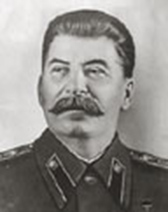
Josef Stalin
Leader of the Soviet Union and Architect of Soviet Power
Born on December 18, 1878
Died on March 5, 1953
Age at death: 75
Profession: Politician, Political Leader
Place of Birth: Gori, Georgia (then Russian Empire)
Place of Death: Moscow, Soviet Union
Joseph Stalin was a Georgian-born Soviet politician who served as General Secretary of the Communist Party of the Soviet Union from 1922 to 1953, a position that represented the highest authority in the Soviet state. He played a significant role in the Bolshevik Revolution and fundamentally altered the course of World War II. His adopted name “Stalin,” meaning “man of steel” in Russian, became synonymous with absolute power and centralized control.
Joseph Stalin, whose birth name was Ioseb (Yosef) Vissarionovich Dzhugashvili, was born on December 18, 1879, in Gori. Due to the scarcity of early sources, limited information exists about his childhood. His mother came from a background of servitude, while his father was a shoemaker who owned a small workshop. His father’s harsh temperament is believed to have contributed to Stalin’s difficult upbringing. He began his formal education in Gori in 1888. Because instruction was conducted in Russian while his native language was Georgian, he struggled both academically and socially. In 1894, he graduated with high academic distinction and the same year entered the Tiflis Theological Seminary.
In 1895, Stalin joined a clandestine Marxist organization opposing Tsarist Russia. Until 1898, he studied the works of Karl Marx and Friedrich Engels with Marxist circles. In August 1898, he began organizing efforts to unify these groups and joined the Georgian Social Democratic Organization, working alongside Lado Ketskhoveli and Noe Zhordania. During this period, debates emerged over whether a revolution could be achieved through legal means.
On May 29, 1899, Stalin was expelled from the seminary due to his revolutionary activities. On November 28, 1899, he began working at the Tiflis Physical Observatory. Under the leadership of Ketskhoveli and others, the group continued organizing, publishing propaganda leaflets, and expanding its influence. A police raid on the observatory forced Stalin into hiding.
In September 1901, Stalin launched the Marxist-oriented journal Brdzola in Baku. He authored articles such as “The Russian Social-Democratic Party and Its Immediate Tasks.” On December 31, 1901, he organized a covert conference disguised as a New Year’s celebration. On November 11, 1902, he was elected to the Tiflis Committee of the Russian Social Democratic Labour Party and was later sent to Batumi to organize socialist groups.
In Batumi, Stalin led labor movements and political demonstrations. On March 9, 1902, a protest he organized involved over 6,000 workers and resulted in violent clashes with police, causing deaths and injuries. He was arrested on April 6, 1902, and imprisoned until April 19, 1903, after which he was transferred to Kutaisi, where he continued spreading Leninist-Iskra ideology among political prisoners.
In 1903, despite being imprisoned, Stalin was elected to the Caucasus Union Committee of the party. During this period, ideological divisions intensified between Bolsheviks and Mensheviks. Stalin aligned himself firmly with the Bolsheviks, supporting the views of Vladimir Lenin. At the Second Party Congress, Lenin’s supporters became known as the Bolsheviks, while the opposing faction became the Mensheviks.
Stalin maintained close ideological alignment with Lenin and attended the Fifth Party Congress in London in 1907. From 1904 to 1907, he continued writing for Brdzola. In 1903, he married Ekaterina Svanidze, who died four years later, leaving Stalin with one son.
Throughout the following years, Stalin experienced repeated arrests, imprisonments, and exiles. He escaped from detention multiple times, continuing underground revolutionary activities in St. Petersburg and Baku. By 1910, he was appointed as a representative to the party’s Central Committee and maintained correspondence with Lenin.
In 1917, Stalin became editor of the communist newspaper Pravda. Following the February and October Revolutions, he emerged as one of the leading figures of the Bolshevik Party. On November 7, 1917, the Bolsheviks seized the Winter Palace in Petrograd, leading to the establishment of Soviet power. After the revolution, Stalin became People’s Commissar for Nationalities in the Soviet government headed by Vladimir Lenin.
In 1922, Stalin was appointed General Secretary of the Communist Party. After Lenin’s death in January 1924, internal power struggles intensified, particularly between Stalin and Leon Trotsky. Stalin ultimately prevailed, forcing Trotsky into exile. By 1929, Stalin had consolidated absolute power.
Under his leadership, the Soviet Union underwent forced collectivization, rapid industrialization, and the implementation of a centrally planned economy between 1928 and 1936. These policies transformed the USSR but caused widespread famine, repression, and loss of life.
During World War II, Stalin served simultaneously as party leader, head of government, and supreme commander of the Soviet armed forces. In August 1939, he signed the Molotov–Ribbentrop Pact with Nazi Germany. After Germany invaded the Soviet Union in 1941, the USSR joined the Allied powers. Despite suffering immense losses, the Soviet Union played a decisive role in defeating Nazi Germany.
The Battle of Stalingrad (August 21, 1942 – February 2, 1943) marked a turning point in the war. Stalin later attended the Yalta Conference in February 1945 with Franklin D. Roosevelt and Winston Churchill, where postwar arrangements and the creation of the United Nations were discussed.
Stalin’s policies also included mass deportations and repression, notably the forced deportation of Crimean Tatars in 1944, which resulted in significant loss of life.
On March 1, 1953, Stalin fell gravely ill after suffering a stroke. He died on March 5, 1953, at the age of seventy-four from a cerebral hemorrhage. His funeral on March 9 drew enormous crowds, resulting in deadly stampedes. His body was initially placed in Lenin’s Mausoleum and later removed in 1961.
Joseph Stalin remains one of the most controversial figures of the twentieth century, remembered both for transforming the Soviet Union into a global superpower and for the immense human cost of his rule.
Source: Biyografiler.com
Frequently asked questions about Josef Stalin
Who is Josef Stalin?, Josef Stalin biography, Josef Stalin life story, Josef Stalin age, Josef Stalin facts, Josef Stalin birthplace, Josef Stalin photos, Josef Stalin videos, Josef Stalin career
Related Biographies

Lamine Yamal
Professional footballer

Kylian Mbappe
Professional footballer

Sam Altman
Entrepreneur, Investor, CEO

Erling Haaland
Professional footballer

Alice Weidel
Politician, Economist

Giorgia Meloni
Politician, Journalist


Hongjoong
Singer, Rapper, Songwriter, Composer

Ludacris
Rapper, Actor

Kwon Eunbi
Singer

Sarah Wayne Callies
Actress, Screenwriter, Producer, Director

LaTavia Roberson
Singer, Actress, Entrepreneur

Alfred Molina
Actor
Lamine Yamal
Professional footballer

Kendall Jenner
Model

Rob Jetten
Politician

Geoffrey Hinton
Psychologist, Computer Scientist

John Healey
Politician