
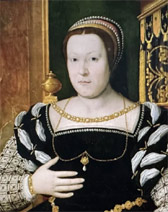
Catherine de' Medici
The Renaissance queen who struggled to preserve the French monarchy through dynastic politics, religious civil war and the reigns of three of her sons
Born on April 13, 1519
Died on January 5, 1589
Age at death: 70
Profession: Queen Consort of France, Queen Mother, Political Ruler
Place of Birth: Florence, Republic of Florence
Place of Death: Blois, France
Catherine de' Medici was an Italian-born Queen of France, regent and one of the most influential political figures of sixteenth-century Europe. Through her marriage to Henry II of France, she entered the House of Valois and became Queen of France in 1547. After her husband's death, Catherine de' Medici exercised extraordinary influence during the reigns of three of her sons—Francis II of France, Charles IX of France and Henry III of France. Her political career was dominated by the French Wars of Religion, the violent struggle between Catholics and Protestant Huguenots that threatened to destroy royal authority. She attempted conciliation, dynastic marriages, negotiation and shifting alliances to preserve the monarchy, but her reputation became permanently associated with the 1572 St. Bartholomew's Day Massacre. Later historical interpretations have treated her role in the massacre, and her political career more broadly, as considerably more complex than the image of the ruthless “Italian queen” created by hostile contemporary propaganda.
Early Life and the Medici Family
Catherine de' Medici was born on April 13, 1519, in Florence, then the capital of the Republic of Florence. Her father, Lorenzo de' Medici, Duke of Urbino, belonged to the extraordinarily powerful Medici family, while her mother, Madeleine de La Tour d'Auvergne, came from a prominent French noble house.
Both parents died within weeks of Catherine's birth. Her mother died shortly after giving birth, and her father followed soon afterward, leaving the infant Catherine an orphan and an exceptionally valuable dynastic heiress.
The Medici were not originally a royal dynasty. Their power had developed through banking, commerce, patronage and the political domination of Florence. By Catherine's lifetime, however, the family had established connections extending across European politics and the Roman Catholic Church. Her relatives included Pope Leo X and Pope Clement VII.
Catherine de' Medici spent her childhood under the protection of relatives in Florence and Rome. Her early years were nevertheless politically dangerous. During the anti-Medici uprising in Florence, she was confined in convents while the city became a battleground between supporters and opponents of her family.
Growing up amid political upheaval exposed Catherine at an unusually young age to a world in which wealth, family alliances and political authority could disappear rapidly. Survival depended on negotiation, dynastic loyalty and the ability to adapt when power changed hands.
Marriage to Henry of Orléans
On October 28, 1533, at the age of fourteen, Catherine de' Medici married Henry, Duke of Orléans, the second son of Francis I of France, in Marseille. The marriage was arranged as part of the diplomatic relationship between the French monarchy and the Medici interests represented by Pope Clement VII.
At the time of the wedding, Henry was not expected to inherit the French crown. That changed dramatically when his elder brother, Francis, Dauphin of France, died in 1536. Henry became Dauphin, making Catherine the wife of the heir to the throne.
When Francis I of France died in 1547, Catherine's husband became Henry II of France, and Catherine de' Medici became Queen Consort of France.
Infertility Crisis and the Birth of Her Children
The first decade of the marriage placed Catherine de' Medici in an extremely vulnerable position because she failed to produce an heir. In a monarchy dependent on dynastic succession, prolonged childlessness could provide grounds for attempting to end a politically important marriage.
Her position changed after she gave birth to her first surviving son, the future Francis II of France, in 1544. Catherine subsequently experienced numerous pregnancies and ultimately gave birth to ten children.
Three of her sons—Francis II of France, Charles IX of France and Henry III of France—would become kings of France. Her daughters also became important instruments of dynastic diplomacy, particularly Elisabeth of Valois, who married Philip II of Spain, and Margaret of Valois, who married Henry of Navarre, the future Henry IV of France.
Diane de Poitiers
Despite Catherine de' Medici's position as queen, Henry II of France maintained a powerful relationship with his older mistress Diane de Poitiers. Diane was far more than a romantic companion. She became an influential figure at court and received valuable estates, jewels and royal favors.
Catherine was therefore forced to tolerate the presence of a woman who enjoyed considerable influence over her husband. During Henry's reign, Catherine's direct political authority remained limited despite her position as queen and mother of the royal children.
The relationship created one of the most famous rivalries in French royal history. Catherine understood that openly attacking Diane while Henry lived would endanger her own position, and she generally acted with restraint.
After Henry II of France died, however, Catherine rapidly recovered properties associated with the crown. Most famously, Diane de Poitiers surrendered Château de Chenonceau, which subsequently became closely associated with Catherine. Even then, Catherine did not attempt to destroy Diane physically or subject her to the extreme revenge later popular legends sometimes suggested.
Death of Henry II
In 1559, Henry II of France participated in a jousting tournament held during celebrations connected with royal marriages and diplomatic agreements. During the tournament, he faced Gabriel de Montgomery, captain of the Scottish Guard.
Montgomery's lance shattered, and fragments penetrated Henry's helmet and entered around his eye. The king survived for several days while physicians attempted to treat the catastrophic injury, but he died on July 10, 1559.
The death transformed Catherine de' Medici's life. The queen who had previously existed partly in the shadow of her husband and Diane de Poitiers became Queen Mother at the center of the monarchy.
Catherine adopted black mourning clothes and continued wearing them for the remainder of her life. She also used the broken lance as a personal emblem associated with her grief.
Francis II and Mary, Queen of Scots
Henry was succeeded by Catherine's fifteen-year-old son Francis II of France. The young king was married to Mary, Queen of Scots, whose powerful maternal relatives belonged to the House of Guise.
Francis, Duke of Guise and his brother Charles, Cardinal of Lorraine consequently gained enormous influence at court. Their strongly Catholic political position alarmed rival noble families, especially members of the Protestant-connected House of Bourbon.
Catherine de' Medici did not yet exercise the dominance she would achieve during the next reign, but the political and religious conflicts that would define the rest of her life were already becoming visible.
Francis II of France died in December 1560 at the age of sixteen. His younger brother Charles IX of France succeeded him. Because Charles was only ten years old, Catherine assumed the regency and became the central political authority of the French monarchy.
Regency and the Search for Religious Compromise
As regent, Catherine de' Medici inherited a kingdom facing a dangerous combination of religious division, aristocratic rivalry, financial weakness and declining royal authority.
The Protestant Reformation had established a significant following in France. French Protestants, generally known as Huguenots, included members of powerful noble families. At the same time, militant Catholic nobles—particularly the House of Guise—were determined to prevent Protestantism from gaining legal or political legitimacy.
Catherine initially pursued a comparatively conciliatory strategy. Rather than seeking the complete destruction of one religious faction, she attempted to establish a political settlement that would allow the monarchy to remain above the conflict.
The Colloquy of Poissy in 1561 brought Catholic and Protestant representatives together in an attempt to reach theological accommodation. The conference failed because fundamental doctrinal disagreements could not be resolved.
In January 1562, Catherine's government issued the Edict of Saint-Germain, granting Huguenots limited rights to worship under specified conditions. Militant Catholics considered the policy dangerously permissive, while many Protestants considered it inadequate.
The Massacre of Vassy and the French Wars of Religion
In March 1562, followers of Francis, Duke of Guise attacked Huguenots worshipping at Vassy. The resulting Massacre of Vassy became a major trigger for the first of the French Wars of Religion.
France descended into a series of conflicts that would continue intermittently for more than three decades. Religious conviction was only one dimension of these wars. Rival aristocratic houses competed for control of the crown, while foreign powers supported factions that served their own strategic interests.
The House of Guise emerged as the dominant aristocratic force on the militant Catholic side. Protestant political leadership increasingly became associated with figures including Louis, Prince of Condé, Gaspard de Coligny and the House of Bourbon.
Catherine de' Medici's policies shifted repeatedly as the military and political balance changed. To later critics, these changes appeared deceitful and opportunistic. From Catherine's perspective, however, maintaining the House of Valois and preventing any single noble faction from controlling the monarchy remained the overriding priority.
The Royal Progress Through France
Between 1564 and 1566, Catherine de' Medici accompanied Charles IX of France and the royal court on an enormous journey through the kingdom. The royal progress covered thousands of kilometers and lasted more than two years.
Its purpose was profoundly political. After years of civil conflict, Catherine wanted subjects across France to see their monarch personally. Royal ceremonies, audiences and public appearances were intended to reassert the symbolic presence of the crown in provinces where its authority had weakened.
Catherine met local officials, nobles, clergy and diplomatic representatives throughout the journey. The progress demonstrated her sophisticated understanding of monarchy as both a political institution and a public performance.
Charles IX and Gaspard de Coligny
As Charles IX of France matured, the relationship between the king, his mother and Huguenot leader Gaspard de Coligny became increasingly important. Coligny gained influence with Charles and advocated a foreign policy that would involve France in conflict against Spain in the Netherlands.
Such a policy threatened Catherine's carefully constructed diplomatic balance and risked drawing a kingdom already damaged by civil war into a major international conflict.
The increasing proximity of Coligny to the king became part of the atmosphere of suspicion that preceded the catastrophe of 1572.
Margaret of Valois and Henry of Navarre
Seeking another dynastic solution to religious division, Catherine de' Medici helped arrange the marriage of her Catholic daughter Margaret of Valois to the Protestant Henry of Navarre, a leading Bourbon prince.
The marriage took place in Paris in August 1572. Because Henry was one of the most important Protestant nobles in France, large numbers of Huguenot aristocrats traveled to the predominantly Catholic capital for the celebrations.
The union was intended to symbolize reconciliation. Instead, it became the immediate prelude to one of the bloodiest episodes in French history.
Attempted Assassination of Gaspard de Coligny
Only days after the wedding, Gaspard de Coligny was shot and wounded in an assassination attempt. The attack immediately increased tensions between Huguenot nobles and the royal court.
Protestant leaders demanded justice, while members of the royal government feared retaliation or an uprising by the armed Huguenot nobility gathered in Paris.
The identity of those ultimately responsible for organizing the attempt has remained the subject of historical debate. Catherine has frequently been accused of arranging it, but the surviving evidence does not provide a simple, universally accepted answer.
St. Bartholomew's Day Massacre
During the night of August 23–24, 1572, royal forces moved against leading Huguenots in Paris. Gaspard de Coligny was murdered, and other Protestant nobles were killed.
The targeted operation rapidly expanded into widespread communal violence. Catholic crowds attacked Protestants throughout Paris. The killings subsequently spread into provincial cities, producing thousands of deaths across France.
The St. Bartholomew's Day Massacre became the event most responsible for Catherine de' Medici's later reputation as a ruthless and murderous political operator.
Her exact responsibility remains historically controversial. Catherine and members of the royal council appear to have supported a decision to eliminate certain Huguenot leaders after the attack on Coligny and amid fears of Protestant retaliation. This is different, however, from demonstrating that Catherine had planned in advance the much broader massacre of ordinary Protestants that followed.
Once violence spread through Paris, it exceeded the scope of a limited political killing. The question of how much of the subsequent mass violence was ordered, anticipated or simply allowed to continue has remained central to historical debate.
The massacre nevertheless represented a catastrophic failure of Catherine's previous strategy of controlled religious coexistence. Whatever the precise chain of responsibility, the monarchy became inseparably associated with the killings.
The “Black Legend” and the Serpent Queen
After 1572, Protestant polemicists increasingly depicted Catherine de' Medici as a foreign Italian poisoner who manipulated her sons and eliminated enemies through assassination, magic and deception.
Her Italian ancestry made such accusations particularly effective in an age already influenced by stereotypes about Italian court politics. Her gender further intensified hostility toward a woman exercising political authority in a deeply patriarchal political culture.
Stories accumulated around Catherine involving poisoned gloves, secret trapdoors, professional assassins, black magic and elaborate conspiracies. Some incidents associated with her were unquestionably violent political actions, but many sensational stories cannot be substantiated by contemporary evidence.
The later nickname “Serpent Queen” reflects this enduring cultural image more than an official title used during her lifetime. The same mythology provided the foundation for modern fictional treatments, including the television series The Serpent Queen.
Death of Charles IX
Charles IX of France became increasingly ill during the years following the massacre and died on May 30, 1574, at the age of twenty-three.
Because he left no legitimate male heir, the crown passed to his brother Henry III of France, who had recently been elected king of the Polish-Lithuanian Commonwealth. Henry abandoned his Polish throne and returned to France.
During the transition, Catherine de' Medici once again played an essential role in maintaining royal government. Yet Henry III was an adult king, and Catherine's formal authority was consequently more limited than it had been during Charles IX's minority.
Henry III and Catherine's Continuing Political Influence
Although Henry III of France created his own circle of advisers and favorites, he continued to rely extensively on his mother's political experience. Catherine de' Medici remained active as a negotiator, diplomat and representative of royal authority.
She repeatedly traveled despite advancing age and deteriorating health. Her missions required negotiations with rebellious nobles, Protestant leaders, Catholic factions and members of her own family.
One persistent difficulty involved her youngest surviving son, Francis, Duke of Anjou, whose ambitions repeatedly destabilized the monarchy. Catherine attempted to mediate between him and Henry III while simultaneously exploring international marriage and diplomatic opportunities for Francis.
His death in 1584 dramatically changed the dynastic situation. Because Henry III of France had no children, the Protestant Henry of Navarre became the presumptive heir to the French throne under hereditary succession principles.
The Catholic League and Dynastic Crisis
The possibility that a Protestant could inherit the throne was unacceptable to the militant Catholic League. Its leading figure, Henry I, Duke of Guise, consequently became one of the most powerful men in France.
The conflict was no longer simply between Catholics and Protestants. It had become a struggle over the survival and independence of royal government itself.
In May 1588, the Day of the Barricades transformed Paris into open rebellion against Henry III of France. The king was forced to flee the capital while Guise's popularity demonstrated how severely Valois authority had deteriorated.
For Catherine de' Medici, now approaching seventy, the crisis represented the collapse of the political balance she had spent decades attempting to preserve.
Assassination of the Duke of Guise
In December 1588, Henry III of France ordered the assassination of Henry I, Duke of Guise at the Château de Blois. Guise's brother Louis II, Cardinal of Guise was killed shortly afterward.
There is no conclusive evidence that Catherine de' Medici had been fully informed beforehand of her son's plan. The killings destroyed any remaining possibility of reconciliation between the king and the Catholic League.
Catherine was already gravely ill. The political system she had attempted to sustain through compromise, marriage, negotiation and sometimes ruthless intervention was disintegrating around her.
Death
Catherine de' Medici died at Blois, France, on January 5, 1589. She was 69 years old, several months short of her seventieth birthday. Her final illness is generally associated with pleurisy or a serious respiratory infection.
Her death came at an extraordinary moment in the dynastic crisis. Approximately seven months later, Henry III of France was assassinated by the Dominican friar Jacques Clément. With Henry's death, the male line of the House of Valois came to an end.
The crown passed to Catherine's son-in-law Henry of Navarre, who eventually secured the throne as Henry IV of France, establishing the House of Bourbon as France's ruling dynasty.
Catherine was initially buried at Blois because political disorder made transportation to Paris difficult. Her remains were later transferred to the royal necropolis at the Basilica of Saint-Denis, where she had commissioned an elaborate tomb for herself and Henry II of France.
Patronage of Renaissance Art
Politics and warfare occupied much of Catherine de' Medici's adult life, but she was also one of the major royal patrons of the French Renaissance. She understood art, architecture and spectacle as instruments through which monarchy could communicate wealth, continuity and political authority.
Her patronage extended across architecture, painting, sculpture, tapestry, portraiture, music, poetry and theatrical entertainment. The enormous festivals organized under her direction combined temporary architecture, elaborate costumes, music, dance and mythological symbolism.
These spectacles were not simply entertainment. They presented the royal family as the center of political order at a time when religious conflict was threatening to fragment the kingdom.
Château de Chenonceau
After the death of Henry II of France, Catherine de' Medici gained control of Château de Chenonceau, previously occupied by Diane de Poitiers.
Catherine transformed the château into one of the most celebrated royal residences of the period. She expanded its gardens and commissioned the great gallery extending across the River Cher, helping create the architectural form for which Chenonceau remains famous.
The château also became a setting for spectacular court entertainments, diplomatic receptions and political gatherings.
The Tuileries Palace and Hôtel de la Reine
In Paris, Catherine de' Medici commissioned the construction of the Tuileries Palace beginning in the 1560s. The project reflected her ambition to establish a modern royal residence near the Louvre.
She later abandoned the Tuileries as her principal Parisian project and developed the Hôtel de la Reine, also known in later periods as the Hôtel de Soissons.
Catherine's architectural projects were extraordinarily expensive, particularly for a monarchy struggling with the financial consequences of civil war. Yet they demonstrate the scale of her conception of kingship: architecture was a political language through which dynastic authority could be made visible.
The Valois Chapel
One of Catherine de' Medici's most ambitious artistic projects was the funerary complex she commissioned at the Basilica of Saint-Denis for herself, Henry II of France and the House of Valois.
The project included monumental sculpture and architecture intended to preserve the dynasty's memory. Among the artists associated with Catherine's royal tomb projects was the sculptor Germain Pilon, one of the leading figures of French Renaissance sculpture.
The enormous expenditure Catherine devoted to funerary monuments reveals both her attachment to Henry II and her preoccupation with dynastic continuity during a period when the survival of the Valois line was becoming increasingly uncertain.
Court Festivals, Dance and the Development of Ballet
Catherine de' Medici became famous for elaborate court festivals that integrated dance, poetry, music, painting, costume and theatrical spectacle. These entertainments were often organized around royal marriages, diplomatic visits or political reconciliations.
The Ballet Comique de la Reine of 1581, created for festivities surrounding a court marriage and associated particularly with Balthasar de Beaujoyeulx, is frequently discussed as an important milestone in the development of court ballet.
It would be misleading to credit Catherine personally with “inventing ballet,” but the artistic environment she cultivated contributed substantially to the development of the French court spectacle from which later ballet traditions emerged.
Nostradamus and Astrology
Catherine de' Medici had a well-documented interest in astrology and prediction, practices that occupied a more respectable place in Renaissance elite culture than they would in later centuries.
She became associated with the celebrated astrologer and physician Nostradamus, whose prophecies attracted attention throughout Europe. Catherine summoned him to court and reportedly consulted him concerning the future of the royal family.
Her interest in astrologers later became incorporated into the darker mythology surrounding her. Writers transformed a fairly conventional Renaissance fascination with astrology into stories involving sorcery, black magic and secret rituals.
Many of the most sensational tales concerning poisoned gloves, magical chambers and professional poisoners belong more securely to Catherine's later legend than to verifiable historical evidence.
Catherine de' Medici and French Cuisine
One of the most persistent legends about Catherine de' Medici claims that she revolutionized French cuisine by bringing Italian chefs, pastry-making techniques and table customs from Florence to France. She is also frequently credited with introducing the fork to the French court.
The historical reality is considerably more complicated. Cultural exchanges between Italy and France were already extensive before Catherine's marriage, and forks were known in Europe before her arrival. Modern food historians therefore treat sweeping claims that Catherine personally “created French cuisine” with considerable skepticism.
Her marriage and large Italian-French court nevertheless formed part of a wider Renaissance exchange of culinary fashions, luxury goods and court customs. The enduring culinary legend surrounding her illustrates how strongly Catherine became associated with the transmission of Italian Renaissance culture into France.
Perfume, Fashion and Italian Court Culture
Catherine de' Medici has similarly been credited in popular accounts with transforming French perfume and fashion. Italian luxury culture undoubtedly exercised substantial influence in sixteenth-century France, and Catherine's court participated in the circulation of perfumes, textiles, jewelry and elaborate clothing.
However, claims that she single-handedly transferred the perfume industry from Venice or created France as a perfume center substantially simplify a much broader commercial and cultural process. Her historical importance lies more convincingly in her role as a major consumer and patron within the interconnected luxury culture of Renaissance Europe.
Historical Reputation
Few European queens have experienced a more dramatic transformation of reputation than Catherine de' Medici. For centuries, she was portrayed as an archetypal schemer: manipulative, vindictive, obsessed with astrology and willing to use assassination or poison whenever diplomacy failed.
Some of that reputation emerged directly from the genuine violence of her political world. Catherine was not a passive observer of the French Wars of Religion. She participated in difficult decisions, sanctioned coercive policies and operated within a political culture in which imprisonment, execution and political killing were realities of government.
Yet the traditional caricature also developed from Protestant propaganda, anti-Italian prejudice, hostility toward the Medici and contemporary discomfort with female political power. Her responsibility for the St. Bartholomew's Day Massacre remains central to any assessment of her career, but reducing more than three decades of political activity to a single narrative of calculated cruelty obscures the complexity of her position.
Modern historical interpretations increasingly emphasize the almost impossible political conditions she confronted. The monarchy was financially weak; aristocratic families maintained private military power; religious divisions had become existential; foreign monarchies intervened in French affairs; and Catherine's own sons frequently lacked either the age, health or political strength required to dominate the kingdom independently.
Catherine de' Medici consequently remains a deeply controversial figure: a ruler capable of conciliation and brutality, a determined defender of dynastic monarchy, an important Renaissance patron and a political survivor whose attempts to preserve the House of Valois ultimately could not prevent its extinction.
Marriage
1533–1559 – Henry II of France – Marriage continued until his death on July 10, 1559Children
1544–1560 – Francis II of France – King of France; married Mary, Queen of Scots1545–1568 – Elisabeth of Valois – Queen of Spain through her marriage to Philip II of Spain
1547–1575 – Claude of France – Married Charles III, Duke of Lorraine
1549–1550 – Louis, Duke of Orléans – Died in infancy
1550–1574 – Charles IX of France – King of France
1551–1589 – Henry III of France – King of Poland and later King of France
1553–1615 – Margaret of Valois – Married Henry of Navarre, later Henry IV of France
1555–1584 – Francis, Duke of Anjou – Youngest surviving son and an important dynastic figure
1556 – Victoria of Valois – Died in infancy
1556 – Joan of Valois – Died shortly after birth
Important Dates in Her Life
1519 – Catherine de' Medici was born in Florence1533 – Married Henry, Duke of Orléans, the future Henry II of France
1544 – Gave birth to her first surviving son, Francis II of France
1547 – Became Queen Consort when Henry II of France inherited the French throne
1559 – Henry II of France died after being injured in a jousting tournament
1559 – Francis II of France became king
1560 – Francis II of France died and Charles IX of France inherited the throne
1560 – Catherine de' Medici became regent for the young Charles IX of France
1561 – Sponsored the Colloquy of Poissy in an attempt to reduce religious conflict
1562 – The Edict of Saint-Germain granted limited toleration to Huguenots
1562 – The Massacre of Vassy helped trigger the French Wars of Religion
1564–1566 – Accompanied Charles IX of France on the great royal progress through France
1572 – Arranged the marriage of Margaret of Valois and Henry of Navarre
1572 – The St. Bartholomew's Day Massacre began in Paris
1574 – Charles IX of France died
1574 – Henry III of France succeeded to the French throne
1584 – Francis, Duke of Anjou died, creating a major succession crisis
1588 – The Day of the Barricades forced Henry III of France to flee Paris
1588 – Henry I, Duke of Guise was assassinated on the orders of Henry III of France
1589 – Catherine de' Medici died at Blois on January 5
1589 – Henry III of France was assassinated seven months later, ending the male line of the House of Valois
Source: Biyografiler.com
Frequently asked questions about Catherine de' Medici
Who is Catherine de' Medici?, Catherine de' Medici biography, Catherine de' Medici life story, Catherine de' Medici age, Catherine de' Medici facts, Catherine de' Medici birthplace, Catherine de' Medici photos, Catherine de' Medici videos, Catherine de' Medici career

Lamine Yamal
Professional footballer

Erling Haaland
Professional footballer

Kylian Mbappe
Professional footballer

Sam Altman
Entrepreneur, Investor, CEO

Giorgia Meloni
Politician, Journalist

Khabib Nurmagomedov
Professional Boxer

Andrew Lincoln
Actor, Producer

Catherine de' Medici
Queen Consort of France, Queen Mother, Political Ruler

Harold Lloyd
Actor, Comedian, Film Producer, Director

Brian Cox
Actor, Director

Vince Vaughn
Actor, Producer, Screenwriter

Peter O'Toole
Actor
Lamine Yamal
Professional footballer

J.K. Rowling
Novelist, Screenwriter
Andrew Lincoln
Actor, Producer
Giorgia Meloni
Politician, Journalist

Andrew Wilson
Actor, Film Director, Producer
Sam Altman
Entrepreneur, Investor, CEO