
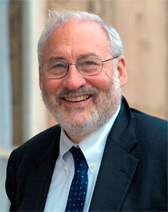
Joseph Stiglitz
American economist who received the 2001 Nobel Memorial Prize in Economic Sciences for his research on markets with asymmetric information.
Born on February 9, 1943
Age: 83
Profession: Economist, Author
Place of Birth: Gary, Indiana, United States
Joseph Stiglitz, full name Joseph Eugene Stiglitz, was born on February 9, 1943, in Gary, Indiana, United States. He is an American economist, professor, and author who received the 2001 Nobel Memorial Prize in Economic Sciences for his research on markets with asymmetric information. He served as Chairman of the United States Council of Economic Advisers from 1995 to 1997 and as Chief Economist and Senior Vice President of the World Bank from 1997 to 2000. He is a professor at Columbia University and is known for his research on market failures, globalization, economic inequality, and development economics.
Early Life and Education
Joseph Stiglitz was born on February 9, 1943, in Gary, Indiana, to a Jewish family. His father, Nathaniel Stiglitz, worked in the insurance business, while his mother, Charlotte Stiglitz, was a schoolteacher.
Between 1960 and 1963, he studied at Amherst College in Massachusetts. During his undergraduate studies, he developed an interest in economics, mathematics, and public policy. He subsequently transferred to the Massachusetts Institute of Technology (MIT), where he continued his economics education.
He conducted research at the University of Chicago during the 1965–1966 academic year and completed his doctorate in economics at MIT in 1967.
Academic Career
Joseph Stiglitz began his academic career at MIT. Between 1969 and 1970, he conducted research at the University of Cambridge in England with support from a Fulbright research fellowship.
He became a full professor at Yale University in 1970 and subsequently held academic positions at Stanford University, University of Oxford, and Princeton University. He also taught at MIT.
In 2001, he joined Columbia University in New York. In 2003, he was appointed University Professor, the university's highest academic rank.
Stiglitz has contributed to microeconomics, public finance, development economics, and economic theory. He also served as an editor of The Economists' Voice, an economics publication founded with J. Bradford DeLong and Aaron Edlin.
Economic Research and the Nobel Prize
Joseph Stiglitz is known for his research on asymmetric information, a situation in which one party to an economic transaction possesses more or better information than another.
His work examined how information differences affect markets, financial institutions, employment, lending, and insurance. His research helped explain why markets do not always produce efficient outcomes, even when individuals and businesses act in their own interests.
In 1979, he received the John Bates Clark Medal from the American Economic Association for his contributions to economic theory.
In 2001, he shared the Nobel Memorial Prize in Economic Sciences with economists George Akerlof and Michael Spence. The prize recognized their analyses of markets with asymmetric information.
Economic Adviser to President Bill Clinton
Joseph Stiglitz joined the United States Council of Economic Advisers in 1993 during the presidency of Bill Clinton. He became Chairman of the Council in 1995 and held the position until 1997.
During this period, he advised the administration on economic policy, public finance, employment, and market regulation.
In 1997, he was appointed Chief Economist and Senior Vice President of the World Bank, where he served until 2000.
His work at the World Bank focused on development economics, financial crises, and economic policies in developing countries. He publicly criticized several policies promoted by the International Monetary Fund (IMF), particularly those adopted during the Asian financial crisis of 1997.
Globalization and Economic Policy
Joseph Stiglitz has written extensively about globalization, international financial institutions, poverty, and economic inequality.
In his 2002 book Globalization and Its Discontents, published in Turkish as Küreselleşme: Büyük Hayal Kırıklığı, he criticized the policies of the International Monetary Fund and examined the consequences of economic liberalization for developing countries.
He continued discussing these subjects in Making Globalization Work (2006), The Price of Inequality (2012), and The Great Divide (2015).
In 2000, he founded the Initiative for Policy Dialogue (IPD), a research organization based at Columbia University that examines economic development and international policy. He has served as its co-president.
He has also held positions at the Brooks World Poverty Institute at the University of Manchester and the Roosevelt Institute. In 2024, he was named an honorary member of the Pontifical Academy of Social Sciences.
Visit to Turkey
In August 2001, Joseph Stiglitz visited Turkey during the country's economic crisis.
At Istanbul Bilgi University, he attended a meeting with State Minister for the Economy Kemal Derviş and Turkish economists, including Asaf Savaş Akat, Gülten Kazgan, and Burhan Şenatalar.
During the meeting, participants discussed Turkey's economic program and the policies of the International Monetary Fund.
Personal Life
Joseph Stiglitz was first married to Adria Wisner. The marriage ended in divorce.
He subsequently married Jane Hannaway; their marriage also ended in divorce. On October 28, 2004, he married Anya Schiffrin, a journalist and academic associated with Columbia University's School of International and Public Affairs.
Stiglitz has four children: Siobhan, Michael, Edward, and Julia.
Selected Books and Publications
1969 - Readings in the Modern Theory of Economic Growth (with Hirofumi Uzawa)1980 - Lectures on Public Economics (with Anthony B. Atkinson)
1981 - The Theory of Commodity Price Stabilization (with David M. G. Newbery)
1988 - Economics of the Public Sector
1992 - Peasants versus City-Dwellers: Taxation and the Burden of Economic Development (with Raaj Kumar Sah)
1994 - Whither Socialism?
2000 - Frontiers of Development Economics: The Future in Perspective (with Gerald M. Meier, Editor)
2001 - Joseph Stiglitz and the World Bank: The Rebel Within (edited by Ha-Joon Chang)
2002 - Globalization and Its Discontents (Küreselleşme: Büyük Hayal Kırıklığı)
2002 - Economics (with Carl E. Walsh)
2002 - Principles of Macroeconomics (with Carl E. Walsh)
2003 - The Roaring Nineties (90'ların Yükselişi)
2003 - Towards a New Paradigm in Monetary Economics (with Bruce Greenwald)
2005 - Fair Trade for All: How Trade Can Promote Development (with Andrew Charlton)
2006 - Making Globalization Work
2006 - Stability with Growth: Macroeconomics, Liberalization and Development (with José Antonio Ocampo and others)
2010 - Freefall: America, Free Markets, and the Sinking of the World Economy
2012 - The Price of Inequality
2015 - The Great Divide: Unequal Societies and What We Can Do About Them
2016 - The Euro: How a Common Currency Threatens the Future of Europe
2017 - Globalization and Its Discontents Revisited
2019 - People, Power, and Profits
2024 - The Road to Freedom: Economics and the Good Society
Major Awards
1979 - John Bates Clark Medal (American Economic Association)2001 - Nobel Memorial Prize in Economic Sciences (with George Akerlof and Michael Spence)
Source: Biyografiler.com
Frequently asked questions about Joseph Stiglitz
Who is Joseph Stiglitz?, Joseph Stiglitz biography, Joseph Stiglitz life story, Joseph Stiglitz age, Joseph Stiglitz facts, Joseph Stiglitz birthplace, Joseph Stiglitz photos, Joseph Stiglitz videos, Joseph Stiglitz career
Related Biographies

Lamine Yamal
Professional footballer

Kylian Mbappe
Professional footballer

Keanu Reeves
Actor

Erling Haaland
Professional footballer

Brad Pitt
Actor

Bad Bunny
Rapper, Songwriter

Julian Assange
Activist, Computer Programmer

Jose Tolentino de Mendonça
Religious Leader, Priest

Joseph Stiglitz
Economist, Author

Jose Raul Mulino
President, Politician, Lawyer


Joseph Gordon Levitt
Actor, Director, Producer

David Yates
Film Director, Film Producer

Sofia Coppola
Film Director, Screenwriter

Jensen Huang
Entrepreneur, CEO

Gadi Eisenkot
Politician, Military Commander

Susie Wiles
Political Consultant
Brad Pitt
Actor