
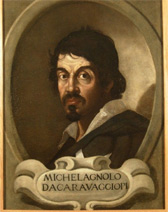
Caravaggio
The Pioneer of Baroque Realism and Master of Chiaroscuro
Born on September 29, 1571
Died on July 18, 1610
Age at death: 39
Profession: Painter
Place of Birth: Milan, Duchy of Milan, Italy
Place of Death: Porto Ercole, Tuscany, Italy
Caravaggio, whose real name was Michelangelo Merisi (also known as Michelangelo Amerighi), is regarded as the first great artist of the Baroque movement and one of the most revolutionary painters in the history of Western art. His works profoundly influenced generations of artists who followed him, introducing an unprecedented realism and a dramatic use of light and shadow that transformed European painting.
Caravaggio was born on September 29, 1571, in Milan. He became known by the name of the town of Caravaggio, near Milan in Lombardy, where his family had roots. His father, Fermo Merisi, worked as an architect and decorator for Francesco Sforza, the Marquess of Caravaggio. His mother, Lucia Aratori, came from a family of minor nobility. During a plague outbreak in Milan, the family relocated to Caravaggio, but when Caravaggio was only eleven years old, his father died, leaving a lasting mark on his early life.
Caravaggio began life as a laborer and taught himself how to paint without formal instruction. At the age of twelve, he entered the workshop of Simone Peterzano in Milan, a student of Titian, where he trained as an apprentice between 1584 and 1588. During this period, he absorbed the Lombard tradition of painting, influenced by artists such as Lorenzo Lotto, Leonardo da Vinci, and Girolamo Savoldo. This tradition emphasized scenes from everyday life, strong contrasts of light and shadow, and a sober, realistic depiction of figures—elements that would later define Caravaggio’s distinctive style.
In 1588, Caravaggio traveled to Rome, where he worked for the Knight of Arpino. Between 1590 and 1599, he contributed to the decoration of the Saint Matthew Chapel in the French church of Saint Louis des Français. He later worked in the churches of Santa Maria del Popolo and Sant’Agostino. Known for his volatile temper, his life in Rome was marked by frequent conflicts and legal troubles.
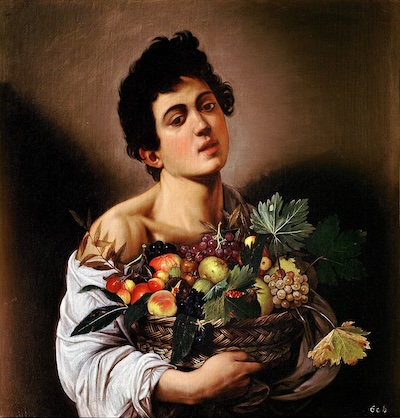
One of his early Roman works, Boy with a Basket of Fruit, painted in the autumn of 1592, belongs to a period when Caravaggio was still relatively unknown. The model was his sixteen-year-old friend Mario Minniti, who would later pose for many of his paintings. The composition features a young man offering a basket filled with grapes, apples, pears, apricots, figs, and pomegranates. Executed using the so-called “cellar light” technique, the painting is built upon sharp contrasts of illuminated and shadowed areas.
Caravaggio was forced to leave Milan for Rome due to accusations related to violence, possibly even murder. From his youth onward, he was known for his aggressive and erratic personality, which intensified as he aged and faced increasing professional difficulties. His early years in Rome were unstable; he changed residences constantly and lived among impoverished painters, sculptors, and stone carvers from Milan. He initially worked for an obscure artist named Lorenzo Siciliano, and later for the priest Pandolfo Pucci, copying religious paintings in exchange for food and shelter.
After falling gravely ill and spending six months recovering, Caravaggio painted his first known self-portrait, Sick Bacchus. Although he was suffering from a serious leg injury at the time, he concealed the wounded limb while projecting his physical pain and melancholy onto the figure’s face. Art historians generally agree that this introspective work represents the artist himself, merging his identity with that of Bacchus, or alternatively Christ.
In The Cardsharps, Caravaggio depicted two young men seated at a gaming table who are, in fact, the same individual shown with opposing personalities. One cheats by secretly pulling a card from behind his belt, while an accomplice signals the card values with his fingers. The worn gloves worn by the figures serve not as symbols of poverty, but as tools to sense marked cards. More than thirty copies of this painting exist.
During this period, Caravaggio developed a compositional style in which realistically rendered human figures dominate the foreground. He painted ordinary people—laborers, the poor, prostitutes—without idealization, portraying their clothing, facial expressions, and bodies with uncompromising honesty. The melancholic atmosphere that permeates these works would deepen as his life progressed.
His painting The Incredulity of Saint Thomas dates to 1601 and exemplifies his intense realism and dramatic lighting.
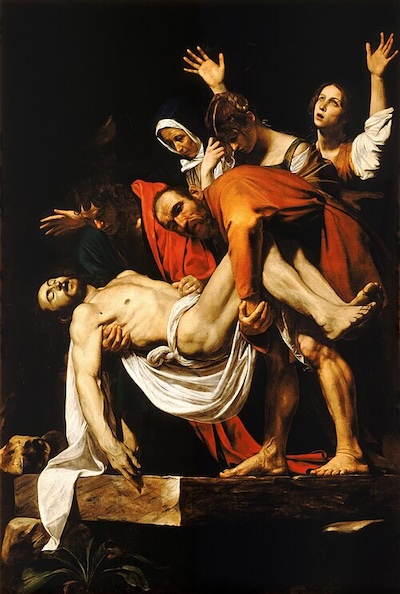
Among his most celebrated masterpieces is The Entombment of Christ, housed in the Vatican Museums. Other major works include The Gypsy Fortune Teller in the Louvre, Madonna of the Rosary in Vienna’s Belvedere Museum, Cupid in Berlin, and Bacchus in the Uffizi Gallery. Caravaggio is widely regarded as a forerunner of modern realism in painting.
In 1606, Caravaggio was again embroiled in violence. On May 28, he killed Ranuccio Tomassoni, a local gang leader, during a brawl in Rome. Facing a death sentence, he fled the city and sought refuge with the Colonna family in Naples. He later traveled to Malta, where he painted for Alof de Vignacourt, Grand Master of the Knights of Malta, who was so impressed that he knighted him. This period of calm was brief; following another violent incident, Caravaggio was imprisoned and later escaped, likely with Vignacourt’s assistance.
In 1608, Caravaggio moved to Sicily, producing major works such as The Burial of Saint Lucy, The Raising of Lazarus, and The Adoration of the Shepherds. Paranoid about being pursued by the Knights of Malta, he lived in constant fear. Contemporary accounts describe him as erratic, armed even in his sleep, and prone to destroying his own paintings in fits of rage.
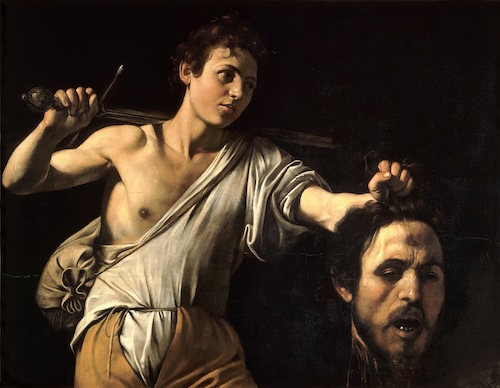
Returning to Naples, he was attacked outside a tavern in 1609 and left for dead. Although he survived, his face was permanently scarred. During this time, he painted Salome with the Head of John the Baptist as an appeal for forgiveness to Vignacourt. In David with the Head of Goliath, the severed head of Goliath is a self-portrait, symbolizing his awareness of his own death sentence and his plea for papal pardon.
His final painting, The Martyrdom of Saint Ursula, reveals a striking stylistic shift. The powerful illumination of his earlier works gives way to subdued, murky tones influenced by Venetian painting. Darkness dominates the canvas, enveloping figures in a somber, ambiguous atmosphere that intensifies the emotional weight of the scene.
In the summer of 1610, hoping for a papal pardon, Caravaggio boarded a ship bound for Rome. He was detained by papal guards at Palo and briefly imprisoned, while the ship carrying his belongings sailed on. Attempting to recover his works, he walked nearly 200 kilometers through marshland to Porto Ercole, where he collapsed and was hospitalized.
Caravaggio died of malaria on July 18, 1610, in Porto Ercole, at the age of thirty-nine. Ten days after his death, the long-awaited official document granting him papal pardon finally arrived.
As a Baroque artist, Caravaggio revolutionized painting through his radical realism, emotional religious imagery, and groundbreaking use of light. By illuminating figures with a single, intense light source against deep darkness, he reshaped visual storytelling and left an enduring legacy that continues to define the language of modern art.
Source: Biyografiler.com
Frequently asked questions about Caravaggio
Who is Caravaggio?, Caravaggio biography, Caravaggio life story, Caravaggio age, Caravaggio facts, Caravaggio birthplace, Caravaggio photos, Caravaggio videos, Caravaggio career
Related Biographies

Lamine Yamal
Professional footballer

Kylian Mbappe
Professional footballer

Sam Altman
Entrepreneur, Investor, CEO

Erling Haaland
Professional footballer

Alice Weidel
Politician, Economist

Giorgia Meloni
Politician, Journalist


Hongjoong
Singer, Rapper, Songwriter, Composer

Ludacris
Rapper, Actor

Kwon Eunbi
Singer

Sarah Wayne Callies
Actress, Screenwriter, Producer, Director

LaTavia Roberson
Singer, Actress, Entrepreneur

John Healey
Politician
Lamine Yamal
Professional footballer

Snoop Dogg
Rapper, Singer, Actor

Austin Abrams
Actor

Florence Pugh
Actress

Eliezer Yudkowsky
Researcher, Writer