
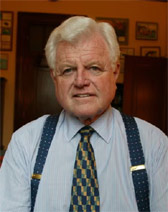
Ted Kennedy
Longest-serving pillar of liberal legislation in modern U.S. Senate history
Born on February 22, 1932
Died on August 25, 2009
Age at death: 77
Profession: Politician
Place of Birth: Dorchester (Boston), Massachusetts, United States
Place of Death: Hyannis Port, Massachusetts, United States
Edward Moore Kennedy, widely known as Ted Kennedy, was one of the most influential and longest-serving senators in the history of the United States. Representing the state of Massachusetts in the United States Senate from 1962 until his death in 2009, he served continuously for 47 years, making him the third-longest-serving senator in American history. In a political family marked by assassination and tragedy, Kennedy’s uninterrupted survival and longevity in public office stood as a notable historical exception.
Early Life and Family Background
Edward Moore Kennedy was born on February 22, 1932, in the Dorchester neighborhood of Boston, Massachusetts. He was the youngest of nine children born to Joseph P. Kennedy Sr. and Rose Fitzgerald Kennedy, members of a prominent Irish Catholic family deeply committed to public service, religious faith, and civic responsibility. These values shaped Kennedy’s worldview and became foundational to his political philosophy.
Kennedy was the younger brother of John F. Kennedy, the 35th President of the United States, and Robert F. Kennedy, both of whom were assassinated during the 1960s. The loss of his brothers profoundly affected Kennedy on both a personal and political level, reinforcing his sense of obligation to continue the family’s public mission while permanently altering the trajectory of his own ambitions.
Entry into the United States Senate
Edward Moore Kennedy entered national politics at an early age. In 1962, at just 30 years old, he won a special election to fill the Massachusetts Senate seat vacated by his brother John F. Kennedy following his election to the presidency. Initially viewed by critics as a beneficiary of political inheritance, Kennedy soon demonstrated legislative seriousness and ideological independence.
During his early Senate years, he aligned himself with progressive causes, supporting civil rights legislation, labor protections, and social welfare initiatives. Over time, his command of legislative detail and procedural mastery transformed him into one of the most powerful lawmakers within the United States Senate.
Personal Crisis and Political Turning Points
In 1964, Edward Moore Kennedy survived a devastating plane crash that killed both the pilot and co-pilot. Kennedy suffered severe injuries and underwent a prolonged recovery. The accident marked a defining physical and psychological trial early in his political career.
In 1969, the Chappaquiddick incident irrevocably altered Kennedy’s public standing. Following a car accident that resulted in the death of Mary Jo Kopechne, Kennedy faced intense scrutiny due to his delayed reporting of the incident. While he retained his Senate seat, the event effectively ended his prospects for the presidency and reshaped his role within American political life.
Despite this, Kennedy challenged incumbent President Jimmy Carter for the Democratic Party presidential nomination in 1980. Although unsuccessful, the campaign reaffirmed his ideological influence within the party and demonstrated his refusal to withdraw from national leadership.
Legislative Achievements and Policy Focus
After abandoning presidential ambitions, Edward Moore Kennedy devoted his career almost entirely to legislative work. Over nearly five decades in the United States Senate, he introduced or co-sponsored more than 2,500 bills, with hundreds becoming law. His legislative priorities included civil rights, healthcare reform, education, immigration policy, minimum wage legislation, voting rights, and protections for individuals with disabilities.
Kennedy frequently described healthcare reform as the central mission of his life. For decades, he advocated universal access to healthcare, laying the intellectual and legislative groundwork for reforms enacted after his death. His persistence earned him respect across party lines and solidified his reputation as a principled yet pragmatic lawmaker.
Foreign Policy and Moral Authority
In foreign affairs, Edward Moore Kennedy was an outspoken critic of U.S. military intervention. He opposed the Vietnam War and later the Iraq War, arguing that both conflicts undermined international stability and moral leadership. His global advocacy extended to human rights, nuclear arms control, global poverty reduction, and the fight against AIDS.
Within the Democratic Party, Kennedy was often described as its moral anchor, frequently referred to as “the conscience of the party.” At the same time, his ability to negotiate bipartisan compromises made him one of the few senators capable of bridging ideological divides. This rare combination earned him the enduring title “The Lion of the Senate.”
Personal Life
Edward Moore Kennedy married Joan Bennett Kennedy on November 29, 1958. The marriage ended in divorce on December 6, 1982. Together, they had three children: Kara Anne Kennedy, Edward Moore Kennedy Jr., and Patrick Joseph Kennedy II.
Despite personal struggles and public controversy, Kennedy remained closely connected to his family and maintained a central role within the broader Kennedy family throughout his life.
Final Years and Death
During the 2004 presidential election, Kennedy supported John Kerry. In the 2008 election cycle, he endorsed Barack Obama early in the Democratic Party primaries, playing a decisive role in legitimizing Obama’s candidacy within the party.
In May 2008, Edward Moore Kennedy was diagnosed with a malignant brain tumor. After approximately fifteen months of treatment, he died on August 25, 2009, at the age of 77.
Legacy
Following his death, the United States Senate renamed the Caucus Room in the Russell Senate Office Building as the Kennedy Caucus Room, jointly honoring Edward Moore Kennedy, Robert F. Kennedy, and John F. Kennedy.
Political Party: Democratic Party
Source: Biyografiler.com
Frequently asked questions about Ted Kennedy
Who is Ted Kennedy?, Ted Kennedy biography, Ted Kennedy life story, Ted Kennedy age, Ted Kennedy facts, Ted Kennedy birthplace, Ted Kennedy photos, Ted Kennedy videos, Ted Kennedy career
Related Biographies

Lamine Yamal
Professional footballer

Sam Altman
Entrepreneur, Investor, CEO

Erling Haaland
Professional footballer

Kylian Mbappe
Professional footballer

Alice Weidel
Politician, Economist

Giorgia Meloni
Politician, Journalist


Hongjoong
Singer, Rapper, Songwriter, Composer

Ludacris
Rapper, Actor

Kwon Eunbi
Singer

Sarah Wayne Callies
Actress, Screenwriter, Producer, Director

LaTavia Roberson
Singer, Actress, Entrepreneur

Sydney Sweeney
Actress

Ursula von der Leyen
Politician, Physician

Kevin Warsh
Economist
Lamine Yamal
Professional footballer

Carl von Clausewitz
Military Commander

Ma Huateng
Entrepreneur, Inventor