
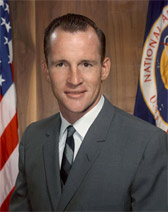
Edward White
First American to walk in space; pioneer of NASA’s early human spaceflight era
Born on November 14, 1930
Died on January 27, 1967
Age at death: 37
Profession: Astronaut
Place of Birth: San Antonio, Texas, United States
Place of Death: Cape Canaveral, Florida, United States
Edward Higgins “Ed” White II was an American astronaut and one of the most emblematic figures of NASA’s early human spaceflight programs. As the first American to perform a spacewalk during the Gemini 4 mission, he became a defining symbol of the United States’ advance in the Space Race. His career, though tragically short, played a foundational role in shaping astronaut training, operational discipline, and safety reforms that ultimately enabled the Apollo Moon landings.
Early Life and Family Background
Edward H. White II was born on November 14, 1930, in San Antonio, Texas, to Mary Rosina White and Edward Higgins White Sr., a career U.S. Air Force officer whose assignments exposed White early on to aviation culture and military structure. Growing up within this environment instilled in him a sense of discipline and purpose that later defined his professional life.
Known among peers for his calm demeanor and moral integrity, White developed a reputation as a principled and deeply focused individual—traits that distinguished him within both the military and NASA astronaut corps.
Education and Military Career
Edward H. White II graduated from the United States Military Academy at West Point in 1952 with a Bachelor of Science degree. After commissioning in the U.S. Air Force, he completed pilot training and was assigned to operational fighter units in Europe during the height of Cold War tensions.
Stationed at Bitburg Air Base in West Germany, White flew F-86 Sabre and F-100 Super Sabre aircraft with the 22nd Fighter Squadron. Seeking advanced technical expertise, he later pursued graduate studies at the University of Michigan, earning a master’s degree in aeronautical engineering in 1958.
His career progressed through the U.S. Air Force Test Pilot School at Edwards Air Force Base, followed by service at Wright-Patterson Air Force Base as a test pilot within the Aeronautical Systems Division. Over the course of his career, he accumulated more than 3,000 flight hours, placing him among the most qualified pilots of his era.
NASA Selection and Astronaut Training
In 1962, Edward H. White II was selected by NASA as part of Astronaut Group 2, widely known as the “Next Nine.” This cohort included astronauts such as James McDivitt, Frank Borman, and Neil Armstrong, and represented NASA’s increasing emphasis on technical proficiency and systems engineering expertise.
Within the astronaut corps, White quickly emerged as a specialist in spacecraft control systems and extravehicular activity planning, contributing to mission procedures that would influence Gemini and Apollo operations alike.
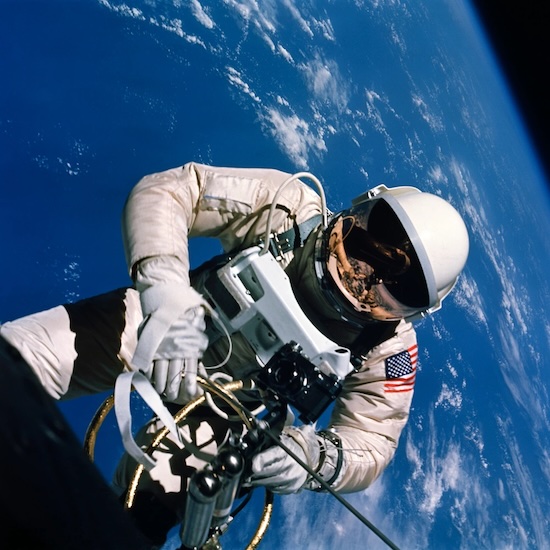
Gemini 4 and America’s First Spacewalk
On June 3, 1965, during the Gemini 4 mission commanded by James McDivitt, Edward H. White II conducted the first extravehicular activity (EVA) performed by an American astronaut. The spacewalk lasted approximately 36 minutes and took place only months after Soviet cosmonaut Aleksey Leonov had completed the world’s first EVA during the Voskhod 2 mission.
Using a handheld maneuvering unit, White propelled himself freely outside the spacecraft, demonstrating controlled human movement in microgravity. The images of White floating above Earth became iconic, marking a symbolic milestone for the United States in its competition with the Soviet space program.
White later recalled the experience as profoundly emotional, famously remarking that being ordered back inside the capsule was “the saddest moment of my life.”
Apollo 1 and Tragic Death
Edward H. White II was later assigned as senior pilot for Apollo 1, NASA’s first planned crewed mission of the Apollo program, alongside commander Virgil “Gus” Grissom and pilot Roger B. Chaffee. The mission was intended to serve as a critical test of the Apollo Command Module in low Earth orbit.
On January 27, 1967, during a pre-launch test at Cape Canaveral, a flash fire erupted inside the pressurized cabin. White, Grissom, and Chaffee were unable to escape, and all three astronauts lost their lives.
The disaster led to sweeping changes in spacecraft design, materials selection, hatch mechanisms, and emergency procedures. These reforms became essential to the later success of Apollo missions, including Apollo 11’s historic Moon landing led by Neil Armstrong.
Personal Life and Faith
Edward H. White II married Patricia Eileen Finegan in 1953 after meeting her at a West Point football game. The couple had two children: Edward Higgins White III, born in 1953, and Bonnie Lynn White, born in 1956.
A devout Methodist, White was known for carrying religious symbols representing multiple faith traditions during his space missions, reflecting his belief in spiritual humility and shared human values beyond national or cultural boundaries.
Awards and Honors
• NASA Distinguished Service Medal
• NASA Exceptional Service Medal
• Congressional Space Medal of Honor (posthumous)
• Air Force Commendation Medal
• U.S. Astronaut Hall of Fame
• International Space Hall of Fame
Legacy and Cultural Impact
The legacy of Edward H. White II remains deeply embedded in American aerospace history. His name has been given to schools, military facilities, parks, and memorials across the United States, often alongside tributes to fellow fallen astronauts such as Virgil “Gus” Grissom and Roger B. Chaffee.
A photograph from his Gemini 4 spacewalk was included on the Voyager Golden Record as one of the images selected to represent humanity to potential extraterrestrial civilizations. In addition, the Omega Speedmaster chronograph approved by NASA for EVA use is widely referred to as the “Ed White” model in his honor.
Source: Biyografiler.com
Frequently asked questions about Edward White
Who is Edward White?, Edward White biography, Edward White life story, Edward White age, Edward White facts, Edward White birthplace, Edward White photos, Edward White videos, Edward White career
Related Biographies

Lamine Yamal
Professional footballer

Sam Altman
Entrepreneur, Investor, CEO

Erling Haaland
Professional footballer

Kylian Mbappe
Professional footballer

Alice Weidel
Politician, Economist

Giorgia Meloni
Politician, Journalist


Hongjoong
Singer, Rapper, Songwriter, Composer

Ludacris
Rapper, Actor

Kwon Eunbi
Singer

Sarah Wayne Callies
Actress, Screenwriter, Producer, Director

LaTavia Roberson
Singer, Actress, Entrepreneur
Lamine Yamal
Professional footballer

Sydney Sweeney
Actress

Ursula von der Leyen
Politician, Physician

Kevin Warsh
Economist
Kylian Mbappe
Professional footballer

Mustafa Suleyman
Business Leader, Entrepreneur