
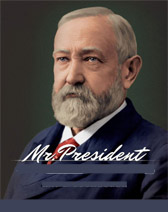
Benjamin Harrison
23rd President of the United States
Born on August 20, 1833
Died on March 13, 1901
Age at death: 68
Profession: President, Lawyer, Politician
Place of Birth: North Bend, near Cincinnati, Ohio, United States
Place of Death: Indianapolis, Indiana, United States
Benjamin Harrison was an American lawyer, Civil War officer, politician, and the 23rd President of the United States, serving from March 4, 1889, to March 4, 1893. A member of the Republican Party, Benjamin Harrison is remembered for his support of protective tariffs, civil rights enforcement, naval modernization, antitrust legislation, and the admission of six western states into the Union. He was also the grandson of William Henry Harrison, the ninth President of the United States, making him part of one of America’s most prominent political families.
Early Life and Education
Benjamin Harrison was born on August 20, 1833, near North Bend, west of Cincinnati, Ohio, on a farm overlooking the Ohio River. He was the second of ten children born to John Scott Harrison and Elizabeth Ramsey Irwin. His family already had a strong political legacy, as his grandfather William Henry Harrison became the ninth President of the United States.
Benjamin Harrison received his early education near home and later enrolled at Farmer’s College near Cincinnati in 1847. During this period he met Caroline Lavinia Scott, the daughter of science professor and Presbyterian minister John Witherspoon Scott. He later transferred to Miami University in Oxford, Ohio, graduating in 1852.
After completing his studies, Benjamin Harrison read law with Cincinnati judge Bellamy Storer. On October 20, 1853, he married Caroline Scott Harrison in a ceremony performed by her father. He was admitted to the Ohio bar in 1854.
Move to Indianapolis and Legal Career
In 1854, after receiving an inheritance of 800 dollars from an aunt, Benjamin Harrison moved to Indianapolis, Indiana. There he began building a legal career and gradually became one of the city’s respected attorneys.
He first worked in the office of John H. Ray and also served as a messenger for the federal court in Indianapolis. Later, he became a commissioner for the United States Court of Claims. In 1857, he was elected Indianapolis city attorney, a position that helped raise his local political profile.
Benjamin Harrison formed legal partnerships with William Wallace and later William Fishback. His reputation for discipline, intelligence, and integrity helped him become a prominent figure in Indiana’s legal and civic life.
Political Beginnings
Raised in a politically active environment, Benjamin Harrison initially supported reform-minded politics before joining the newly formed Republican Party in 1856. That year, he campaigned for Republican presidential candidate John C. Frémont.
His political identity was shaped by opposition to slavery, support for the Union, and commitment to constitutional government. These values later influenced both his Civil War service and his public career.
Civil War Service
During the American Civil War, Benjamin Harrison joined the Union cause. In 1862, Indiana Governor Oliver P. Morton asked him to help raise a regiment. Harrison recruited men from northern Indiana and was commissioned as colonel of the 70th Indiana Infantry Regiment.
His regiment served in Kentucky and Tennessee before joining William Tecumseh Sherman’s Atlanta Campaign. Benjamin Harrison commanded troops in battles including Resaca, Cassville, New Hope Church, Kennesaw Mountain, Peachtree Creek, and Atlanta.
He earned a reputation as a brave and steady officer. On January 23, 1865, President Abraham Lincoln nominated him for the brevet rank of brigadier general of volunteers, and the United States Senate confirmed the appointment on February 14, 1865.
Return to Law and Senate Career
After the war, Benjamin Harrison returned to Indianapolis and resumed his law practice. He also continued public service, including work as reporter for the Indiana Supreme Court.
In 1869, President Ulysses S. Grant appointed him to represent the federal government in a civil case brought by Lambdin P. Milligan, whose wartime conviction had led to the important Supreme Court case Ex parte Milligan.
Benjamin Harrison ran unsuccessfully for governor of Indiana in 1876, but in 1881 he entered the United States Senate. He served as senator from Indiana from March 4, 1881, to March 3, 1887. In the Senate, he supported pensions for Civil War veterans, protective tariffs, civil rights legislation, and expansion of the American Navy.
Election as President
In 1888, Benjamin Harrison became the Republican nominee for president. He ran against incumbent Democratic President Grover Cleveland. Although Cleveland won the popular vote, Harrison won the Electoral College and became the 23rd President of the United States.
His victory reflected the strength of Republican support for tariffs, veterans’ benefits, and industrial development. He took office on March 4, 1889.
Presidency
As president, Benjamin Harrison supported a highly active legislative agenda. His administration backed the McKinley Tariff, one of the highest protective tariffs in American history. The tariff was designed to protect American industry but was criticized by many consumers and Democrats for raising prices.
His presidency also saw the passage of the Sherman Antitrust Act in 1890, the first major federal law aimed at limiting monopolistic business practices. Although early enforcement was limited, the law later became a cornerstone of American antitrust policy.
Benjamin Harrison also supported the creation of national forest reserves through the Land Revision Act of 1891. This marked an important early step in federal conservation policy.
During his administration, six states were admitted to the Union: North Dakota, South Dakota, Montana, Washington, Idaho, and Wyoming. No other presidential term saw more states added to the Union.
Harrison strengthened and modernized the United States Navy, helping lay the groundwork for America’s later emergence as a global naval power. He also pursued an active foreign policy and supported American influence in Latin America and the Pacific.
Civil Rights and Domestic Policy
Benjamin Harrison supported federal protection of African American voting rights, especially in the South. His administration backed legislation intended to protect Black voters from intimidation and disenfranchisement.
These proposals ultimately failed in Congress, but Harrison’s support for civil rights enforcement distinguished him from many politicians of his era. He also supported federal education funding, though this effort was likewise unsuccessful.
Defeat and Later Life
In the 1892 presidential election, Benjamin Harrison again faced Grover Cleveland. This time Cleveland defeated him, and Harrison left office on March 4, 1893.
After leaving the presidency, Benjamin Harrison returned to Indianapolis and resumed legal work. In 1894, he taught law at Stanford University. He later served on the Board of Trustees of Purdue University from 1895 until his death.
In 1899, he represented Venezuela in an international boundary dispute with British Guiana. Although Venezuela lost the case, Harrison’s legal arguments won him international respect.
Personal Life
Benjamin Harrison married Caroline Scott Harrison in 1853. They had two children, Russell Benjamin Harrison and Mary Harrison McKee. Caroline served as First Lady during his presidency and died in 1892, shortly before the end of his term.
In 1896, Benjamin Harrison married Mary Scott Lord Dimmick, the widowed niece and former secretary of his first wife. His adult children did not approve of the marriage and did not attend the wedding. Benjamin and Mary had one daughter, Elizabeth Harrison.
Death
Benjamin Harrison died of pneumonia on March 13, 1901, at his home in Indianapolis, Indiana. He was 67 years old, shortly before what would have been his 68th birthday.
He is remembered as a hardworking, honest, and serious public servant. Although historians often rank his presidency as moderate or average, his administration produced important legislation and oversaw major developments in antitrust law, conservation, naval modernization, and western statehood.
Political Party
Before 1856 – Liberal / reform-oriented political background
1856–1901 – Republican Party
States Admitted During His Presidency
November 2, 1889 – North Dakota
November 2, 1889 – South Dakota
November 8, 1889 – Montana
November 11, 1889 – Washington
July 3, 1890 – Idaho
July 10, 1890 – Wyoming
Source: Biyografiler.com
Frequently asked questions about Benjamin Harrison
Who is Benjamin Harrison?, Benjamin Harrison biography, Benjamin Harrison life story, Benjamin Harrison age, Benjamin Harrison facts, Benjamin Harrison birthplace, Benjamin Harrison photos, Benjamin Harrison videos, Benjamin Harrison career
Related Biographies

Lamine Yamal
Professional footballer

Sam Altman
Entrepreneur, Investor, CEO

Kylian Mbappe
Professional footballer

Alice Weidel
Politician, Economist

Erling Haaland
Professional footballer

Giorgia Meloni
Politician, Journalist


Hongjoong
Singer, Rapper, Songwriter, Composer

Ludacris
Rapper, Actor

Kwon Eunbi
Singer

Sarah Wayne Callies
Actress, Screenwriter, Producer, Director

LaTavia Roberson
Singer, Actress, Entrepreneur
Lamine Yamal
Professional footballer

Austin Abrams
Actor

Xi Jinping
Politician, Statesman, Head of State

Claudia Sheinbaum
President, Politician, Scientist, Academic

Colman Domingo
Actor, Director, Producer

Kaia Gerber
Model, Actress