
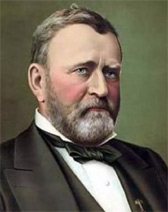
Ulysses S. Grant
Union General Who Preserved the United States | 18th President of the United States
Born on April 27, 1822
Died on July 23, 1885
Age at death: 63
Profession: Military Commander, Politician, Former President
Place of Birth: Point Pleasant, Ohio, United States
Place of Death: Grant Cottage, Wilton, New York, United States
Ulysses S. Grant was the 18th President of the United States and the commanding general of the Union Army during the American Civil War. By leading the Northern Union forces to victory, he gained international recognition and became one of the most prominent military and political figures in American history.
Ulysses S. Grant was born on April 27, 1822, in Point Pleasant, Ohio, as the first son of a family with six children. His birth name was Hiram Ulysses Grant. His father, Jesse Root Grant, was involved in the leather tanning business. One year after his birth, the family moved to Georgetown, Ohio, where they owned a farm inherited from his grandfather. In 1839, at the age of seventeen, Grant entered the United States Military Academy at West Point, where he completed his military education.
In 1843, Grant graduated as an officer and was assigned to an infantry unit stationed in St. Louis, Missouri. During this period, he met Julia Dent, whom he fell in love with, and they married in 1848. Grant later acknowledged that many of his professional successes were due to the unwavering support and understanding of his wife. Between 1846 and 1848, he participated in the Mexican–American War and was promoted to the rank of captain at the end of the conflict.
In 1854, following disagreements with his superiors, Ulysses S. Grant was forced to resign from the army. He returned to Missouri, where he attempted farming for four years without success. After abandoning agriculture, he tried various occupations before finally working at his father’s leather business in Galena, Illinois. During this time, tensions in the United States intensified over economic policies and slavery, particularly between representatives of the Northern and Southern states.
The election of Abraham Lincoln as President in 1860 marked a turning point in North–South relations. South Carolina declared its secession in December 1860, and by February 1861, eleven Southern states formed the Confederate States of America under the leadership of Jefferson Davis. As the threat of civil war loomed, President Lincoln called for volunteers to fight for the Union.
Ulysses S. Grant rejoined the army and took responsibility for recruiting, arming, and training volunteer forces in Galena. He led these troops to Springfield, Illinois, and was appointed commander of the regiment by the state governor. With strict discipline, he prepared the unit and advanced into Missouri. He was promoted to brigadier general and placed in command of the Southern Missouri district.
After an unsuccessful engagement at Belmont, Grant’s forces achieved major victories by capturing Fort Henry on February 6, 1862, and Fort Donelson on February 16, 1862. These victories marked some of the first significant successes for the Union Army and brought Grant national fame.
On July 4, 1863, Ulysses S. Grant captured the city of Vicksburg after a prolonged siege, forcing the surrender of 30,000 Confederate soldiers. Later that year, on November 24, 1863, he defeated Southern forces at Chattanooga. These successes led President Lincoln to summon him to Washington, D.C., where he was promoted to lieutenant general and given command of all Union armies in the Western Theater.
Under Grant’s leadership, Union forces adopted coordinated and strategic offensives for the first time. In the spring of 1864, he launched a series of attacks against Confederate armies. After besieging Petersburg in June 1864, Grant finally captured the city on April 9, 1865. This decisive victory effectively ended the Civil War and secured Union triumph.
On April 14, 1865, President Abraham Lincoln was assassinated at Ford’s Theatre in Washington, D.C., during a performance of Our American Cousin, shot by Confederate sympathizer John Wilkes Booth. Grant and his wife had originally been invited to attend the performance but did not go that evening. Following Lincoln’s death, Andrew Johnson assumed the presidency.
In 1866, Ulysses S. Grant was appointed Commander-in-Chief of the United States Army and later served briefly as Secretary of War before resigning. In the 1868 election, he was nominated by the Republican Party and won the presidency.
Ulysses S. Grant served as the 18th President of the United States from March 4, 1869, to March 4, 1877. Despite having no prior political experience, he remained closely aligned with Republican Party policies. He was re-elected in 1872 by a large majority.
After leaving office in 1877, Grant embarked on a two-year world tour. In 1878, he visited the Ottoman Empire and was received by Abdulhamid II at Yıldız Palace on March 5, 1878. Although there were efforts to nominate him again for the presidency in the 1881 elections, these attempts were unsuccessful.
Grant later settled in New York and invested in a private banking firm. When the firm collapsed due to fraud in 1884, he was left financially ruined. To support his family, he wrote articles for magazines while also composing his memoirs. The renowned American writer Mark Twain compiled Grant’s memoirs into two volumes. While completing the final sections, Grant was diagnosed with throat cancer.
Ulysses S. Grant died on July 23, 1885, at the age of sixty-three, at Grant Cottage in Wilton, New York, from throat cancer.
Grant married Julia Dent Grant in 1848. They had four children: Jesse Grant, Ulysses Grant Jr., Nellie Grant, and Frederick Grant. His legacy endures not only as a wartime leader who preserved the Union but also as a national symbol—his portrait appears on the front of the 50 U.S. dollar bill.
Source: Biyografiler.com
Frequently asked questions about Ulysses S. Grant
Who is Ulysses S. Grant?, Ulysses S. Grant biography, Ulysses S. Grant life story, Ulysses S. Grant age, Ulysses S. Grant facts, Ulysses S. Grant birthplace, Ulysses S. Grant photos, Ulysses S. Grant videos, Ulysses S. Grant career
Related Biographies

Lamine Yamal
Professional footballer

Sam Altman
Entrepreneur, Investor, CEO

Erling Haaland
Professional footballer

Kylian Mbappe
Professional footballer

Alice Weidel
Politician, Economist

Giorgia Meloni
Politician, Journalist


Hongjoong
Singer, Rapper, Songwriter, Composer

Ludacris
Rapper, Actor

Kwon Eunbi
Singer

Sarah Wayne Callies
Actress, Screenwriter, Producer, Director

LaTavia Roberson
Singer, Actress, Entrepreneur

Sydney Sweeney
Actress

Austin Abrams
Actor

Ma Huateng
Entrepreneur, Inventor
Lamine Yamal
Professional footballer

Silvio Berlusconi
Politician, Businessperson

Ursula von der Leyen
Politician, Physician