
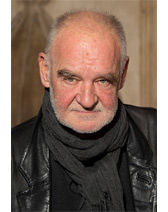
Bela Tarr
Born on July 21, 1955
Died on January 6, 2026
Age at death: 71
Profession: Film Director, Screenwriter
Place of Birth: Pécs, Hungary
Place of Death: Budapest, Hungary
Béla Tarr is widely regarded as the most internationally recognized director of Hungarian cinema. He was born on July 21, 1955, in the southern Hungarian city of Pécs and grew up in Budapest. Both of his parents were closely involved with theater and cinema; his father worked as a stage designer, while his mother spent more than fifty years working as a prompter in theaters.
When Béla Tarr was ten years old, his mother took him to auditions at Hungarian National Television for a television film adaptation of The Death of Ivan Ilyich by Lev Tolstoy. He secured a role in the production, marking his earliest direct contact with filmmaking. By the age of sixteen, he began shooting amateur films, which significantly deepened his interest in cinema. These early works, mostly documentary in nature, focused on the lives of workers and impoverished people in Hungary. After producing several 8 mm short films, the Hungarian government did not allow him to continue his university education, and Tarr chose to pursue filmmaking independently. He later graduated from the Budapest Academy of Theatre and Film Arts in 1981.
Based in Budapest, Béla Tarr developed a film style rooted in social realism. Recurring themes in his work include fear, intergenerational conflict, corruption, dehumanization, and political–economic systems. His first feature-length film, Family Nest, was shot in 1977 when he was only twenty-two years old and completed in just six days. The cast consisted entirely of non-professional local residents who participated purely out of friendship and were not paid. The film was released in 1979. Maintaining his stylistic approach with only minor variations, he went on to direct The Outsider and The Prefab People, the latter being his first film to feature professional actors.
In 1982, Béla Tarr directed a television adaptation of William Shakespeare’s Macbeth, structured in only two shots: a five-minute opening scene followed by a single continuous sixty-seven-minute sequence. After writing the screenplays for his first four feature films himself, Tarr began collaborating with Hungarian writer László Krasznahorkai. Together, they wrote the screenplay for Damnation, which marked the beginning of a long-term artistic partnership.
Béla Tarr achieved international acclaim with his 7.5-hour film Sátántangó (1994), which he advised audiences to watch in one uninterrupted sitting. The film is widely regarded as his masterpiece. He was married to Ágnes Hranitzky, who also collaborated with him professionally.
In his final film, The Turin Horse (2011), which he described as his farewell to cinema, Béla Tarr drew inspiration from an episode in the life of Friedrich Nietzsche. During Nietzsche’s 1889 journey in Turin, Italy, he reportedly embraced a horse to stop it from being whipped, an event after which he suffered a mental collapse and spent the remaining eleven years of his life silent and bedridden. The film takes its title from this story.
Béla Tarr was honored as a guest of honor at the International Istanbul Bosphorus Film Festival held between November 17 and 26, 2017. Between September 29 and October 5, 2018, at the 55th International Antalya Film Festival organized by the Antalya Metropolitan Municipality, he received one of the Honor Awards, alongside director Ömer Vargı and actor Vincent Cassel, while the Lifetime Achievement Award was presented to Ferzan Özpetek.
After a long illness, Béla Tarr passed away on January 6, 2026, in Budapest, Hungary, at the age of seventy-one.
Awards2018 – 55th International Antalya Film Festival – Honor Award
2011 – Berlin International Film Festival – Grand Jury Prize (The Turin Horse)
U.S. National Society of Film Critics – Best Experimental Film Award
Filmography
Director
2011 – The Turin Horse (Feature Film)
2007 – The Man from London (Feature Film)
2004 – Visions of Europe (Feature Film)
2000 – Werckmeister Harmonies (Feature Film)
1995 – Journey on the Plain (Feature Film)
1990 – City Life (Documentary)
1994 – Sátántangó (Feature Film)
1987 – Damnation (Feature Film)
1984 – Almanac of Fall (Feature Film)
1982 – Macbeth (TV Film)
1982 – The Prefab People (Feature Film)
1981 – The Outsider (Feature Film)
1979 – Family Nest (Feature Film)
Screenwriter
2011 – The Turin Horse (Feature Film)
2007 – The Man from London (Feature Film)
1994 – Sátántangó (Feature Film)
1987 – Damnation (Feature Film)
1984 – Almanac of Fall (Feature Film)
Producer
2000 – Werckmeister Harmonies (Feature Film)
Short Films
2004 – Visions of Europe
1995 – Journey on the Plain
1990 – The Last Boat
1987 – Hotel Magnezit
Source: Biyografiler.com
Frequently asked questions about Bela Tarr
Who is Bela Tarr?, Bela Tarr biography, Bela Tarr life story, Bela Tarr age, Bela Tarr facts, Bela Tarr birthplace, Bela Tarr photos, Bela Tarr videos, Bela Tarr career
Related Biographies

Lamine Yamal
Professional footballer

Sam Altman
Entrepreneur, Investor, CEO

Kylian Mbappe
Professional footballer

Alice Weidel
Politician, Economist

Erling Haaland
Professional footballer

Giorgia Meloni
Politician, Journalist


Hongjoong
Singer, Rapper, Songwriter, Composer

Ludacris
Rapper, Actor

Kwon Eunbi
Singer

Sarah Wayne Callies
Actress, Screenwriter, Producer, Director

LaTavia Roberson
Singer, Actress, Entrepreneur
Lamine Yamal
Professional footballer

Claudia Sheinbaum
President, Politician, Scientist, Academic

Colman Domingo
Actor, Director, Producer

Austin Abrams
Actor

Pedro Sanchez
Politician

Kaia Gerber
Model, Actress