
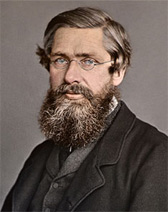
Alfred Russel Wallace
British naturalist who independently developed the theory of evolution by natural selection alongside Charles Darwin. His research in the Amazon and Malay Archipelago also contributed to the development of biogeography, particularly through the identification of Wallace's Line.
Born on January 8, 1823
Died on November 7, 1913
Age at death: 90
Profession: Naturalist, Biologist
Place of Birth: Usk, Monmouthshire, Wales, United Kingdom
Place of Death: Broadstone, Dorset, England, United Kingdom
Alfred Russel Wallace (January 8, 1823 – November 7, 1913) was a British naturalist, explorer, geographer, anthropologist, and evolutionary theorist. He independently developed the theory of evolution by natural selection, reaching conclusions similar to those of Charles Darwin. Their findings were jointly presented to the Linnean Society of London in 1858, a year before Darwin published On the Origin of Species. Wallace conducted extensive scientific expeditions in the Amazon basin and the Malay Archipelago, collecting thousands of animal and plant specimens. His observations of the geographic distribution of species led to the identification of Wallace's Line, a biogeographical boundary separating many Asian and Australasian animal groups. His principal books include The Malay Archipelago (1869), Contributions to the Theory of Natural Selection (1870), and The Geographical Distribution of Animals (1876).
Early Life and Education
Alfred Russel Wallace was born on January 8, 1823, in Usk, Monmouthshire, Wales. He was the eighth of nine children born to Thomas Vere Wallace and Mary Anne Greenell. His family experienced financial difficulties during his childhood, eventually becoming unable to support his formal education.
Wallace attended school in Hertford, England, but left at the age of fourteen. He subsequently moved to London, where he lived with his older brother, who was training in the building trade.
During his stay in London, he attended lectures and became interested in scientific subjects, political philosophy, and social reform. His later intellectual interests were influenced partly by the writings of Robert Owen and other nineteenth-century reformers.
Surveying Work and Interest in Natural History
Between 1840 and 1843, Alfred Russel Wallace worked with his older brother William Wallace, who was employed as a land surveyor. The work involved measuring land, preparing maps, and traveling through rural parts of England and Wales.
Spending much of his time outdoors encouraged Wallace to study geology, plants, and insects. He began reading scientific publications and acquired books issued by the Society for the Diffusion of Useful Knowledge.
In 1844, he became a teacher at a school in Leicester, where he taught drawing, surveying, and other subjects.
There he met naturalist Henry Walter Bates, who introduced him to insect collecting and the systematic study of natural history.
Wallace also read Vestiges of the Natural History of Creation (1844), published anonymously by Robert Chambers. The book discussed the development of life and encouraged Wallace to investigate the origins of species.
Following his brother William's death in 1845, he returned temporarily to surveying before deciding to pursue scientific exploration.
Amazon Expedition, 1848–1852
In April 1848, Alfred Russel Wallace traveled to Brazil with Henry Walter Bates to collect animal and plant specimens in the Amazon rainforest.
The two naturalists intended to study the distribution of species while financing their journey through the sale of specimens to museums and private collectors.
After initially traveling together, they separated to investigate different areas. Wallace explored the Amazon and Rio Negro river systems, including regions along the Uaupés River.
He collected birds, butterflies, beetles, and other animals while studying their geographic distribution and differences between related species.
He also recorded information about Indigenous communities and produced geographic observations, including a map of the Uaupés River that remained useful to later travelers.
During the expedition, Wallace increasingly considered whether species might develop from earlier forms rather than having been independently created.
Shipwreck and Return to England
In 1852, after approximately four years in the Amazon region, Alfred Russel Wallace began his return voyage to England aboard the ship Helen.
During the Atlantic crossing, the vessel caught fire and sank. Wallace and the other passengers escaped in lifeboats, but most of his scientific specimens, notebooks, and personal possessions were destroyed.
He spent approximately ten days at sea before being rescued by another vessel. The rescue ship also encountered difficulties during the remainder of the voyage.
Wallace reached England in October 1852 with only a small portion of his collections and notes.
He subsequently published A Narrative of Travels on the Amazon and Rio Negro (1853) and Palm Trees of the Amazon and Their Uses (1853), documenting his observations from the expedition.
Expedition to the Malay Archipelago, 1854–1862
In 1854, Alfred Russel Wallace began an eight-year scientific expedition to the Malay Archipelago, covering territories now belonging principally to Indonesia and Malaysia. His outward journey received assistance from the Royal Geographical Society.
He traveled through regions including Singapore, Borneo, Java, Bali, Lombok, Sulawesi, the Moluccas, and New Guinea.
During his travels, Wallace and his assistants collected approximately 125,660 natural history specimens. These included about 310 mammals, 100 reptiles, 8,050 birds, 7,500 shells, 13,100 butterflies and moths, 83,200 beetles, and 13,400 other insects.
The collections contained thousands of species previously undocumented by European naturalists. Wallace worked with local assistants, including a young Malay collector named Ali, whose assistance he acknowledged in his writings.
His observations provided material for studies of zoology, geography, and evolution. He returned to England in 1862.
Wallace's Line and Biogeography
While studying animals in the Malay Archipelago, Alfred Russel Wallace observed differences between species inhabiting neighboring islands.
He found that animals on islands such as Bali and Borneo generally resembled Asian species, while those on Lombok and Sulawesi showed stronger connections with the fauna of the Australian region.
In 1859, he published observations concerning the separation of these faunal regions. The boundary subsequently became known as Wallace's Line.
The line passes between Bali and Lombok and between Borneo and Sulawesi, marking a transition between major animal distributions.
Wallace's studies helped establish Biogeography as a scientific field concerned with the geographic distribution of living organisms and the historical processes that explain it.
Independent Discovery of Natural Selection
In 1855, Alfred Russel Wallace published On the Law Which Has Regulated the Introduction of New Species, an article arguing that new species arise in association with closely related existing species.
While recovering from a fever on the island of Ternate in 1858, he developed a clearer explanation of how species could change through natural selection.
He proposed that individuals possessing characteristics better suited to their environments were more likely to survive and reproduce, allowing those characteristics to become more common in subsequent generations.
Wallace described the idea in a paper titled On the Tendency of Varieties to Depart Indefinitely from the Original Type and sent it to Charles Darwin for his opinion.
Darwin had independently developed a similar theory during the preceding two decades but had not yet published a complete account.
After receiving Wallace's manuscript, Darwin consulted scientists Charles Lyell and Joseph Dalton Hooker, who arranged for the two men's writings to be presented together.
The Darwin–Wallace Presentation of 1858
On July 1, 1858, papers by Alfred Russel Wallace and Charles Darwin were jointly presented to the Linnean Society of London.
The presentation included Wallace's newly written essay and extracts from Darwin's earlier unpublished manuscripts and correspondence.
Wallace was still in the Malay Archipelago and did not attend the meeting.
Darwin subsequently prepared his theory for publication, resulting in On the Origin of Species in November 1859.
The joint presentation established the independent development of the principle of natural selection by both naturalists. They maintained a scientific correspondence afterward, although they did not agree on every aspect of evolution.
Differences with Charles Darwin
Alfred Russel Wallace accepted natural selection as a principal mechanism of biological evolution, but his views gradually diverged from those of Charles Darwin concerning certain human characteristics.
Wallace believed that human physical characteristics had developed through evolutionary processes. However, he questioned whether natural selection alone could fully explain human consciousness, mathematical reasoning, artistic creativity, and moral judgment.
During the 1860s, he became interested in spiritualism and eventually argued that some aspects of human mental development involved influences beyond ordinary biological mechanisms.
Darwin disagreed with these conclusions and continued seeking natural explanations for the development of human mental abilities.
Wallace's spiritualist beliefs were not supported by scientific evidence, but they remained part of his philosophical outlook throughout his later life.
Scientific Publications and Social Views
In 1869, Alfred Russel Wallace published The Malay Archipelago, describing his travels, scientific collections, and observations of the region's peoples and wildlife.
In 1870, he released Contributions to the Theory of Natural Selection, collecting essays on evolutionary theory.
His two-volume The Geographical Distribution of Animals (1876) examined the global distribution of animal groups and proposed geographic divisions based on their relationships.
He continued these investigations in Island Life (1880), which discussed island environments, geographic isolation, and the development of species.
Beyond natural history, Wallace supported land reform, women's suffrage, and other social causes. He also opposed compulsory vaccination, a position inconsistent with established modern medical evidence concerning vaccine effectiveness and public health.
In 1898, he published Vaccination a Delusion, criticizing the vaccination policies of his time.
Personal Life
In 1866, Alfred Russel Wallace married Annie Mitten, the daughter of botanist William Mitten.
The couple had three children: Herbert, Violet, and William. Their eldest son, Herbert, died during childhood.
Wallace continued writing and corresponding with scientists while living in different parts of England. Financial difficulties affected him during several periods, and in 1881 he received a government pension following support from prominent scientific colleagues.
Death
Alfred Russel Wallace died on November 7, 1913, in Broadstone, Dorset, England, at the age of 90.
He was buried in Broadstone Cemetery. A memorial medallion commemorating him was subsequently installed in Westminster Abbey in 1915.
Awards and Honors
1868 – Royal Medal, Royal Society
1870 – Gold Medal, Société de Géographie, France
1890 – Darwin Medal, Royal Society
1892 – Founder's Medal, Royal Geographical Society
1892 – Gold Medal, Linnean Society of London
1908 – Gold Darwin–Wallace Medal, Linnean Society of London
1908 – Copley Medal, Royal Society
1908 – Order of Merit, United Kingdom
Selected Books and Scientific Publications
1853 – A Narrative of Travels on the Amazon and Rio Negro
1853 – Palm Trees of the Amazon and Their Uses
1855 – On the Law Which Has Regulated the Introduction of New Species (Scientific paper)
1858 – On the Tendency of Varieties to Depart Indefinitely from the Original Type (Scientific paper)
1869 – The Malay Archipelago
1870 – Contributions to the Theory of Natural Selection
1876 – The Geographical Distribution of Animals
1880 – Island Life
1889 – Darwinism: An Exposition of the Theory of Natural Selection, with Some of Its Applications
1898 – Vaccination a Delusion
1905 – My Life: A Record of Events and Opinions (Autobiography)
Source: Biyografiler.com
Frequently asked questions about Alfred Russel Wallace
Who is Alfred Russel Wallace?, Alfred Russel Wallace biography, Alfred Russel Wallace life story, Alfred Russel Wallace age, Alfred Russel Wallace facts, Alfred Russel Wallace birthplace, Alfred Russel Wallace photos, Alfred Russel Wallace videos, Alfred Russel Wallace career
Related Biographies

Lamine Yamal
Professional footballer

Kylian Mbappe
Professional footballer

Keanu Reeves
Actor

Erling Haaland
Professional footballer

Brad Pitt
Actor

Bad Bunny
Rapper, Songwriter

Julian Assange
Activist, Computer Programmer

Jose Tolentino de Mendonça
Religious Leader, Priest

Joseph Stiglitz
Economist, Author

Jose Raul Mulino
President, Politician, Lawyer


Joseph Gordon Levitt
Actor, Director, Producer

David Yates
Film Director, Film Producer

Jensen Huang
Entrepreneur, CEO

Susie Wiles
Political Consultant

Edith Piaf
Singer, Actress

Gadi Eisenkot
Politician, Military Commander
Brad Pitt
Actor