
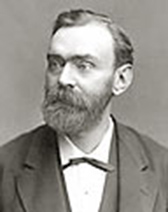
Alfred Bernhard Nobel
Swedish chemist, engineer, and inventor of dynamite. He held 355 patents and established the Nobel Prizes through his will, creating awards in physics, chemistry, physiology or medicine, literature, and peace.
Born on October 21, 1833
Died on December 10, 1896
Age at death: 63
Profession: Chemist, Engineer, Inventor
Place of Birth: Stockholm, Sweden
Place of Death: Sanremo, Italy
Alfred Nobel, whose full name was Alfred Bernhard Nobel, was born on October 21, 1833, in Stockholm, Sweden, and died on December 10, 1896, in Sanremo, Italy. He was a Swedish chemist, engineer, inventor, and industrialist best known for inventing Dynamite in 1866 and patenting it in 1867. He also developed blasting caps, blasting gelatin, and Ballistite, an early smokeless propellant. Through his inventions and international manufacturing companies, Nobel accumulated a substantial fortune. In his final will, signed in Paris on November 27, 1895, he directed that most of his estate be used to establish the Nobel Prizes. The awards were first presented in 1901, five years after his death.
Early Life and Family Background
Alfred Nobel was born on October 21, 1833, in Stockholm, Sweden. His father, Immanuel Nobel, was an engineer and inventor, while his mother, Andriette Ahlsell, came from a relatively prosperous family.
Alfred was the third son of the family. His brothers included Robert Nobel, Ludvig Nobel, and Emil Nobel. Shortly before Alfred's birth, his father's business encountered financial difficulties and eventually went bankrupt.
In 1838, Immanuel moved to Saint Petersburg, Russia, where he established a mechanical workshop. The business developed equipment and naval mines for the Russian military.
In 1842, the rest of the Nobel family joined him in Saint Petersburg. As his father's financial position improved, Alfred received private instruction in languages, natural sciences, physics, and chemistry.
Education and Interest in Chemistry
By the age of seventeen, Alfred Nobel spoke Swedish, Russian, French, English, and German fluently. Although his father wanted him to become an engineer, he also developed an interest in English literature, poetry, and drama.
To improve his scientific education, his father arranged for him to travel abroad. Between 1850 and 1852, he visited several European countries and the United States.
In Paris, he studied chemistry in the laboratory of Théophile-Jules Pelouze, where he met Italian chemist Ascanio Sobrero, who had discovered nitroglycerin in 1847.
He also spent time in the United States, where he became acquainted with engineering developments and worked with Swedish-American inventor John Ericsson.
Nobel became interested in the possibility of using nitroglycerin for industrial purposes, particularly mining and construction. However, the substance was highly sensitive to shock and difficult to handle safely.
Return to Sweden and Explosives Research
In 1852, Alfred Nobel returned to Saint Petersburg and joined the family business. During the Crimean War, the workshop received military contracts, but its financial position deteriorated after the war ended in 1856.
Following another business failure, Alfred returned to Sweden in 1863 with his father and younger brother Emil. Robert and Ludvig remained in Russia, where they subsequently became involved in the petroleum industry.
In Stockholm, Nobel continued experimenting with nitroglycerin at the family's laboratory in Heleneborg. His objective was to develop a controlled method of using the explosive.
In 1863, he obtained a patent related to the industrial use of nitroglycerin. The following year, he developed an improved detonator, or blasting cap, which made it possible to initiate explosions more reliably.
The 1864 Laboratory Explosion
On September 3, 1864, a serious explosion occurred at the Nobel family's laboratory in Heleneborg, Stockholm.
Five people died, including Alfred's younger brother Emil Nobel, who was twenty-one years old.
Following the accident, authorities restricted the production and testing of nitroglycerin within Stockholm. Nobel continued his experiments on a barge anchored on Lake Mälaren.
Despite the accident, he established Nitroglycerin AB and continued developing safer methods of manufacturing, transporting, and using explosives.
Invention of Dynamite
In 1866, Alfred Nobel discovered that nitroglycerin could be absorbed into a porous material called kieselguhr, or diatomaceous earth, producing a mixture that was more stable and easier to handle than liquid nitroglycerin.
He named the substance Dynamite, deriving the name from the Greek word *dynamis*, meaning power.
Nobel patented dynamite in 1867. The invention made it possible to use powerful explosives more practically in mining, tunneling, railway construction, and other engineering projects.
Demand increased rapidly, and he established manufacturing companies in several European countries and the United States.
His industrial activities eventually extended to more than twenty countries, while his inventions and related developments resulted in 355 patents during his lifetime.
Other Inventions and Industrial Activities
Alfred Nobel continued experimenting with explosives after developing dynamite.
In 1875, he invented Blasting Gelatin, a powerful explosive developed from nitroglycerin and nitrocellulose. He obtained a patent for the substance in 1876.
He subsequently worked on smokeless propellants for firearms and artillery. In 1887, he patented Ballistite, a propellant based on nitroglycerin and nitrocellulose.
His work contributed to the development of industrial explosives and military propellants, although some of his inventions became the subject of patent disputes.
In Britain, Nobel entered a legal dispute involving Cordite, a smokeless propellant developed for military use. He claimed that the British formulation infringed his patents, but the litigation was ultimately unsuccessful.
His business activities included laboratories, explosives factories, and investments in industrial enterprises. In 1894, he acquired Bofors, a Swedish ironworks and manufacturing company that subsequently became associated with the arms industry.
Life in Paris and Sanremo
From 1873, Alfred Nobel lived primarily in Paris, where he maintained a residence and continued his scientific and commercial activities.
In 1881, he acquired property and established a laboratory at Sevran, near Paris, where he worked on explosives and other chemical developments.
His relations with the French authorities deteriorated following disputes concerning Ballistite and allegations involving the sale of military technology.
In 1891, Nobel left Paris and settled in Sanremo, Italy, where he established another laboratory and continued working.
Although he traveled frequently and maintained business interests in several countries, Sanremo became his principal residence during the final years of his life.
Personal Life and Interest in Literature
Alfred Nobel never married and had no children. He maintained an interest in literature and wrote poetry and dramatic works alongside his scientific activities.
In 1876, he employed Bertha von Suttner, then Bertha Kinsky, as a secretary. Although she worked for him only briefly, they maintained a correspondence for many years.
Von Suttner subsequently became a peace activist and wrote Lay Down Your Arms! (1889). She received the Nobel Peace Prize in 1905.
Nobel also had a long relationship with Sofie Hess, whom he met in Vienna in 1876. Their correspondence continued for approximately eighteen years.
His interest in literature was reflected in his final will, which included a prize for literary achievement alongside awards for science and peace.
Alfred Nobel's Will and the Nobel Prizes
On November 27, 1895, Alfred Nobel signed his final will at the Swedish-Norwegian Club in Paris.
He directed that most of his remaining fortune, approximately 31 million Swedish kronor, be invested in a fund. The income generated from that fund would finance annual prizes for individuals whose work benefited humanity.
The will established five award categories: physics, chemistry, physiology or medicine, literature, and peace.
Nobel specified that the science and literature prizes would be awarded by Swedish institutions, while the peace prize would be selected by a committee appointed by the Norwegian Parliament.
His decision surprised relatives and business associates, and the will faced legal and administrative challenges after his death.
The executors, Ragnar Sohlman and Rudolf Lilljequist, worked to implement the instructions. On June 29, 1900, the statutes of the Nobel Foundation were approved, allowing preparations for the first awards to proceed.
Death
Alfred Nobel died of a cerebral hemorrhage on December 10, 1896, at his residence in Sanremo, Italy. He was 63 years old.
His remains were returned to Sweden, and he was buried at Norra begravningsplatsen cemetery in Stockholm.
His estate was subsequently administered according to the provisions of his will, leading to the establishment of the Nobel Foundation and its annual awards.
The First Nobel Prizes in 1901
The first Nobel Prizes were awarded on December 10, 1901, the fifth anniversary of Alfred Nobel's death.
The inaugural recipients were:
Physics – Wilhelm Conrad Röntgen, Germany, for the discovery of X-rays
Chemistry – Jacobus Henricus van 't Hoff, Netherlands, for research on chemical dynamics and osmotic pressure
Physiology or Medicine – Emil Adolf von Behring, Germany, for the development of serum therapy against diphtheria
Literature – Sully Prudhomme, France, for his poetry
Peace – Henry Dunant, Switzerland, and Frédéric Passy, France, for their humanitarian and peace-related work
The prizes have since been awarded annually, subject to occasional interruptions and years in which particular categories were not awarded.
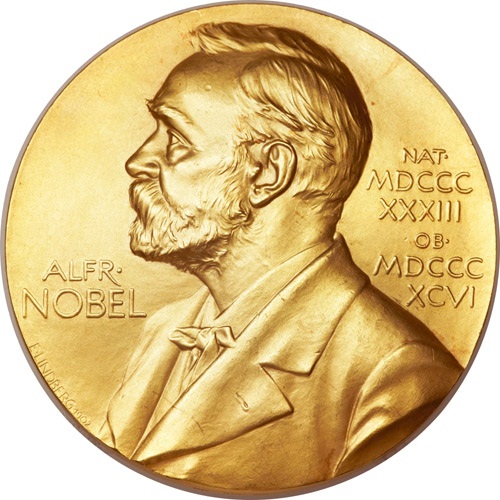
The Nobel Prize in Economic Sciences
Economics was not among the five categories established in Alfred Nobel's will.
In 1968, Sveriges Riksbank, Sweden's central bank, established the Sveriges Riksbank Prize in Economic Sciences in Memory of Alfred Nobel to commemorate the bank's 300th anniversary.
The prize was first awarded in 1969 to economists Ragnar Frisch of Norway and Jan Tinbergen of the Netherlands.
Although administered alongside the Nobel Prizes, the economics award is technically a memorial prize rather than one of Nobel's original five prizes.
Selected Inventions and Scientific Developments
1863 – Patented an industrial application of nitroglycerin
1864 – Developed an improved blasting cap and established Nitroglycerin AB
1866 – Developed dynamite by stabilizing nitroglycerin with kieselguhr
1867 – Patented dynamite
1875 – Invented blasting gelatin
1876 – Patented blasting gelatin
1887 – Patented Ballistite, a smokeless propellant
1894 – Acquired the Bofors industrial company
Source: Biyografiler.com
Frequently asked questions about Alfred Bernhard Nobel
Who is Alfred Bernhard Nobel?, Alfred Bernhard Nobel biography, Alfred Bernhard Nobel life story, Alfred Bernhard Nobel age, Alfred Bernhard Nobel facts, Alfred Bernhard Nobel birthplace, Alfred Bernhard Nobel photos, Alfred Bernhard Nobel videos, Alfred Bernhard Nobel career

Lamine Yamal
Professional footballer

Erling Haaland
Professional footballer

Keanu Reeves
Actor

Kylian Mbappe
Professional footballer

Bad Bunny
Rapper, Songwriter

Leonardo DiCaprio
Actor

Andre Gide
Novelist, Essayist

Andreas Papandreu
Former Prime Minister, Politician, Economist

Andrea Mantegna
Painter

Andrea del Verrocchio
Sculptor, Painter

Andrea del Sarto
Painter

Andrea Bargnani
Former Professional Basketball Player

Amy Ryan
Actress

Andy Garcia
Actor, Film Director

Andy Serkis
Actor, Film Director

Ali Larter
Actress, Former Model

John Healey
Politician
Lamine Yamal
Professional footballer