
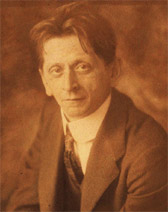
Alexander von Zemlinsky
Austrian composer and conductor associated with late Romanticism and early twentieth-century musical modernism. He composed the Lyric Symphony, The Mermaid, A Florentine Tragedy, and The Dwarf, and taught Arnold Schoenberg.
Born on October 14, 1871
Died on March 15, 1942
Age at death: 71
Profession: Composer, Pianist
Place of Birth: Vienna, Austria-Hungary (present-day Austria)
Place of Death: Larchmont, New York, United States
Alexander von Zemlinsky (October 14, 1871 – March 15, 1942), also known as Alexander Zemlinsky, was an Austrian composer, conductor, pianist, and music educator. Born in Vienna, he studied at the Vienna Conservatory and received early encouragement from Johannes Brahms. He was a teacher and close associate of Arnold Schoenberg, who married his sister Mathilde in 1901. Zemlinsky conducted opera in Vienna, served as music director at the New German Theatre in Prague from 1911 to 1927, and subsequently worked at the Kroll Opera in Berlin. His compositions include the orchestral fantasy The Mermaid (1902–1903), Lyric Symphony (1922–1923), the operas A Florentine Tragedy (1915–1916) and The Dwarf (1919–1921), four completed numbered string quartets, and orchestral songs. After the Nazi seizure of power in Germany, he returned to Vienna in 1933 and emigrated to the United States in 1938. He died in New York State in 1942.
Early Life and Family Background
Alexander von Zemlinsky was born on October 14, 1871, in Vienna, then the capital of the Austro-Hungarian Empire. He grew up in Leopoldstadt, Vienna's second district, which had a substantial Jewish population.
His family had a mixed religious and cultural background. His paternal grandfather, Anton Semlinski, came from Žilina, then part of the Kingdom of Hungary and now located in Slovakia. He moved to Vienna and married an Austrian woman. Both came from Roman Catholic families.
His father, Adolf von Zemlinszky, was raised Catholic but converted to Judaism in 1870. He worked as secretary of Vienna's Turkish-Israelite religious community and was also active as a writer and journalist.
His mother, Clara Semo, came from Sarajevo. Her father belonged to the Sephardic Jewish community, while her maternal background included Bosnian Muslim ancestry.
The family practiced Judaism, and Zemlinsky received a Jewish upbringing. His early education included attendance at a Sephardic school in Leopoldstadt.
The family name appeared in several forms, including Semlinsky and Zemlinszky. Alexander later adopted the spelling Zemlinsky. The aristocratic particle "von" was used by his father, although the family did not possess a hereditary noble title.
Childhood and Musical Education
Alexander von Zemlinsky began playing the piano at approximately four years of age. His musical training developed within Vienna's Jewish community, where he also played the organ and accompanied singing at the synagogue.
In 1884, at the age of twelve, he passed the entrance examination for the preparatory division of the conservatory operated by the Society of Friends of Music in Vienna.
He continued studying there until 1892. From 1887, he studied piano with Anton Door and music theory with Robert Fuchs. His composition teachers included Johann Nepomuk Fuchs, and his education also brought him into contact with the musical tradition associated with Anton Bruckner.
In 1890, he won a conservatory piano competition with a performance of the Variations and Fugue on a Theme by Handel by Johannes Brahms. The prize included a grand piano supplied by Bösendorfer.
After completing his piano diploma, he continued composition studies for another two years. His early compositions included piano pieces, chamber music, and orchestral works.
In July 1892, he conducted a performance of his Symphony in D minor, one of his earliest substantial orchestral compositions.
Johannes Brahms and Early Compositions
During the 1890s, Alexander von Zemlinsky became involved in Vienna's concert and chamber music organizations. In 1893, he joined the Wiener Tonkünstlerverein, where he appeared as a pianist, conductor, and composer.
His association with this organization brought his music to the attention of Johannes Brahms. Brahms attended performances of some of Zemlinsky's compositions and followed the younger musician's development.
Zemlinsky's teacher Johann Nepomuk Fuchs helped arrange opportunities for his orchestral compositions to be heard. His early chamber works were also performed by ensembles active in Vienna.
In 1896, Zemlinsky completed his Trio for Clarinet, Cello and Piano in D minor, Op. 3. Brahms recommended the work to the publisher N. Simrock, which subsequently issued it.
The trio was written for clarinet, cello, and piano, with an alternative violin part. Its musical language reflected late nineteenth-century chamber music traditions while developing the harmonic and melodic approach that appeared in Zemlinsky's later compositions.
Friendship with Arnold Schoenberg
In 1895, Alexander von Zemlinsky founded an amateur orchestral society called Polyhymnia. Among its members was the young composer Arnold Schoenberg, who played the cello.
The two musicians developed a friendship based on their shared interest in composition and contemporary musical developments.
Zemlinsky gave Schoenberg instruction in counterpoint and composition. Schoenberg later identified him as his only formal composition teacher.
In 1901, Schoenberg married Zemlinsky's sister, Mathilde Zemlinsky, making the two composers brothers-in-law.
Their professional relationship continued through musical organizations, performances, and discussions about composition. Although their later approaches to harmony differed, they remained closely associated for much of their careers.
In 1904, Zemlinsky joined Schoenberg and Gustav Mahler in supporting the establishment of the Vereinigung Schaffender Tonkünstler, an organization intended to promote performances of contemporary compositions.
First Operas and Early Recognition
In the 1890s, Alexander von Zemlinsky began composing works for the operatic stage.
His first opera, Sarema, composed between 1893 and 1895, won the Luitpold Prize in Munich in 1896. Its premiere took place at the Munich Court Theatre in 1897.
He subsequently composed Es war einmal (*Once Upon a Time*), written between 1897 and 1899 and revised in 1912.
Gustav Mahler, who was then director of the Vienna Court Opera, supported the work and conducted its premiere in Vienna on January 22, 1900.
The opera's production brought Zemlinsky further professional opportunities in the city's musical institutions.
He increasingly divided his time between composition, conducting, and teaching.
Alma Schindler and His Personal Relationships
Around 1900, Alexander von Zemlinsky became romantically involved with Alma Schindler, a young composer and musician who had studied with him.
The relationship ended in 1901. Alma subsequently married Gustav Mahler in March 1902.
The correspondence and memoirs associated with their relationship have been examined by biographers, particularly in connection with the period when Zemlinsky was beginning his professional conducting career.
His later opera The Dwarf has sometimes been interpreted in relation to his experiences with Alma, although the work is an adaptation of a story by Oscar Wilde and cannot be reduced to a single autobiographical explanation.
Conducting Career in Vienna
From 1900 onward, Alexander von Zemlinsky held conducting appointments at several Viennese theaters.
He initially worked at the Carltheater, followed by the Theater an der Wien. In 1904, he became music director at the Vienna Volksoper.
His repertoire included operas by Wolfgang Amadeus Mozart, Richard Wagner, and other composers represented in Vienna's theatrical institutions.
During the 1907–1908 season, he worked at the Vienna Court Opera, where Mahler had previously established an extensive repertoire and demanding production standards.
Zemlinsky subsequently returned to the Volksoper, continuing to conduct opera and participate in Vienna's musical life.
He conducted works by contemporary composers, including music by Paul Dukas, whose opera Ariane et Barbe-Bleue was introduced to Viennese audiences during this period.
In 1910, his opera Kleider machen Leute (*Clothes Make the Man*) received its premiere. The work was based on the novella by Gottfried Keller and was subsequently revised.
Music Teaching and the Schwarzwald School
Alongside his conducting appointments, Alexander von Zemlinsky taught music theory, orchestration, and composition.
From 1903, he was associated with the Schwarzwald School in Vienna, a private educational institution established by Eugenie Schwarzwald.
The school provided educational opportunities for women and supported approaches to teaching that differed from many conventional institutions of the period.
Arnold Schoenberg also taught there.
Zemlinsky's students and younger associates included composers who later pursued different approaches to twentieth-century music. Among those connected with his teaching were Erich Wolfgang Korngold, Hans Krása, and Karl Weigl.
The Mermaid
Between 1902 and 1903, Alexander von Zemlinsky composed The Mermaid (*Die Seejungfrau*), a symphonic fantasy inspired by the fairy tale by Hans Christian Andersen.
The work is scored for a large orchestra and is divided into three movements. It uses orchestral color and recurring musical material to develop its narrative.
Its premiere took place in Vienna on January 25, 1905, at a concert that also included the first performance of Pelleas und Melisande by Arnold Schoenberg.
The Mermaid remained unpublished and was performed infrequently after its premiere. Its score and surviving materials became the subject of renewed research during the late twentieth century.
Prague: Deutsches Landestheater, 1911–1927
In 1911, Alexander von Zemlinsky moved to Prague, where he became music director of the New German Theatre, also known as the Deutsches Landestheater.
He remained in this position until 1927, making Prague the center of his professional activities for sixteen years.
As opera conductor, he directed productions from the established repertoire and introduced works by contemporary composers.
He conducted operas by Mozart and Wagner and supported performances of music by Gustav Mahler and Arnold Schoenberg.
The position involved extensive rehearsals, conducting schedules, and administrative responsibilities, which restricted the time available for composition.
Nevertheless, he completed several major works during his years in Prague, including his second and third string quartets, Lyric Symphony, and the operas A Florentine Tragedy and The Dwarf.
In 1920, he became head of the German Academy of Music and Fine Arts in Prague, combining institutional leadership with his responsibilities at the theater.
He also conducted the Czech Philharmonic as a guest conductor, including appearances beginning in 1923.
On June 6, 1924, Zemlinsky conducted the premiere of Schoenberg's monodrama Erwartung at an international contemporary music festival in Prague.
A Florentine Tragedy and The Dwarf
During the Prague period, Alexander von Zemlinsky composed two one-act operas based on works by Oscar Wilde.
A Florentine Tragedy (*Eine florentinische Tragödie*), Op. 16, was composed in 1915–1916 and premiered in Stuttgart in 1917.
The opera depicts the confrontation between a merchant, his wife, and her aristocratic lover. Its dramatic structure concentrates on the psychological tensions among the three characters.
The Dwarf (*Der Zwerg*), Op. 17, was composed between 1919 and 1921 and premiered in Cologne in 1922.
It is based on Wilde's story The Birthday of the Infanta. The plot concerns a dwarf presented as a birthday gift to a Spanish princess, who becomes aware of his physical appearance and the princess's treatment of him.
The opera uses vocal writing and orchestral passages to develop the contrast between the characters' perspectives.
Both works became subjects of renewed scholarly and performance interest during the later twentieth century.
Lyric Symphony
In 1922–1923, Alexander von Zemlinsky composed Lyric Symphony, Op. 18, a seven-movement work for soprano, baritone, and orchestra.
The composition uses poems by Rabindranath Tagore in German translation. Its movements explore different aspects of love, longing, separation, and emotional experience.
The work was influenced in part by the model of orchestral song cycles associated with Gustav Mahler, particularly Das Lied von der Erde.
It received its first performance in Prague in 1924.
The composition brings together vocal soloists and large orchestral forces, with each movement developing a distinct musical setting for its text.
Lyric Symphony is among the Zemlinsky compositions most frequently represented in modern recordings and concert programming.
Berlin and the Kroll Opera
In 1927, Alexander von Zemlinsky left Prague and moved to Berlin.
He became a conductor at the Kroll Opera, where Otto Klemperer served as music director.
The company developed productions incorporating contemporary approaches to stage design and operatic performance.
Zemlinsky conducted several productions during this period and continued working with musicians associated with modern European opera.
The Kroll Opera closed in 1931 as a result of financial and political pressures.
After its closure, he accepted a teaching position at Berlin's Hochschule für Musik. He also continued working as a guest conductor, traveling to different European cities for concerts and opera productions.
In December 1931, he conducted the Berlin premiere of Rise and Fall of the City of Mahagonny by Kurt Weill and Bertolt Brecht.
Return to Vienna After the Nazi Rise to Power
When the Nazi Party came to power in Germany in 1933, Alexander von Zemlinsky faced restrictions arising from the regime's anti-Jewish legislation.
His employment in German public institutions became untenable, and he returned to Vienna with his second wife, Louise Sachsel.
In Austria, he no longer held a permanent conducting appointment comparable to his earlier positions in Prague or Berlin.
He concentrated on composing and occasionally appeared as a guest conductor.
During the 1930s, he wrote Sinfonietta, Op. 23 (1934), String Quartet No. 4, Op. 25 (1936), and his final opera, Der König Kandaules (*King Candaules*).
He also completed settings of poems and continued work on chamber and orchestral compositions.
The annexation of Austria by Nazi Germany in March 1938 made it impossible for him to remain safely in Vienna.
Emigration to the United States
In September 1938, Alexander von Zemlinsky emigrated to the United States with his wife and members of her family.
They initially settled in New York City.
Unlike Arnold Schoenberg, who had established a teaching career in California, Zemlinsky struggled to secure a permanent musical appointment in the United States.
His health deteriorated, and he experienced financial difficulties while attempting to complete compositions and find publishing opportunities.
He remained in contact with musicians and former associates, including Arthur Bodanzky, Fritz Stiedry, and Hans Heinsheimer.
During his final years, he attempted to continue work on his opera Der König Kandaules and began another opera project, Circe.
He composed smaller educational pieces and songs, some published under the pseudonym Al Roberts.
His health problems increasingly limited his ability to compose and conduct.
Personal Life
In 1907, Alexander von Zemlinsky married Ida Guttmann. Their marriage lasted until Ida's death in 1929.
The couple had a daughter, Johanna.
In 1930, Zemlinsky married Louise Sachsel, a former student who was considerably younger than him.
Louise accompanied him during his return to Vienna in 1933 and his emigration to the United States in 1938.
His relationship with Arnold Schoenberg continued to connect him with the development of twentieth-century music, although disagreements emerged between them over compositional methods and other matters.
Death
Following his emigration, Alexander von Zemlinsky suffered a series of strokes. A serious stroke in December 1940 left him unable to resume regular professional activity.
He died on March 15, 1942, in Larchmont, New York, United States, at the age of 70.
His ashes were transferred to Austria in 1985 and interred in an honorary grave at the Vienna Central Cemetery.
Operas
1893–1895 – Sarema (Premiere: Munich, 1897)
1897–1899 – Es war einmal (*Once Upon a Time*; revised 1912; premiere: Vienna, 1900)
1904–1906 – Der Traumgörge, Op. 11 (*The Dreamer Görge*)
1907–1909 – Kleider machen Leute, Op. 12 (*Clothes Make the Man*; revised 1910 and 1922)
1915–1916 – Eine florentinische Tragödie, Op. 16 (*A Florentine Tragedy*)
1919–1921 – Der Zwerg, Op. 17 (*The Dwarf*)
1930–1931 – Der Kreidekreis, Op. 21 (*The Chalk Circle*)
1935–1936 – Der König Kandaules, Op. 26 (*King Candaules*; orchestration completed by Antony Beaumont in 1992–1996)
Other Stage Works
1901 – Ein Lichtstrahl (*A Ray of Light*), a pantomime with piano accompaniment, based on a scenario by Oskar Geller; revised 1902
1901–1904 – Ein Tanzpoem (*A Dance Poem*), a one-act ballet for orchestra, developed from the ballet project Der Triumph der Zeit with a scenario by Hugo von Hofmannsthal
1913–1915 – Incidental music for Cymbeline by William Shakespeare, for tenor, chorus, and orchestra
Choral Works
1895 – Minnelied, for male chorus and chamber ensemble, text by Heinrich Heine
1896 – Frühlingsglaube, for mixed chorus and string orchestra, text by Ludwig Uhland
1896 – Geheimnis, for mixed chorus and string orchestra
1896 – Hochzeitgesang, for tenor solo, chorus, and organ, based on a biblical text
1896–1897 – Frühlingsbegräbnis, cantata for soprano, baritone, mixed chorus, and orchestra, text by Paul Heyse; revised around 1903
1898 – Aurikelchen, for women's chorus, text by Richard Dehmel
1900 – Psalm 83, for soloists, mixed chorus, and orchestra
1910 – Psalm 23, Op. 14, for chorus and orchestra; premiered in Vienna in 1910
1935 – Psalm 13, Op. 24, for chorus and orchestra
Works for Voice and Orchestra
1896 – Waldgespräch, for soprano, two horns, harp, and strings, text by Joseph von Eichendorff
c. 1898 – Maiblumen blühten überall, for soprano and string sextet, text by Richard Dehmel
1910–1913 – Sechs Gesänge, Op. 13, six songs on poems by Maurice Maeterlinck, subsequently orchestrated
1922–1923 – Lyrische Symphonie, Op. 18, for soprano, baritone, and orchestra, based on poems by Rabindranath Tagore
1929 – Symphonische Gesänge, Op. 20, for baritone or alto and orchestra, based on poems from Afrika singt, an anthology of African American poetry
Songs for Voice and Piano
1895–1896 – Songs, Op. 2
1896–1897 – Songs, Op. 5
1898 – Walzer-Gesänge, Op. 6, based on Tuscan songs translated by Ferdinand Gregorovius
1898–1899 – Irmelin Rose und andere Gesänge, Op. 7
1898–1899 – Turmwächterlied und andere Gesänge, Op. 8
1899–1901 – Ehetanzlied und andere Gesänge, Op. 10
1910–1913 – Sechs Gesänge, Op. 13, settings of poems by Maurice Maeterlinck
1934 – Sechs Lieder, Op. 22, six songs, first performed in Prague in 1934
1937 – Zwölf Lieder, Op. 27, twelve songs
1939 – Three songs on texts by Irma Stein-Firner
Orchestral Works
1891 – Symphony in E minor (Two surviving movements)
1892–1893 – Symphony in D minor
1897 – Symphony No. 2 in B-flat major
1902 – Drei Ballettstücke, three ballet pieces from Der Triumph der Zeit
1902–1903 – Die Seejungfrau (*The Mermaid*), symphonic fantasy based on Hans Christian Andersen; premiered in Vienna in 1905
1934 – Sinfonietta, Op. 23, premiered in Prague in 1935
Chamber Music
1891 – Three Pieces for Cello and Piano
c. 1893 – String Quartet in E minor
1894 – Sonata for Cello and Piano in A minor
1894–1896 – Two Movements for String Quintet in D minor
1895 – Serenade (Suite) for Violin and Piano
1896 – Trio in D minor, Op. 3, for clarinet (or violin), cello, and piano
1896 – String Quartet No. 1 in A major, Op. 4
1913–1915 – String Quartet No. 2, Op. 15, premiered in Vienna in 1918
1924 – String Quartet No. 3, Op. 19
1927 – Two Movements for String Quartet, from an unfinished quartet
1936 – String Quartet No. 4, Op. 25, also known as the Suite
1938–1939 – Clarinet Quartet, for clarinet, violin, viola, and cello (unfinished)
1939 – Humoreske, for woodwind quintet
1939 – Jagdstück, for two horns and piano
Piano Works
1892 – Ländliche Tänze, Op. 1 (*Rural Dances*)
1892–1893 – Vier Balladen (*Four Ballads*)
1895 – Albumblatt (Erinnerung aus Wien)
1896 – Skizze (*Sketch*)
1898 – Fantasien über Gedichte von Richard Dehmel, Op. 9, fantasies based on poems by Richard Dehmel
1901 – Menuett (Das gläserne Herz)
Source: Biyografiler.com
Frequently asked questions about Alexander von Zemlinsky
Who is Alexander von Zemlinsky?, Alexander von Zemlinsky biography, Alexander von Zemlinsky life story, Alexander von Zemlinsky age, Alexander von Zemlinsky facts, Alexander von Zemlinsky birthplace, Alexander von Zemlinsky photos, Alexander von Zemlinsky videos, Alexander von Zemlinsky career
Related Biographies

Lamine Yamal
Professional footballer

Kylian Mbappe
Professional footballer

Keanu Reeves
Actor

Erling Haaland
Professional footballer

Brad Pitt
Actor

Bad Bunny
Rapper, Songwriter

Julian Assange
Activist, Computer Programmer

Jose Tolentino de Mendonça
Religious Leader, Priest

Joseph Stiglitz
Economist, Author

Jose Raul Mulino
President, Politician, Lawyer


Joseph Gordon Levitt
Actor, Director, Producer

David Yates
Film Director, Film Producer

Sofia Coppola
Film Director, Screenwriter

Jensen Huang
Entrepreneur, CEO

Gadi Eisenkot
Politician, Military Commander

Susie Wiles
Political Consultant
Brad Pitt
Actor