
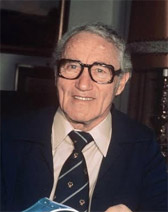
Adolf Dassler
German entrepreneur and founder of Adidas, a pioneer of specialized athletic footwear whose innovations helped shape the modern global sportswear industry.
Born on November 3, 1900
Died on September 6, 1978
Age at death: 78
Profession: Entrepreneur, Businessperson
Place of Birth: Herzogenaurach, Bavaria, Germany
Place of Death: Herzogenaurach, Bavaria, West Germany
Adolf "Adi" Dassler (November 3, 1900 – September 6, 1978) was a German entrepreneur, shoemaker, and sports footwear designer who founded Adidas, one of the world's leading sporting goods companies. He helped transform athletic footwear manufacturing by developing specialized shoes for different sports, emphasizing lightweight construction, functional design, and the specific requirements of individual athletes. Together with his brother Rudolf Dassler, who later founded Puma, he established the Dassler Brothers Shoe Factory in 1924. Following their separation in 1948, he registered Adidas in 1949. His company's international recognition grew through its association with Olympic athletes, including Jesse Owens, and the West German national football team's victory at the 1954 FIFA World Cup. His innovations in running spikes, football boots, and interchangeable studs contributed to the development of modern sports footwear.
Early Life and Family Background
Adolf Dassler, commonly known as Adi Dassler, was born on November 3, 1900, in Herzogenaurach, a small town in Bavaria, Germany. He was the son of Christoph Dassler and Pauline Dassler, who belonged to a working-class family connected with traditional craftsmanship and footwear production.
His father worked in the shoemaking trade, while his mother operated a laundry service from the family home. The laundry facilities would later become the location of Adi's earliest experiments in athletic shoe manufacturing.
He grew up with his brothers Rudolf Dassler and Fritz Dassler, and his sister Marie Dassler. His older brother Rudolf would eventually become both his business partner and one of his principal competitors.
Herzogenaurach had an established tradition of shoemaking, and the local economy provided opportunities for young craftsmen to learn about leatherworking, footwear construction, and related trades.
Dassler became interested in sports during childhood. He participated in athletics, football, boxing, ice hockey, javelin throwing, skiing, and ski jumping, developing practical familiarity with the demands of different sporting activities.
He frequently trained and participated in sports with his childhood friend Fritz Zehlein. Their activities encouraged him to observe how footwear affected movement, grip, stability, and comfort.
Education and Apprenticeship
In 1913, Adolf Dassler completed his formal schooling and began training as a baker, following his father's wishes.
Although he completed an apprenticeship, he had little interest in pursuing baking as a permanent profession. His enthusiasm remained focused on sports and footwear.
Through his family's connection with the local shoemaking industry, he began developing the practical skills necessary to repair and manufacture shoes.
He later received specialized technical education at the footwear training school in Pirmasens, an important center of the German shoe industry. During 1932 and 1933, he attended courses that helped improve his knowledge of footwear design, materials, and manufacturing techniques.
Military Service During World War I
In June 1918, during the final months of World War I, Adolf Dassler was called into military service.
He served in the German Army during the closing period of the conflict and remained in military service into 1919.
After returning to Herzogenaurach, he began pursuing his interest in shoemaking more seriously.
Germany's postwar economy faced shortages of materials, widespread unemployment, and difficulties associated with industrial reconstruction. These conditions influenced the methods and materials available to Dassler during his earliest experiments.
Beginning of Sports Shoe Manufacturing
In 1920, Adolf Dassler began producing and repairing shoes in a small workshop established in his mother's laundry room.
His initial objective was to develop athletic footwear that would improve performance in different sporting disciplines.
At a time when sports shoes were often heavy and relatively standardized, Dassler believed that athletes would benefit from footwear adapted to the particular requirements of their activities.
He experimented with leather, rubber, metal components, different sole constructions, and arrangements of studs or spikes.
For running shoes, he focused on reducing weight while providing adequate traction. For football boots, he studied the relationship between grip, durability, and the conditions of different playing surfaces.
His experiments involved repeated testing and modifications. He examined the effects of different designs while participating in sporting activities and receiving feedback from other athletes.
Working with local craftsmen, he developed early models of football boots and track shoes.
The Zehlein family's blacksmith workshop helped manufacture metal spikes used in athletic footwear. These components were important for developing shoes suitable for competitive running.
Innovation During the Early Workshop Years
The early years of Adolf Dassler's workshop were marked by limited financial resources and unreliable access to electricity.
To overcome interruptions in electrical power, he developed a mechanical system that allowed a leather-milling machine to operate through human pedal power.
The arrangement involved connecting the machine to a stationary bicycle by means of belts. Pedaling the bicycle supplied the energy required to operate the equipment.
This improvised solution became one of the frequently recounted examples of the practical ingenuity associated with the company's beginnings.
Dassler also reused available materials and adapted existing machinery to continue production despite shortages.
By 1921, his workshop had begun producing specialized athletic shoes more consistently, and the business gradually expanded beyond simple footwear repair.
Founding of the Dassler Brothers Shoe Factory
In 1923, Adolf Dassler's older brother Rudolf Dassler joined the growing footwear business.
On July 1, 1924, the brothers formally registered their company in Herzogenaurach under the name Gebrüder Dassler Schuhfabrik, meaning Dassler Brothers Shoe Factory.
The partnership brought together different professional strengths. Adi concentrated primarily on product development, manufacturing, and technical innovation, while Rudolf handled much of the commercial activity, sales, and business relationships.
In 1925, the company was manufacturing leather football boots with studs and lightweight running shoes fitted with metal spikes.
The brothers worked to improve the quality and durability of their products while expanding their relationships with athletes and sporting organizations.
In 1926, production moved into a larger factory building near the railway station in Herzogenaurach.
The new facilities allowed the brothers to increase manufacturing capacity and develop a broader range of athletic footwear.
1928 Amsterdam Olympic Games
One of the first international milestones for the Dassler brothers occurred at the 1928 Summer Olympics in Amsterdam, Netherlands.
German middle-distance runner Lina Radke competed wearing athletic shoes manufactured by the Dassler brothers.
Radke won the women's 800-meter race, becoming an Olympic gold medalist in an event that was being contested by women for the first time at the Games.
Her victory drew attention to the footwear used by competitive athletes and contributed to the growing recognition of Dassler shoes.
The company subsequently supplied footwear to participants in other major sporting competitions.
At the 1932 Summer Olympics in Los Angeles, German sprinter Arthur Jonath won a bronze medal in the men's 100 meters while wearing Dassler footwear.
These early Olympic associations helped establish the company's reputation among athletes and coaches before the Second World War.
Jesse Owens and the 1936 Berlin Olympics
The 1936 Summer Olympics in Berlin became a particularly important event in the history of Adolf Dassler's early footwear business.
During the Games, Dassler established contact with American sprinter and long jumper Jesse Owens, who competed in several track-and-field events.
According to accounts associated with the company's history, Owens wore specialized running shoes developed by the Dassler brothers.
Owens won four Olympic gold medals in Berlin, taking first place in the 100 meters, 200 meters, long jump, and 4 × 100 meters relay.
His performances became internationally significant because they took place in Nazi Germany, where the ruling regime promoted racial doctrines that were contradicted by the achievements of athletes such as Owens.
The story of Dassler supplying Owens with running shoes became one of the most widely repeated accounts of the company's early history. Although certain details of their initial meeting and the precise footwear arrangements remain difficult to establish conclusively, their association is documented in the company's historical accounts.
Owens and Dassler maintained contact after the Olympic Games. In later years, Owens participated in promotional activities associated with Adidas.
The 1936 Olympics contributed to the international reputation of the Dassler family's athletic footwear, particularly among competitive runners and sporting organizations.
Nazi Germany and Political Party Membership
On May 1, 1933, Adolf Dassler and his brother Rudolf Dassler joined the National Socialist German Workers' Party, commonly known as the Nazi Party.
Both remained party members until the end of World War II in 1945.
Their membership placed them within the political and economic system established under Adolf Hitler and the National Socialist government.
Historical accounts of Dassler's political involvement have distinguished between his documented party membership and the question of his personal ideological commitments.
Available evidence does not conclusively establish that Adi joined the party because of a deeply held commitment to Nazi ideology. Business owners in Germany frequently faced political and economic pressure to establish relationships with the ruling party in order to continue operating their companies.
However, the brothers' participation in the Nazi political system and the involvement of their business in wartime production remain significant aspects of the company's history.
Adi also held a supervisory role in local sports activities connected with the Hitler Youth organization.
These activities formed part of the broader relationship between organized sports, public institutions, and the Nazi government during the 1930s.
World War II and the Dassler Factory
The outbreak of World War II in September 1939 severely disrupted the operations of the Dassler Brothers Shoe Factory.
Shortages of leather, rubber, labor, and other essential materials restricted production. Government regulations increasingly directed industrial resources toward military requirements.
In 1940, Adolf Dassler was conscripted into the German armed forces and assigned to training as a radio operator.
He was stationed in Zirndorf, near Nuremberg, but subsequently sought release from military service because of his responsibilities at the family factory.
In 1941, he was discharged after his technical skills and involvement in footwear manufacturing were considered necessary for the business.
As the war continued, the German authorities expanded their control over civilian factories.
In 1943, the Dassler factory was redirected toward military production. Its equipment and workforce were adapted to manufacture components for anti-tank weapons, including parts associated with a shoulder-fired rocket launcher.
Sporting goods production was largely replaced by military manufacturing, although limited repair and footwear activities continued.
The war also intensified personal and professional tensions between Adi and Rudolf, whose disagreements over the operation of the business became increasingly serious.
Postwar Denazification and Factory Recovery
In April 1945, American forces entered Herzogenaurach as the Allied advance reached southern Germany.
The Dassler factory's involvement in wartime military manufacturing created uncertainty about whether it would be permitted to resume civilian production.
According to accounts preserved in the company's history, the Americans' knowledge of the factory's connection with Olympic athletes, including Jesse Owens, helped support its continued existence.
Following Germany's defeat, the Allied occupation authorities investigated individuals and businesses associated with the Nazi system.
Adolf Dassler initially received a classification that prevented him from exercising full control over his company.
During the denazification proceedings, he submitted testimony concerning his conduct and political involvement, including statements from employees and other individuals who supported his case.
He was eventually reclassified as a follower rather than an active Nazi offender and was allowed to resume control of the business.
After the war, the factory faced shortages of materials necessary for shoe production. Dassler and his employees used available substitutes, including rubber recovered from military equipment, canvas, and other surplus materials.
These practical adaptations helped the company resume production during the difficult postwar years.
Breakdown of the Partnership with Rudolf Dassler
Relations between Adolf Dassler and his brother Rudolf Dassler deteriorated significantly during the war and its immediate aftermath.
Disagreements concerning management, family relationships, business decisions, and responsibilities within the company contributed to their growing estrangement.
The brothers had considered separating their business interests as early as 1941, but wartime conditions prevented an immediate division.
After the war, their differences became increasingly difficult to resolve.
In 1948, the brothers formally dissolved their partnership and divided the assets and employees of the Dassler Brothers Shoe Factory.
Adi continued operating from one part of the existing manufacturing business, while Rudolf established a separate company.
The separation transformed the brothers from business partners into competitors, creating a rivalry that would continue for decades.
Rudolf Dassler and the Foundation of Puma
Following the division of the family business, Rudolf Dassler established his own sports footwear company in Herzogenaurach.
He initially considered the name Ruda, derived from the opening letters of his first and last names.
He subsequently adopted the name Puma, which became the official brand identity of the company.
Both businesses operated in the same small Bavarian town, competing for employees, customers, athletes, and relationships with sports organizations.
The rivalry between Adidas and Puma influenced the social and commercial life of Herzogenaurach.
Over time, the companies developed separate distribution networks and international marketing strategies, becoming major competitors in the global sporting goods industry.
Founding of Adidas in 1949
After separating from Rudolf, Adolf Dassler began developing his own independent sports footwear company.
He considered using the name Addas, formed from parts of his name, but ultimately selected the name Adidas.
The brand combined his nickname, Adi, with the opening letters of his surname, Dassler.
On August 18, 1949, he formally registered Adolf Dassler adidas Sportschuhfabrik in Herzogenaurach.
The new business began operations with 47 employees.
Dassler maintained his emphasis on specialized athletic footwear, seeking to develop products adapted to the requirements of different sports and competitive conditions.
His wife, Käthe Dassler, participated actively in the company's operations, helping manage its commercial activities and relationships with customers.
The new business gradually expanded its production facilities and established distribution relationships beyond Germany.
The Three Stripes Trademark
In 1949, Adolf Dassler registered footwear featuring three parallel stripes, establishing one of the most recognizable visual elements associated with the Adidas brand.
The stripes were initially incorporated into shoe designs as a distinctive identifying feature.
They also provided a visual element that could be recognized during athletic competitions and public appearances.
The three-stripe design became central to Adidas products and advertising.
Over time, the company extended the use of the stripes to sports clothing, accessories, and other products.
The design became a major element of the company's international brand identity.
1954 FIFA World Cup and the Miracle of Bern
One of the most important events in the early history of Adidas occurred during the 1954 FIFA World Cup in Switzerland.
The West German national football team, coached by Sepp Herberger, competed in the tournament against leading international teams.
Adolf Dassler had developed a professional relationship with Herberger and supplied the German team with specialized football boots.
The boots were comparatively lightweight and incorporated interchangeable screw-in studs that could be adapted to different ground conditions.
This design allowed players to use studs suitable for wet or muddy playing surfaces.
In the final on July 4, 1954, West Germany faced Hungary, a team led by players including Ferenc Puskás and Sándor Kocsis.
Hungary entered the final as the favored team and had defeated West Germany 8–3 earlier in the tournament.
Despite falling behind by two goals, West Germany recovered to win the match 3–2.
The victory became known as the Miracle of Bern and acquired major cultural significance in postwar West Germany.
The Adidas boots worn by the German players received substantial attention because of their lightweight construction and interchangeable studs.
The event contributed to the international recognition of the Adidas brand and helped establish its reputation in football equipment.
Expansion of Adidas and Sports Innovation
Following the 1954 World Cup, Adolf Dassler expanded Adidas production into a broader range of specialized athletic footwear.
The company developed shoes for running, football, jumping events, indoor sports, and other athletic activities.
Dassler maintained regular contact with athletes, trainers, and sporting organizations to understand their technical requirements.
His approach emphasized direct observation and repeated product testing.
He sought to identify how footwear could influence traction, weight, flexibility, stability, and protection against injury.
In 1955, Adidas developed football footwear incorporating additional protection around the outer part of the foot.
In 1957, the company introduced football boots featuring nylon soles, helping reduce overall shoe weight.
Further innovations included running shoes with systems for interchangeable spikes mounted in synthetic soles.
During the 1960s and 1970s, Adidas expanded into additional categories of sporting goods, including athletic clothing and equipment.
The company's growth was supported by international sporting competitions, relationships with professional athletes, and expanding distribution networks.
Relationships with Olympic Athletes
Adolf Dassler regarded direct cooperation with athletes as an essential element of footwear development.
He frequently visited training facilities and sporting competitions to observe athletes using Adidas products.
These relationships allowed him to modify shoe designs according to the requirements of individual competitors.
German footballer Uwe Seeler was among the athletes associated with Adidas footwear innovations. Following an Achilles tendon injury, he used specially developed boots designed to provide additional support and protection.
At the 1972 Summer Olympics in Munich, West German athlete Heide Ecker-Rosendahl won two gold medals while wearing specialized Adidas footwear.
The shoes incorporated distinctive sole features intended to improve grip during competitive events.
Such products reflected Dassler's longstanding principle that footwear should be developed in response to the demands of a particular sport.
Family and Marriage
Adolf Dassler met Käthe Martz in Pirmasens during his period of technical footwear education.
The couple married on March 17, 1934.
They had five children: Horst Dassler, Inge Dassler, Karin Dassler, Brigitte Dassler, and Sigrid Dassler.
Käthe became closely involved in the management of Adidas, contributing to commercial operations, organizational responsibilities, and relationships with athletes.
Their son Horst Dassler, born in 1936, later assumed significant management responsibilities within the company.
Horst became involved in international sporting goods marketing and helped develop commercial relationships between Adidas and major sporting organizations.
The Dassler family's involvement in Adidas continued after the founder's death.
Final Years and Death
During the final years of his life, Adolf Dassler continued taking an interest in the development of Adidas products and the company's manufacturing operations.
By the 1970s, Adidas had become an internationally recognized sportswear brand with products used by athletes in numerous countries.
Dassler remained associated with the company's technical approach to sports footwear, even as its management and commercial activities became increasingly complex.
Adolf Dassler died on September 6, 1978, in Herzogenaurach, West Germany, at the age of 77.
Following his death, his wife Käthe Dassler and son Horst Dassler continued managing the company.
The business remained associated with the Dassler family before subsequent changes in ownership and corporate management.
Major Business Milestones
1900 – Born in Herzogenaurach, Bavaria, Germany
1913 – Completed school and began a baking apprenticeship
1918–1919 – Served in the German Army during the final period of World War I
1920 – Began producing athletic shoes in his mother's laundry room
1923 – Brother Rudolf Dassler joined the footwear business
1924 – Founded Gebrüder Dassler Schuhfabrik with Rudolf Dassler
1925 – Began manufacturing specialized football boots and spiked running shoes
1928 – Dassler footwear used during the Amsterdam Olympic Games
1932 – Dassler shoes used by Olympic athletes in Los Angeles
1933 – Joined the Nazi Party with Rudolf Dassler
1934 – Married Käthe Martz
1936 – Associated with Olympic champion Jesse Owens during the Berlin Games
1940–1941 – Served in the German armed forces as a radio operator
1943 – Factory redirected toward military production
1945–1947 – Postwar factory recovery and denazification proceedings
1948 – Dissolved the business partnership with Rudolf Dassler
1949 – Founded Adidas with 47 employees
1949 – Registered footwear featuring the three-stripe design
1954 – Adidas footwear used by West Germany during its FIFA World Cup victory
1955 – Developed football boots with additional protective features
1957 – Introduced football footwear incorporating nylon soles
1962 – Developed running shoes with interchangeable spikes mounted in nylon soles
1972 – Adidas footwear used by Olympic athletes during the Munich Games
1978 – Died in Herzogenaurach at the age of 77
Source: Biyografiler.com
Frequently asked questions about Adolf Dassler
Who is Adolf Dassler?, Adolf Dassler biography, Adolf Dassler life story, Adolf Dassler age, Adolf Dassler facts, Adolf Dassler birthplace, Adolf Dassler photos, Adolf Dassler videos, Adolf Dassler career
Related Biographies

Lamine Yamal
Professional footballer

Erling Haaland
Professional footballer

Keanu Reeves
Actor

Kylian Mbappe
Professional footballer

Austin Abrams
Actor

Bad Bunny
Rapper, Songwriter

Alex Konanykhin
Entrepreneur, Investor

Alexis Tsipras
Politician, Former Prime Minister

Alan Arkin
Actor, Film Director

Alain Resnais
Film Director, Screenwriter

Alain Prost
Formula 1 Driver

Akon
Singer, Rapper

Adewale Akinnuoye-Agbaje
Actor, Former Model

John Healey
Politician
Erling Haaland
Professional footballer

Ursula von der Leyen
Politician, Physician

Christine Lagarde
Lawyer, Politician
Lamine Yamal
Professional footballer