
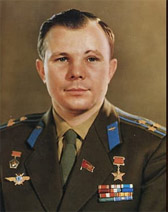
Yuri Gagarin
First human in space
Born on March 9, 1934
Died on March 27, 1968
Age at death: 34
Profession: Astronaut
Place of Birth: Klushino, Smolensk Oblast, Soviet Union
Place of Death: Near Kirzhach, Vladimir Oblast, Soviet Union
Yuri Gagarin, born Yuri Alekseyevich Gagarin, was a Soviet cosmonaut who became the first human to travel into space on April 12, 1961. His historic flight aboard Vostok 1 marked a defining moment in the Space Race and established him as an international symbol of scientific achievement and Cold War-era Soviet prestige.
Early Life and Wartime Hardship
Yuri Gagarin was born on March 9, 1934, in the village of Klushino near Gzhatsk (later renamed Gagarin in his honor). His parents, Anna Timofeyevna Gagarina and Alexei Ivanovich Gagarin, were collective farm workers in the Soviet Union.
During World War II, the Gagarin family endured severe hardship under German occupation. In 1943, his two older siblings were deported to Germany for forced labor and did not return until after the war. These formative years shaped Gagarin’s resilience and determination.
From a young age, he developed an interest in aviation and space. After working briefly as a foundry apprentice, he was admitted to a technical school in Saratov, where he joined the local Aero Club. There, he learned to fly light aircraft—an experience that defined his future career.
Military Aviation Career
After completing his technical education, Yuri Gagarin entered military flight training in 1955. During this period, he met Valentina Goryacheva, whom he married in 1957. Upon graduation, he was assigned to Luostari Air Base in Murmansk Oblast.
Standing at approximately 1.57 meters tall, Gagarin’s relatively short stature later proved advantageous for fitting inside the compact cockpit of the Vostok spacecraft.
Selection as a Cosmonaut
In 1960, following an intensive selection process, Yuri Gagarin was chosen as one of 20 candidates for the Soviet space program. The physical and psychological tests were rigorous, designed to measure endurance under extreme isolation and stress.
After final evaluations, Gagarin and Gherman Titov emerged as the top two candidates for the first human spaceflight. Soviet leadership ultimately selected Gagarin, considering not only his technical qualifications but also his calm demeanor, charisma, and ability to represent the Soviet Union internationally.
First Human in Space
On April 12, 1961, Yuri Gagarin launched aboard the spacecraft Vostok 1 (Vostok 3KA-2). His call sign during the mission was “Kedr” (Cedar). The flight lasted 108 minutes and completed one orbit of Earth.
During the mission, Soviet authorities promoted him from senior lieutenant to major. His safe return marked a technological triumph for the Soviet Union and a dramatic escalation in the Space Race against the United States, whose first astronaut in space, Alan Shepard, would fly less than a month later.
Gagarin’s famous exclamation, “Poyekhali!” (“Let’s go!”), became one of the most iconic phrases in the history of space exploration.
International Recognition
Following his successful mission, Yuri Gagarin embarked on an extensive international tour to promote Soviet achievements in space. He visited countries including the United Kingdom, Italy, Germany, Canada, and Japan, receiving numerous honors and decorations.
He was awarded the title Hero of the Soviet Union and received medals and honorary distinctions from many nations. His image became synonymous with human exploration beyond Earth.
Later Career and Research
After returning to the Soviet Union, Gagarin continued to work within the space program, contributing to the development of future spacecraft, including early research related to reusable systems. Although he trained for additional missions, Soviet authorities were cautious about risking their national hero in further flights.
Death
On March 27, 1968, Yuri Gagarin died during a routine training flight when the MiG-15 jet he was piloting crashed near Kirzhach. The exact cause of the accident has never been definitively established, though later investigations suggested turbulence from a nearby Su-11 aircraft may have contributed.
His death at the age of 34 shocked the Soviet Union and the global community. He was buried with full state honors in the Kremlin Wall Necropolis in Moscow.
Legacy
Yuri Gagarin remains one of the most celebrated figures in the history of space exploration. As the first human to journey into outer space, he not only altered scientific history but also reshaped humanity’s perception of its place in the universe. His flight paved the way for subsequent missions by astronauts and cosmonauts, including Alan Shepard and later Neil Armstrong, marking the beginning of the era of human spaceflight.
Source: Biyografiler.com
Frequently asked questions about Yuri Gagarin
Who is Yuri Gagarin?, Yuri Gagarin biography, Yuri Gagarin life story, Yuri Gagarin age, Yuri Gagarin facts, Yuri Gagarin birthplace, Yuri Gagarin photos, Yuri Gagarin videos, Yuri Gagarin career
Related Biographies

Lamine Yamal
Professional footballer

Sam Altman
Entrepreneur, Investor, CEO

Kylian Mbappe
Professional footballer

Alice Weidel
Politician, Economist

Erling Haaland
Professional footballer

Giorgia Meloni
Politician, Journalist


Hongjoong
Singer, Rapper, Songwriter, Composer

Ludacris
Rapper, Actor

Kwon Eunbi
Singer

Sarah Wayne Callies
Actress, Screenwriter, Producer, Director

LaTavia Roberson
Singer, Actress, Entrepreneur
Lamine Yamal
Professional footballer

Xi Jinping
Politician, Statesman, Head of State
Kylian Mbappe
Professional footballer

Brad Pitt
Actor

Sydney Sweeney
Actress

Neymar
Professional footballer