
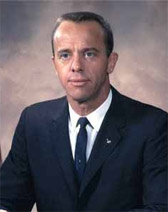
Alan Shepard
First American in space and fifth human to walk on the Moon
Born on November 18, 1923
Died on July 21, 1998
Age at death: 75
Profession: Astronaut
Place of Birth: Derry, New Hampshire, United States
Place of Death: Pebble Beach, California, United States
Alan Shepard, born Alan Bartlett Shepard Jr., was an American astronaut, naval aviator, and test pilot who became the first American to travel into space and later one of the few humans to walk on the Moon. A pioneering figure of the early U.S. space program, Shepard played a central role in both the Mercury and Apollo missions, marking historic milestones during the Space Race against the Soviet Union led in space by Yuri Gagarin.
Early Life and Naval Career
Alan Shepard was born on November 18, 1923, in Derry, New Hampshire. He graduated from the United States Naval Academy in Annapolis in 1944 and joined the United States Navy during the final phase of World War II. After serving with the Atlantic Fleet, he became a naval aviator in 1946 and later qualified as a test pilot in 1950.
In 1957, Shepard graduated from the U.S. Naval War College, strengthening his strategic and operational credentials. His combination of flight experience and technical precision made him an ideal candidate for the emerging American space program.
The Mercury Seven
In 1959, Alan Shepard was selected as one of NASA’s original Mercury Seven astronauts. The group consisted of Scott Carpenter, Gordon Cooper, John Glenn, Gus Grissom, Wally Schirra, Deke Slayton, and Shepard himself. These men became the public faces of America’s first human spaceflight program.
The selection marked the beginning of intense training and preparation for the Mercury Program, designed to send an American astronaut into space in response to Soviet achievements.
First American in Space
On May 5, 1961, aboard the spacecraft Freedom 7, Alan Shepard piloted the Mercury-Redstone 3 mission, becoming the first American in space. The launch took place from Cape Canaveral, and the spacecraft reached an altitude of approximately 187.5 kilometers during its suborbital flight.
Although Shepard’s mission did not reach orbit, he manually controlled the spacecraft’s orientation, making him the first astronaut to pilot a spacecraft by hand. The capsule splashed down safely in the Atlantic Ocean near the Bahamas and was recovered by helicopter before being transported to the aircraft carrier USS Lake Champlain.
Shepard’s flight followed the historic orbital mission of Soviet cosmonaut Yuri Gagarin, who had become the first human in space on April 12, 1961, aboard Vostok 1. Shepard’s achievement restored national confidence in the American space effort.
Return to Flight and Apollo 14
Shortly after his Mercury mission, Shepard was grounded due to Ménière’s disease, an inner ear disorder that affected his balance. After undergoing corrective surgery, he returned to active flight status and was assigned as commander of Apollo 14.
Launched on January 31, 1971, Apollo 14 included crew members Stuart Roosa and Edgar Mitchell. The command module was named Kitty Hawk, and the lunar module was named Antares. On February 5, 1971, Shepard and Mitchell landed on the Moon.
The astronauts conducted two extravehicular activities (EVAs), spending approximately 33 hours on the lunar surface and about nine hours performing moonwalks. They collected lunar samples and scientific data critical to understanding the Moon’s geological history.
During the mission, Alan Shepard famously hit two golf balls on the Moon using a makeshift club head attached to a sampling tool, becoming the first—and so far only—person to play golf on the lunar surface. The golf balls remain on the Moon today.
Later Career and Promotion
On August 25, 1971, Alan Shepard was promoted to rear admiral, becoming the first astronaut to reach flag officer rank. He later retired from both NASA and the United States Navy on July 31, 1974, with the rank of vice admiral.
Personal Life
Alan Shepard married Louise Brewer on March 3, 1945. The couple had three daughters and remained married throughout his lifetime. Despite the pressures of public life and spaceflight risk, Shepard maintained a relatively private family life.
Death and Legacy
Alan Shepard died of leukemia on July 21, 1998, at the age of 75 in Pebble Beach, California.
In 2011, the United States Postal Service issued a commemorative stamp honoring Shepard and the Mercury Program, featuring the inscription “Alan Shepard: First American in Space.”
As a member of the Mercury Seven and commander of Apollo 14, Alan Shepard stands alongside figures such as John Glenn and Neil Armstrong as one of the foundational personalities of the American space program. His career bridged the earliest days of suborbital flight and the era of lunar exploration, securing his place in the history of human spaceflight.
Source: Biyografiler.com
Frequently asked questions about Alan Shepard
Who is Alan Shepard?, Alan Shepard biography, Alan Shepard life story, Alan Shepard age, Alan Shepard facts, Alan Shepard birthplace, Alan Shepard photos, Alan Shepard videos, Alan Shepard career
Related Biographies

Lamine Yamal
Professional footballer

Sam Altman
Entrepreneur, Investor, CEO

Kylian Mbappe
Professional footballer

Alice Weidel
Politician, Economist

Erling Haaland
Professional footballer

Giorgia Meloni
Politician, Journalist


Hongjoong
Singer, Rapper, Songwriter, Composer

Ludacris
Rapper, Actor

Kwon Eunbi
Singer

Sarah Wayne Callies
Actress, Screenwriter, Producer, Director

LaTavia Roberson
Singer, Actress, Entrepreneur
Lamine Yamal
Professional footballer

Xi Jinping
Politician, Statesman, Head of State
Kylian Mbappe
Professional footballer

Brad Pitt
Actor

Neymar
Professional footballer

Sydney Sweeney
Actress