
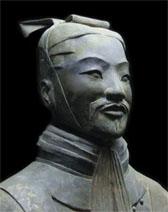
Sun Tzu
Ancient Chinese Military Strategist and Philosopher, Author of The Art of War
Born on ?? ??, 0544
Died on 0473
Age at death: -71
Profession: Military Commander, Philosopher
Place of Birth: State of Ch’i (Qi), ancient China
Place of Death: Ancient China (exact location unknown)
Sun Tzu was a Chinese military commander. The conversations collected in his writings on war strategy, later known as The Art of War, are accepted as the oldest strategic theories in the world.
Sun Tzu was born in 544 BC. His real names are recorded as Sun-Tzu, Sun-Wu, and Sun-Zi. The meaning of his name is interpreted as “the sun of the master.” He was born in the State of Ch’i during the 5th century BC, within the borders of present-day China. A Chinese sage, soldier, and philosopher, Sun Tzu lived around 500 BC in the State of Wu, also within the territory of modern China.
His book on war strategy, The Art of War, is regarded as the world’s oldest collection of strategic theories. The writings, gathered into 13 chapters, are believed to be a comprehensive presentation of warfare principles known in China long before his time, unified under the interpretation of Master Sun Tzu during the Warring States period (480–221 BC).
In these conversations, Sun Tzu described “True Victory” with the following words: “True victory is the victory won without fighting. The true leader is the one who wins without war.”
Although the exact years of his life are unknown, his emergence is known to coincide with the Warring States period. In China, where the written tradition is ancient and strong, the uncertainty surrounding the lifespans of sages is often explained by their tendency to withdraw from public life toward the end of their lives.
His guiding words have retained their value for 2,500 years. Sun Tzu’s work The Art of War has directly influenced many famous figures in sports, politics, science, and art, helping them in decision-making processes. Among them are Mao Zedong, General Nguyen Giap, Douglas MacArthur, Napoleon Bonaparte, and Adolf Hitler. His principles are applied not only in military affairs but also extensively in economics and the business world.
While defining the principles of The Art of War, Sun Tzu drew inspiration from events of his own era. However, the 384 principles of war he articulated have not lost their relevance. For this reason, today Sun Tzu’s principles are taught as textbooks in military academies across the world, particularly in the United States.
Sun Tzu died in 473 BC at the age of 71.
Books
The Art of War (Chinese: 兵法, Pinyin: Bīng Fǎ)
Sayings of Sun Tzu
Keep your friends close, and your enemies even closer.
Build your opponent a golden bridge to retreat across.
If your forces are equal, you may still engage. If your strength is weak, avoid the enemy. But if you are weaker in every respect, retreat. This is a wise course of action.
Leave an outlet for a surrounded enemy. Do not drive the enemy into complete despair.
Apply your ideas correctly and do not deviate from what you know to be right.
The true leader cultivates moral authority and clings firmly to discipline, thus controlling success.
Morality and discipline bring success.
In war, conceal your emotions, movements, and intentions from the enemy. You will win.
Do not allow the enemy to know you.
Do not fear struggle; success requires courage and preparation.
The better you analyze events and the more knowledge you possess, the more accurate your decisions will be.
Life is sometimes surrendering to the current and sometimes crossing to the opposite shore. You must know which is which.
If you are weak, appear strong. If you are strong, appear weak. Victory will be yours.
There are two keys to success: Know yourself — discover what you can do and your limits. Know life — learn the rules of the game and become the best player.
The Five Essential Conditions for Victory
- (a) Victory belongs to the one who knows when to fight and when not to fight.
- (b) Victory belongs to the one who uses both weak and strong forces effectively.
- (c) Victory belongs to the one who instills the same spirit throughout the entire army.
- (d) Victory belongs to the one who waits for the enemy’s unprepared moment.
- (e) Victory belongs to the commander who possesses military authority without civilian interference.
The Chapters of The Art of War
- I. Planning (25 Articles)
- II. The Cost of War (19 Articles)
- III. Strategy in War (19 Articles)
- IV. Tactics (20 Articles)
- V. Energy (23 Articles)
- VI. Use of Force (34 Articles)
- VII. Maneuvering (37 Articles)
- VIII. Tactical Adaptation (14 Articles)
- IX. The Army on the March (45 Articles)
- X. Terrain (31 Articles)
- XI. The Nine Situations (68 Articles)
- XII. Attack by Fire (22 Articles)
- XIII. Espionage and Intelligence (27 Articles)
Selected Aphorisms from the Book
In all warfare, the best victory is not to conquer by fighting, but to break the enemy’s resistance without battle.
If you know both the enemy and yourself, you need not fear the result of a hundred battles. If you know yourself but not the enemy, you will win one and lose one. If you know neither yourself nor the enemy, you will lose every battle.
When people unite, the brave cannot advance alone, nor can the fearful retreat alone.
The skilled soldier does not become angry. The victorious soldier is fearless. The wise conquer before fighting; the ignorant fight to conquer.
Sun Tzu on War
According to Sun Tzu, if the enemy intends to attack, preparation for defensive warfare must begin long in advance. The most important task is to seek ways to defeat the enemy before engaging in battle.
War must be analyzed through enemy, weather, and terrain conditions. Commanders must issue clear and understandable orders. War is a matter of life and death for a nation — the key either to victory or captivity.
The main objective of war must always be victory. As wars drag on, weapons lose effectiveness and morale deteriorates. No nation has ever benefited from prolonged warfare.
Speed and swiftness are the keys to victory. All material and moral resources of the state must be utilized. First, the enemy’s alliance system must be dismantled, then direct attacks may follow.
If the enemy is fortified and well-defended, direct assault is unwise. Other means of victory must be found.
If the enemy is stronger, avoid him. If the enemy is unstable, disturb him. If the enemy is arrogant, never appear weak.
The highest form of warfare is to defeat the enemy without fighting.
Sun Tzu – Knowing the Enemy
If you know the enemy and know yourself, you will not be imperiled in a hundred battles.
Sun Tzu – Tactics and Strategy
Strategy without tactics is the slowest route to victory. Tactics without strategy is the noise before defeat.
Sun Tzu – Deception
All warfare is based on deception. If capable, feign incapacity. If near, appear far.
Sun Tzu – Command
Treat your soldiers as your own children, and they will follow you into the deepest valleys.
Sun Tzu – Retreat
Build your enemy a golden bridge to retreat across.
Source: Biyografiler.com
Frequently asked questions about Sun Tzu
Who is Sun Tzu?, Sun Tzu biography, Sun Tzu life story, Sun Tzu age, Sun Tzu facts, Sun Tzu birthplace, Sun Tzu photos, Sun Tzu videos, Sun Tzu career
Related Biographies

Lamine Yamal
Professional footballer

Kylian Mbappe
Professional footballer

Erling Haaland
Professional footballer

Sam Altman
Entrepreneur, Investor, CEO

Austin Abrams
Actor

Bad Bunny
Rapper, Songwriter


Hongjoong
Singer, Rapper, Songwriter, Composer

Ludacris
Rapper, Actor

Kwon Eunbi
Singer

Sarah Wayne Callies
Actress, Screenwriter, Producer, Director

LaTavia Roberson
Singer, Actress, Entrepreneur

Pedro Sanchez
Politician

Adam Sandler
Actor

Cillian Murphy
Actor
Lamine Yamal
Professional footballer
Austin Abrams
Actor

Brad Pitt
Actor