
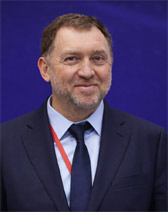
Oleg Deripaska
A powerful oligarch shaped by post-Soviet privatization and global aluminum markets
Born on January 2, 1968
Age: 58
Profession: Businessperson
Place of Birth: Dzerzhinsk, Soviet Union (now Russia)
Oleg Deripaska is a Russian billionaire businessman and oligarch, best known as the founder of Basic Element and for his leadership roles in major industrial entities such as Rusal and En+ Group. Emerging during the turbulent post-Soviet privatization era, he became one of the most influential figures in Russia’s metals and energy sectors. Often mentioned alongside prominent oligarchs like Roman Abramovich and figures within Russia’s political and economic sphere such as Vladimir Putin, Oleg Deripaska represents a generation of industrialists who reshaped the country’s economic landscape after the collapse of the Soviet Union.
Early Life and Education
Oleg Deripaska, January 2, 1968 tarihinde Soviet Union’ın Dzerzhinsk kentinde doğmuştur. He spent much of his childhood in southern Russia, in the Kuban region near Ust-Labinsk, where rural life and disciplined upbringing shaped his early character. From a young age, he showed a strong inclination toward reading and scientific subjects, particularly physics and mathematics.
During his school years, Oleg Deripaska excelled academically and graduated from School No. 2 in Ust-Labinsk. At the age of eleven, he began working part-time as an electrician’s assistant at a local factory, gaining early exposure to industrial environments—an experience that would later influence his career path.
He later enrolled at Moscow State University, where he studied physics. In 1986, he was conscripted into the Soviet Army and served for two years in the Strategic Missile Forces. After completing his service, he returned to university, focusing on quantum statistics and field theory, and graduated with honors. In 1996, he obtained a second degree in economics from Plekhanov Russian University of Economics, blending technical knowledge with financial expertise.
Early Business Ventures
Oleg Deripaska began his entrepreneurial journey during his university years, co-founding a trading company focused on metal exports. This venture marked his entry into the industrial sector at a time when Russia’s economy was undergoing rapid transformation.
In 1994, at just 26 years old, he acquired a controlling stake in the Sayanogorsk aluminum smelter and became its general director. This move positioned him at the center of Russia’s emerging aluminum industry and laid the groundwork for his future empire.
Formation of Rusal and Industrial Expansion
In 1997, Oleg Deripaska founded Siberian Aluminium, which later merged with Roman Abramovich’s investment company Millhouse Capital. This consolidation led to the formation of Rusal, one of the largest aluminum producers in the world.
In 2007, Rusal expanded further through a merger involving SUAL Group and the alumina assets of Glencore, transforming it into a global leader in aluminum production. Through these strategic consolidations, Oleg Deripaska became a central figure in the global metals market.
Basic Element and Diversified Holdings
In 2001, Oleg Deripaska established Basic Element, a diversified industrial holding company with interests spanning energy, mining, aviation, construction, and manufacturing. The group quickly grew into one of Russia’s largest industrial conglomerates, reflecting the scale and ambition of his business operations.
His companies were also involved in major infrastructure projects, including preparations for the 2014 Sochi Winter Olympics, where Basic Element contributed to the reconstruction of Sochi International Airport and the development of key Olympic facilities.
“Aluminum Wars” and Post-Soviet Context
Oleg Deripaska was a key participant in the so-called “aluminum wars” of the 1990s, a period marked by intense competition, consolidation, and often violent disputes over control of industrial assets following the collapse of the Soviet Union. Alongside figures like Roman Abramovich and other emerging oligarchs, he navigated a volatile environment to secure dominant positions in strategic industries.
This era defined the structure of modern Russian capitalism, with Oleg Deripaska emerging as one of its most successful and controversial beneficiaries.
Financial Challenges and Resilience
Before the global financial crisis of 2007–2008, Oleg Deripaska was considered one of the richest individuals in Russia. However, the crisis significantly impacted his wealth, forcing him to restructure debts and reassess his holdings.
Despite these setbacks, he maintained influence in the industrial sector. According to Forbes estimates, his net worth remained around $5 billion as of 2026, reflecting both resilience and continued relevance in global markets.
Philanthropy and Social Initiatives
In 2008, Oleg Deripaska founded the Volnoye Delo Foundation, aimed at supporting education, science, and cultural initiatives across Russia. Through this foundation, he funded numerous social and educational programs, particularly in regional areas.
His company Rusal also played a role in international health efforts, including establishing an epidemiological center in Guinea during the Ebola outbreak between 2014 and 2016. These activities positioned Oleg Deripaska as a figure engaged not only in business but also in global humanitarian efforts.
Sanctions and Political Context
Oleg Deripaska has been a subject of international attention due to sanctions imposed by Western governments. In 2018, the United States sanctioned him in connection with geopolitical tensions following the annexation of Crimea. In 2022, the United Kingdom included him among Russian oligarchs targeted by sanctions related to the Russia–Ukraine war.
Despite these measures, he has occasionally made public statements advocating for peace, including remarks warning against destructive policies toward Ukraine. His position reflects the complex intersection of business, politics, and international relations in which he operates.
Personal Life
Oleg Deripaska married Polina Deripaska (Polina Yumasheva) in 2001, and the couple had two children, Pyotr and Maria. They later divorced in 2018. His personal life, like his business career, has often been intertwined with Russia’s political and economic elite.
In 2017, Oleg Deripaska acquired citizenship in Cyprus, further reflecting his international financial and personal connections. Today, he remains a significant figure in global industry, particularly within the aluminum and energy sectors, representing the enduring legacy of post-Soviet industrial capitalism.
Source: Biyografiler.com
Frequently asked questions about Oleg Deripaska
Who is Oleg Deripaska?, Oleg Deripaska biography, Oleg Deripaska life story, Oleg Deripaska age, Oleg Deripaska facts, Oleg Deripaska birthplace, Oleg Deripaska photos, Oleg Deripaska videos, Oleg Deripaska career
Related Biographies

Lamine Yamal
Professional footballer

Sam Altman
Entrepreneur, Investor, CEO

Kylian Mbappe
Professional footballer

Alice Weidel
Politician, Economist

Erling Haaland
Professional footballer

Giorgia Meloni
Politician, Journalist


Hongjoong
Singer, Rapper, Songwriter, Composer

Ludacris
Rapper, Actor

Kwon Eunbi
Singer

Sarah Wayne Callies
Actress, Screenwriter, Producer, Director

LaTavia Roberson
Singer, Actress, Entrepreneur

Lady Gaga
Singer, Musician, Songwriter, Actress, Producer
Lamine Yamal
Professional footballer

Delcy Rodriguez
Politician, Lawyer, Diplomat


Taylor Swift
Singer, Musician, Songwriter

Austin Abrams
Actor