
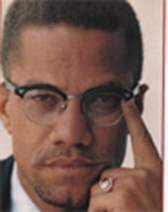
Malcolm X
African American civil rights leader who served as a spokesman for the Nation of Islam before founding Muslim Mosque, Inc. and the Organization of Afro-American Unity in 1964. After making the pilgrimage to Mecca, he adopted the name El-Hajj Malik El-Shabazz.
Born on May 19, 1925
Died on February 21, 1965
Age at death: 40
Profession: Civil Rights Leader, Human Rights Activist
Place of Birth: Omaha, Nebraska, United States
Place of Death: New York City, United States
Malcolm X, born Malcolm Little on May 19, 1925, in Omaha, Nebraska, was an African American Muslim minister, political speaker, and civil rights activist. He advocated racial equality, Black self-determination, economic independence, and protection against racist violence. After joining the Nation of Islam during his imprisonment, he became one of the organization's principal spokesmen. He left the movement in 1964, embraced Sunni Islam, and adopted the name El-Hajj Malik El-Shabazz following his pilgrimage to Mecca. He subsequently founded Muslim Mosque, Inc. and the Organization of Afro-American Unity. He was assassinated in New York City on February 21, 1965, at the age of 39.
Early Life and Family
Malcolm X was born Malcolm Little in Omaha, Nebraska. His father, Earl Little, was a Baptist preacher and an organizer for the Universal Negro Improvement Association (UNIA), established by Marcus Garvey. His mother, Louise Norton Little, was born in Grenada in the Caribbean and was also active in the organization.
Louise was of mixed African and European ancestry. Both parents supported Garvey's ideas concerning Black pride, economic independence, and the political organization of people of African descent.
Malcolm's family experienced racial harassment and threats during his childhood. After living in Omaha, they moved through Milwaukee and other cities before settling in Lansing, Michigan.
In 1929, the family's home in Lansing was destroyed by fire. Malcolm's family believed the fire had been deliberately started by white supremacists associated with the Black Legion, an extremist organization operating in the region.
On September 28, 1931, his father died after being struck by a streetcar. Authorities classified the death as an accident, but Malcolm and his family believed that white supremacists had been responsible. The allegation of murder was never conclusively established.
Following Earl Little's death, the family experienced serious financial difficulties. Louise Little struggled to support her children and was eventually admitted to Kalamazoo State Hospital in 1939. The children were separated and placed in different foster homes and institutions.
Education and Adolescence
Malcolm X was placed in foster care and attended school in Mason, Michigan. He performed well academically and was elected class president during his junior high school years.
As a student, he wanted to become a lawyer. According to his later autobiography, a teacher discouraged him from pursuing that profession and suggested carpentry instead, arguing that becoming a lawyer was not a realistic ambition for a Black student.
Malcolm left formal education after the eighth grade. In 1941, he moved to Boston to live with his older half-sister Ella Little-Collins, who had previously encouraged him to leave Michigan.
In Boston, he lived in the predominantly African American Roxbury neighborhood. He worked in restaurants, on railroads, and in other temporary jobs.
Life in Boston and Harlem
During his late teenage years, Malcolm X became involved in street gambling, theft, drug use, and other illegal activities. He spent time in Boston and New York's Harlem neighborhood.
He became known by the nickname Detroit Red, a reference to his reddish hair and earlier associations with Detroit. His later autobiography described the criminal networks and street culture with which he had become involved.
In January 1946, he was arrested in Massachusetts on charges including burglary and larceny. He received a prison sentence of eight to ten years and began serving it in February 1946, when he was twenty years old.
Prison Years and Religious Conversion
While imprisoned, Malcolm X began an extensive program of reading and self-education. He studied history, philosophy, religion, dictionaries, and other subjects available through prison libraries.
He participated in prison debate activities and developed the speaking and argumentative skills that would later characterize his public appearances.
His siblings introduced him to the teachings of the Nation of Islam, a religious and Black nationalist organization founded by Wallace Fard Muhammad and subsequently led by Elijah Muhammad.
Malcolm began corresponding with Elijah Muhammad and studying the organization's teachings. He adopted its emphasis on religious discipline, abstinence from alcohol and drugs, and the economic independence of African Americans.
He later described prison as a place where he had acquired an education through independent study. His reading habits and involvement in debates became central to his intellectual development.
Release from Prison and the Nation of Islam
On August 7, 1952, Malcolm X was released on parole after serving approximately six and a half years in prison. He moved to Detroit to live with his brother Wilfred and joined the local Nation of Islam congregation.
He abandoned the surname Little, which he considered a name inherited from the history of slavery. Following the organization's practice, he adopted the letter X to represent the African family name that had been lost through enslavement.
In 1953, Elijah Muhammad appointed him assistant minister of the organization's Detroit temple. Later that year, he became minister of its Boston congregation.
In 1954, he was appointed minister of Temple No. 7 in Harlem, New York. He subsequently became one of the Nation of Islam's most visible public representatives.
Nation of Islam Teachings and Political Views
During his years in the Nation of Islam, Malcolm X defended Black economic independence, separate institutions, and the right of African Americans to organize outside white-controlled political and social structures.
The organization taught that white society had systematically oppressed Black Americans and that separation was necessary to achieve genuine independence. Some of its religious teachings, including the description of white people as inherently evil, differed substantially from mainstream Sunni Islamic doctrine.
Malcolm adopted and publicly defended these positions during much of his association with Elijah Muhammad.
The Nation of Islam also enforced rules concerning alcohol, drugs, gambling, sexuality, diet, and personal discipline. Malcolm's speeches presented these practices as part of the organization's program for personal and community development.
He advocated the right of Black communities to defend themselves against racist attacks and questioned whether racial integration alone could eliminate discrimination.
Public Speeches and Organizational Growth
Malcolm X traveled throughout the United States, delivering lectures and organizing new Nation of Islam congregations. His public appearances included university debates, television interviews, radio programs, and political meetings.
He helped develop the organization's publishing activities, including the newspaper Muhammad Speaks, which began publication in 1960.
During his years as a minister, Nation of Islam membership grew from several hundred followers in the early 1950s to tens of thousands by the early 1960s. Malcolm was among the principal figures involved in recruiting members and establishing congregations.
In 1961, Elijah Muhammad appointed him national representative of the organization.
His speeches frequently examined the history of slavery, racial segregation, discrimination in education and employment, police violence, and restrictions on political participation.
Differences with Martin Luther King Jr.
Malcolm X criticized aspects of the American civil rights movement, particularly its commitment to nonviolent resistance and racial integration.
He disagreed with Martin Luther King Jr., who advocated nonviolent protest and civil disobedience as methods of challenging segregation and securing equal rights.
Malcolm argued that African Americans should possess the right to defend themselves when attacked. He believed that Black communities needed political organization, economic resources, and control over their own institutions.
Although he rejected King's approach to nonviolence, he also recognized him as a fellow leader working on behalf of African Americans. The two men met briefly on March 26, 1964, at the United States Capitol in Washington, D.C. Their meeting was photographed.
Rhetoric on Racism and Self-Defense
In interviews and speeches, Malcolm X responded to accusations that his statements expressed hatred toward white Americans by referring to the history of enslavement, racial violence, and discriminatory institutions in the United States.
He argued that people who had suffered generations of oppression could not reasonably be expected to ignore that history when responding to questions about racial hostility.
During his Nation of Islam years, he frequently used confrontational language toward white society and Black leaders whom he considered excessively accommodating to segregationist institutions.
He also maintained that his demand for Black self-defense should not be confused with indiscriminate attacks. His position distinguished between defending people against violence and initiating violence against others.
His political demands included access to education, employment, public facilities, political representation, and equal treatment under the law.
Disagreements with Elijah Muhammad
By 1963, tensions had developed between Malcolm X and Elijah Muhammad, the leader of the Nation of Islam.
Malcolm became increasingly dissatisfied with the organization's restrictions on political participation and its reluctance to cooperate with other civil rights organizations.
He also learned of allegations that Elijah Muhammad had sexual relationships with several female secretaries and had fathered children with them. The allegations conflicted with the organization's public teachings on sexual morality.
Following the assassination of President John F. Kennedy in November 1963, Malcolm commented that violence practiced in American society was producing consequences within that same society. His remarks were widely interpreted as insensitive toward the murdered president.
Elijah Muhammad suspended Malcolm from public speaking for ninety days. The disciplinary action intensified the disagreements between them.
Leaving the Nation of Islam
In March 1964, Malcolm X announced his departure from the Nation of Islam. He subsequently established Muslim Mosque, Inc., a religious organization intended to provide an alternative to the Nation of Islam.
He also began developing a broader political program addressing African American civil and human rights independently of the religious movement.
During this period, he had been associated with boxer Muhammad Ali, then known as Cassius Clay. Malcolm had visited Ali before the boxer's February 1964 championship fight against Sonny Liston. Their relationship deteriorated after Ali remained affiliated with Elijah Muhammad's organization.
Pilgrimage to Mecca and Sunni Islam
In April 1964, Malcolm X traveled to Saudi Arabia to perform the Hajj pilgrimage to Mecca. During the journey, he encountered Muslims from different racial and national backgrounds worshipping together.
He described these experiences in letters sent to friends and supporters in the United States. The pilgrimage led him to reconsider his earlier belief that all white people were inherently hostile to Black people.
He adopted Sunni Islam and began using the name El-Hajj Malik El-Shabazz.
Although he continued to oppose racism and support Black self-determination, he increasingly distinguished between people who practiced racial oppression and people of other racial backgrounds who rejected discrimination.
During 1964, he also traveled through Africa and met political figures and officials in countries including Egypt, Ghana, Nigeria, and Algeria. He sought international support for the struggle against racial discrimination in the United States.
Organization of Afro-American Unity
On June 28, 1964, Malcolm X announced the establishment of the Organization of Afro-American Unity (OAAU).
The organization was inspired by the Organization of African Unity, established by independent African states in 1963. Its objectives included political participation, economic development, education, and the protection of African Americans' human rights.
Malcolm argued that discrimination against Black Americans should be addressed as a human rights issue, allowing it to be raised internationally rather than treated solely as a domestic civil rights question.
In April 1964, he delivered the speech The Ballot or the Bullet, discussing voting rights, political representation, and the possibility of independent Black political action.
The Autobiography of Malcolm X
During the final years of his life, Malcolm X worked with writer Alex Haley on an account of his personal experiences and political development.
The book described his childhood, criminal activities, imprisonment, religious conversion, years in the Nation of Islam, and changing political views.
Published after his death in 1965, The Autobiography of Malcolm X became a widely read account of his life. The text was based on a series of interviews and conversations between Malcolm and Haley.
Assassination
On February 14, 1965, the home of Malcolm X and his family in East Elmhurst, Queens, was attacked with incendiary devices. His wife and children escaped without serious physical injuries.
One week later, on February 21, 1965, Malcolm was preparing to address a meeting of the Organization of Afro-American Unity at the Audubon Ballroom in Manhattan, New York City.
As he began speaking, a disturbance occurred in the audience. Armed attackers opened fire on him at close range. He was taken to Columbia Presbyterian Medical Center, where he was pronounced dead. He was 39 years old.
His funeral was held on February 27, 1965, with approximately 1,500 mourners attending. Actor and civil rights advocate Ossie Davis delivered a eulogy. Malcolm was buried at Ferncliff Cemetery in Hartsdale, New York.
Assassination Investigation and 2021 Exonerations
In 1966, three men associated with the Nation of Islam were convicted of murdering Malcolm X: Talmadge Hayer, also known as Thomas Hagan and Mujahid Abdul Halim; Norman Butler, later known as Muhammad Aziz; and Thomas Johnson, later known as Khalil Islam.
Hayer admitted participating in the assassination but maintained that Butler and Johnson were innocent.
On November 18, 2021, a New York court overturned the murder convictions of Muhammad Aziz and Khalil Islam after a reinvestigation identified withheld evidence and serious problems with the original prosecution. Khalil Islam had died in 2009.
The conviction of Talmadge Hayer was not overturned.
In November 2024, three daughters of Malcolm X and his estate filed a civil lawsuit against federal and New York authorities, alleging misconduct connected with the assassination and the concealment of evidence. These allegations are separate from the established facts of the criminal convictions and their later reversal.
Marriage and Children
Malcolm X married Betty Sanders, later known as Betty Shabazz, on January 14, 1958. She was a nurse who had become involved with the Nation of Islam.
The couple had six daughters: Attallah Shabazz, Qubilah Shabazz, Ilyasah Shabazz, Gamilah Lumumba Shabazz, and twins Malikah Shabazz and Malaak Shabazz.
The twins were born in 1965 after their father's assassination. Betty Shabazz continued her education and later worked as an educator. She died in 1997.
Film Adaptation
In 1992, director Spike Lee released the biographical film Malcolm X, starring Denzel Washington in the title role.
The film dramatized Malcolm's childhood, imprisonment, involvement with the Nation of Islam, religious and political transformation, and assassination. It was based in part on The Autobiography of Malcolm X.
Source: Biyografiler.com
Frequently asked questions about Malcolm X
Who is Malcolm X?, Malcolm X biography, Malcolm X life story, Malcolm X age, Malcolm X facts, Malcolm X birthplace, Malcolm X photos, Malcolm X videos, Malcolm X career
Related Biographies


Lamine Yamal
Professional footballer

Kylian Mbappe
Professional footballer

Brad Pitt
Actor

Erling Haaland
Professional footballer

Keanu Reeves
Actor

Leonardo DiCaprio
Actor

Mark Carney
Prime Minister, Economist

Mark Hamill
Actor, Voice Actor

Mark Spitz
Professional Swimmer

Marc Benioff
Entrepreneur, Business Executive, Investor

Malala Yousafzai
Activist, Author

Mark Hamill
Actor, Voice Actor

Jensen Huang
Entrepreneur, CEO, Engineer

Hailey Bieber
Model, Entrepreneur
Lamine Yamal
Professional footballer

Demi Moore
Actress

Sadio Mane
Professional footballer