
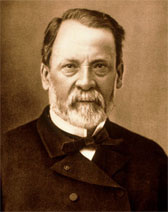
Louis Pasteur
French scientist whose research on fermentation, microorganisms, and infectious diseases contributed to the development of microbiology. He developed pasteurization and vaccines against anthrax and rabies.
Born on December 27, 1822
Died on September 28, 1895
Age at death: 73
Profession: Chemist, Biologist
Place of Birth: Jura, France
Place of Death:
Louis Pasteur was born on December 27, 1822, in Dole, France. He was a French chemist and microbiologist known for his research on fermentation, microorganisms, and infectious diseases. He demonstrated that microorganisms were responsible for many fermentation processes and contributed to establishing the germ theory of disease. He developed pasteurization and vaccines against anthrax and rabies. His research also influenced antiseptic practices in medicine.
Early Life and Education
Louis Pasteur was born in Dole, in the Jura region of France. His father, Jean-Joseph Pasteur, was a tanner who had served in Napoleon Bonaparte's army. His mother was Jeanne-Étiennette Roqui. The family later settled in Arbois, where Pasteur attended school.
In 1838, he was sent to Paris to continue his education but returned home because of homesickness. He subsequently studied at the Royal College of Besançon, obtaining a bachelor's degree in letters in 1840 and a science qualification in 1842.
He entered the École Normale Supérieure in Paris in 1843 and studied chemistry and physics. He earned his doctorate in science in 1847.
Early Scientific Research
In 1848, Louis Pasteur published research on tartaric acid crystals. He demonstrated that crystals with similar chemical compositions could have different molecular arrangements and rotate polarized light differently.
His findings contributed to the study of molecular asymmetry and stereochemistry. French physicist Jean-Baptiste Biot supported his research.
Pasteur was appointed professor of physics in Dijon in 1848 and professor of chemistry at the University of Strasbourg in 1849.
Marriage and Academic Career
On May 29, 1849, Louis Pasteur married Marie Laurent, the daughter of the rector of the Strasbourg Academy. They had five children, three of whom died during childhood.
In 1854, Pasteur became professor of chemistry and dean of the newly established Faculty of Sciences at Lille. There, he began studying problems affecting local alcohol producers.
In 1857, he moved to Paris as director of scientific studies at the École Normale Supérieure. He later served as professor of chemistry at the Sorbonne from 1867 to 1875.
Research on Fermentation
Louis Pasteur demonstrated that fermentation was associated with the activity of living microorganisms. His experiments showed that yeast was responsible for alcoholic fermentation, while other microorganisms could cause lactic acid fermentation and the spoilage of beverages.
He studied the production of wine, beer, and vinegar, explaining why certain manufacturing processes failed when products became contaminated.
His findings helped establish methods for controlling microorganisms during food and beverage production.
Microorganisms and Pasteurization
During the early 1860s, Louis Pasteur investigated the theory of spontaneous generation, which held that living organisms could arise directly from nonliving matter.
Using swan-neck flasks containing sterilized nutrient broth, he demonstrated that the broth remained free of microbial growth when airborne dust and microorganisms were prevented from reaching it.
These experiments supported the conclusion that microorganisms originated from existing microorganisms rather than appearing spontaneously under the conditions tested.
In the 1860s, Pasteur developed a method of heating wine to reduce microorganisms responsible for spoilage. This process became known as pasteurization and was later adapted for milk and other food products.
His research influenced British surgeon Joseph Lister, who developed antiseptic methods to reduce infections during surgery.
Silkworm Diseases
In 1865, the French government asked Louis Pasteur to investigate diseases affecting silkworms and threatening the silk industry.
Through microscopic examinations, he identified two distinct diseases, pébrine and flacherie. He developed procedures for selecting healthy silkworm eggs and preventing infection during breeding.
His research continued until 1870 and provided practical methods for controlling disease in silkworm production.
Chicken Cholera and Anthrax Vaccines
In 1868, Louis Pasteur suffered a stroke that left him partially paralyzed. Despite ongoing health problems, he continued his scientific work.
During the late 1870s, he investigated chicken cholera and discovered that weakened microbial cultures could provide protection against later exposure to the disease.
He subsequently developed an anthrax vaccination method with colleagues including Émile Roux and Charles Chamberland.
In 1881, Pasteur conducted a public demonstration of anthrax vaccination at Pouilly-le-Fort. Vaccinated sheep survived exposure to anthrax, while most unvaccinated animals died.
Rabies Vaccine and Joseph Meister
Louis Pasteur began researching rabies during the 1880s. Working with his colleagues, he developed an experimental vaccine using preparations from infected animals.
On July 6, 1885, nine-year-old Joseph Meister, who had been bitten repeatedly by a rabid dog, was brought to Pasteur in Paris.
Because Pasteur was not a physician, the treatment was administered under medical supervision by Jacques-Joseph Grancher. Meister received a series of injections over ten days and did not develop rabies.
The treatment was subsequently given to other patients exposed to the disease, including Jean-Baptiste Jupille in 1885.
Foundation of the Pasteur Institute
Following the development of the rabies vaccine, Louis Pasteur supported the establishment of a research and treatment center dedicated to infectious diseases.
The Institut Pasteur officially opened in Paris on November 14, 1888. It provided facilities for scientific research, vaccination, and training.
Pasteur served as its founding director. His health increasingly limited his direct participation in laboratory work.
Death
Louis Pasteur died on September 28, 1895, in Marnes-la-Coquette, near Paris, at the age of 72.
He received a state funeral in Paris. His remains were later transferred to a crypt at the Institut Pasteur, where he was buried in 1896.
Selected Scientific Contributions
1848 - Research on molecular asymmetry and tartaric acid crystals1857 - Research demonstrating the role of microorganisms in fermentation
1861–1862 - Experiments challenging spontaneous generation
1860s - Development of pasteurization
1865–1870 - Research on silkworm diseases
1879 - Experimental vaccination against chicken cholera
1881 - Public demonstration of anthrax vaccination
1885 - First successful human rabies vaccination
1888 - Opening of the Institut Pasteur
Source: Biyografiler.com
Frequently asked questions about Louis Pasteur
Who is Louis Pasteur?, Louis Pasteur biography, Louis Pasteur life story, Louis Pasteur age, Louis Pasteur facts, Louis Pasteur birthplace, Louis Pasteur photos, Louis Pasteur videos, Louis Pasteur career
Related Biographies

Lamine Yamal
Professional footballer

Kylian Mbappe
Professional footballer

Brad Pitt
Actor

Erling Haaland
Professional footballer

Keanu Reeves
Actor

Leonardo DiCaprio
Actor

Loris Karius
Professional footballer

Louis Aragon
Poet, Novelist, Essayist

Louis Pasteur
Chemist, Biologist

Luca Toni
Professional footballer, Football Manager

Luc Besson
Film Director, Screenwriter

Luciano Benetton
Businessperson, Entrepreneur

Jensen Huang
Entrepreneur, CEO, Engineer

Lilly Wachowski
Film Director, Screenwriter

Liam Neeson
Actor

Oliver Kahn
Professional footballer
Loris Karius
Professional footballer

Prabowo Subianto
Politician, President, Military Commander