
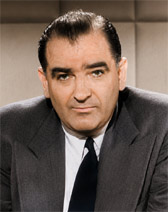
Joseph Raymond McCarthy
“The Symbolic Figure of the Anti-Communist Crusade Known as McCarthyism”
Born on November 14, 1908
Died on May 2, 1957
Age at death: 49
Profession: Lawyer, Politician
Place of Birth: Grand Chute, Wisconsin, United States
Place of Death: Bethesda, Maryland, United States
Joseph Raymond McCarthy was an American politician, lawyer, and United States senator whose name became permanently associated with one of the most controversial periods in American political history. Rising to national prominence during the early years of the Cold War, Joseph Raymond McCarthy led aggressive anti-communist investigations that targeted government officials, military personnel, academics, journalists, and entertainment figures. His methods and accusations became so influential that the term “McCarthyism” entered the political vocabulary as a description of campaigns based on fear, suspicion, and often unproven allegations.
Early Life and Education
Joseph Raymond McCarthy was born on November 14, 1908, in Grand Chute, Wisconsin, to a farming family of Irish-American heritage. Growing up in a rural environment, he spent much of his youth working on the family farm and taking on various jobs before pursuing higher education.
Determined to improve his opportunities, Joseph Raymond McCarthy returned to formal education after initially leaving school and eventually enrolled at Marquette University in Milwaukee. He studied law and graduated with a law degree, establishing himself as a practicing attorney in Wisconsin. His ambition and strong public speaking abilities soon drew him toward public office.
Legal Career and Military Service
Before entering national politics, Joseph Raymond McCarthy served as a circuit court judge in Wisconsin. Elected at a relatively young age, he gained a reputation for energy and determination, characteristics that would later define his political career.
During World War II, Joseph Raymond McCarthy served in the United States Marine Corps. He frequently emphasized his military service throughout his political life, presenting himself as a patriotic defender of American interests. The war years also intensified American concerns about global ideological conflict, particularly with the growing influence of the Soviet Union.
Rise to the United States Senate
In 1946, Joseph Raymond McCarthy was elected to the United States Senate as a member of the Republican Party. His early years in Washington attracted limited national attention, but he was determined to establish himself as a significant political figure.
His breakthrough came in February 1950 during a speech in Wheeling, West Virginia. There, Joseph Raymond McCarthy claimed that he possessed a list of communists allegedly working within the United States Department of State. Although the exact number and evidence behind these claims changed repeatedly, the speech generated enormous publicity and transformed him into a national figure almost overnight.
The Emergence of McCarthyism
The rise of Joseph Raymond McCarthy coincided with a period of intense anxiety in the United States. The Soviet acquisition of nuclear weapons, the victory of communists in China, and several high-profile espionage cases contributed to widespread fears of communist infiltration.
Capitalizing on these concerns, Joseph Raymond McCarthy launched a series of investigations and accusations aimed at identifying alleged communist sympathizers within government institutions and other sectors of American society. Many individuals found themselves publicly accused without substantial evidence, often facing severe professional and personal consequences.
The atmosphere created during this period became known as “McCarthyism.” The term eventually came to describe the practice of making accusations of disloyalty, subversion, or political extremism without adequate proof. The impact extended far beyond politics, affecting universities, labor organizations, cultural institutions, and especially the Hollywood entertainment industry.
Influence and Controversy
Between 1950 and 1954, Joseph Raymond McCarthy became one of the most recognizable and controversial figures in the United States. Supporters viewed him as a courageous defender of national security who was exposing genuine threats. Critics argued that he relied on intimidation, innuendo, and public spectacle rather than verifiable evidence.
His investigations frequently dominated newspaper headlines and television broadcasts. In an era when television was becoming a powerful medium, Joseph Raymond McCarthy skillfully used public hearings to attract attention and shape public opinion.
However, many legal scholars, journalists, and political leaders increasingly questioned the fairness of his methods. Critics contended that the presumption of innocence was being undermined and that fear was replacing due process within public discourse.
The Army-McCarthy Hearings
The turning point in Joseph Raymond McCarthy’s career came in 1954 during the widely televised Army-McCarthy Hearings. These hearings focused on disputes between McCarthy and the United States Army and were watched by millions of Americans.
For the first time, a large television audience witnessed his aggressive interrogation style directly. During the hearings, attorney Joseph N. Welch famously challenged McCarthy's tactics, delivering the memorable rebuke: “Have you no sense of decency, sir?” The exchange became one of the defining moments of American political history.
The hearings significantly damaged Joseph Raymond McCarthy’s public image. Many Americans who had previously supported him began to view his methods as excessive and unfair.
Senate Censure and Political Decline
Later in 1954, the United States Senate formally censured Joseph Raymond McCarthy for conduct deemed inappropriate for a senator. The censure represented a major political defeat and effectively ended his influence as a dominant national figure.
Although he remained in office, his authority and visibility declined rapidly. The anti-communist movement continued in various forms, but Joseph Raymond McCarthy never regained the political power he had exercised during the early 1950s.
Personal Life
Joseph Raymond McCarthy married Jean Fraser Kerr Minetti in 1953. The couple adopted a daughter, Tierney Elizabeth McCarthy. Despite his public prominence, much of his later life was overshadowed by political controversy and declining influence.
Death
Joseph Raymond McCarthy died on May 2, 1957, in Bethesda, Maryland, at the age of 48, just months before what would have been his 49th birthday. Official reports cited complications related to liver disease as the cause of death.
Historical Legacy
The legacy of Joseph Raymond McCarthy remains deeply contested. To some, he represented a politician responding to legitimate concerns about Soviet espionage during the Cold War. To many historians, however, he symbolizes the dangers of political fear, public accusation without sufficient evidence, and the erosion of civil liberties during times of national anxiety.
Today, the term “McCarthyism” continues to be used internationally as a warning against political witch hunts, guilt by association, and the use of fear as a tool of public persuasion. More than six decades after his death, Joseph Raymond McCarthy remains one of the most controversial figures in the history of American politics.
Source: Biyografiler.com
Frequently asked questions about Joseph Raymond McCarthy
Who is Joseph Raymond McCarthy?, Joseph Raymond McCarthy biography, Joseph Raymond McCarthy life story, Joseph Raymond McCarthy age, Joseph Raymond McCarthy facts, Joseph Raymond McCarthy birthplace, Joseph Raymond McCarthy photos, Joseph Raymond McCarthy videos, Joseph Raymond McCarthy career

Lamine Yamal
Professional footballer

Sam Altman
Entrepreneur, Investor, CEO

Kylian Mbappe
Professional footballer

Alice Weidel
Politician, Economist

Erling Haaland
Professional footballer

Giorgia Meloni
Politician, Journalist


Hongjoong
Singer, Rapper, Songwriter, Composer

Ludacris
Rapper, Actor

Kwon Eunbi
Singer

Sarah Wayne Callies
Actress, Screenwriter, Producer, Director

LaTavia Roberson
Singer, Actress, Entrepreneur
Lamine Yamal
Professional footballer

Austin Abrams
Actor

Xi Jinping
Politician, Statesman, Head of State

Claudia Sheinbaum
President, Politician, Scientist, Academic

Colman Domingo
Actor, Director, Producer

Kaia Gerber
Model, Actress