
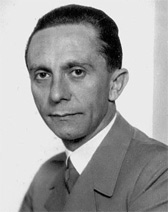
Joseph Goebbels
“The Architect of Nazi Propaganda”
Born on October 29, 1897
Died on May 1, 1945
Age at death: 48
Profession: Politician
Place of Birth: Rheydt, Mönchengladbach, Germany
Place of Death: Berlin, Germany
Joseph Goebbels was one of the closest associates of Adolf Hitler in Nazi Germany and served as Reich Minister of Public Enlightenment and Propaganda from 1933 to 1945. He was known as Hitler’s most loyal follower, distinguished by his intense oratory, radical anti-Semitic ideology, and mastery of mass propaganda.
Joseph Goebbels was born on October 29, 1897, in Rheydt, Mönchengladbach, Germany, as the son of an accountant. His full name was Paul Joseph Goebbels. He graduated from high school in 1916 and volunteered for service in World War I, but due to a deformity in his right foot, he was classified as physically unfit for combat. Between June 1916 and January 1917, he served briefly as a clerical soldier in the Vaterländisches Hilfswerk.
Goebbels completed five years of undergraduate education at Heidelberg University, studying history, German philology, and classical philology. In 1921, he earned a doctorate with a dissertation on nineteenth-century Romantic drama and was awarded the title Dr. Phil. in 1922.
After completing his education, Goebbels worked briefly as a volunteer at the newspaper Westdeutsche Landeszeitung. He aspired to become a writer and authored a semi-autobiographical novel titled Michael. In this book, his psychological struggles stemming from his physical disability, short stature, dark complexion, and hair are clearly reflected. He also wrote plays, but none were staged, and until 1929 he was unable to find a publisher for his book.
During a period of severe financial hardship, Goebbels worked as a bank clerk and later as a broker for a stock exchange firm. In these years, he was heavily influenced by Friedrich Nietzsche, Oswald Spengler, and most notably the anti-Semitic thinker Houston Stewart Chamberlain. His political worldview solidified during this time, becoming increasingly dominated by anti-Semitic ideology.
Goebbels first encountered the Nazi Party in 1923 and was deeply impressed by its nationalism and anti-communist stance. After Adolf Hitler was imprisoned following the Beer Hall Putsch, the party was left without its leader. Goebbels joined the movement in late 1924, and his political development was strongly shaped by Gregor Strasser, who became the Nazi organizer for Northern Germany in March 1924.
In 1924, Goebbels became one of the founders of the National Socialist Freedom Party in the Rhineland and served as editor-in-chief of the newspaper Völkische Freiheit. In 1925, he worked as an editor for the party publication Nationalsozialistische Briefe.
After Adolf Hitler was released from prison on December 20, 1924, Goebbels pledged absolute loyalty to him. Recognizing Goebbels’ talents, Hitler promoted him to Gauleiter of Berlin. Following a private meeting in April 1926, Goebbels bound himself entirely to Hitler. Later that year, Hitler ordered him to establish and expand the Nazi organization in “Red Berlin,” a stronghold of the political left.
In Berlin, Goebbels demonstrated his propaganda skills for the first time on a large scale and also discovered his enthusiasm for political violence. He deployed Nazi SA members against social democrats, forcibly driving them out of streets, bars, and social venues. He famously declared, “History is made in the streets,” and threatened former leftist acquaintances by saying, “If I unleash the demon inside me, none of you will be able to stop it.”
In 1927, Goebbels founded the weekly National Socialist newspaper Der Angriff and served as its editor-in-chief. This initiative paved his path to the leadership of Nazi propaganda.
Goebbels possessed the ability to captivate crowds for hours, leading them in chants, songs, mass salutes, and collective oaths. These actions were not spontaneous but carefully calculated based on mass psychology. He rejected the idea of educating people, viewing them instead as tools that needed constant psychological conditioning for political ends. He famously declared, “National Socialism is my religion. My party is my temple.”
He directed the election campaigns of 1930, 1932, and 1933, as well as Adolf Hitler’s 1932 presidential campaign. Torchlight marches, bands, mass choirs, cinema, radio, and continuously evolving slogans played a central role in mobilizing German youth and expanding party support.
After 1933, Goebbels served as Reich Minister of Public Enlightenment and Propaganda. He oversaw all media—press, radio, film, theater, literature—and used them to indoctrinate the public with Nazism and anti-Semitism. In 1932, on Hitler’s orders, he initiated a nationwide boycott of Jewish businesses. In 1933, he orchestrated the burning of Jewish books, declaring that “Jewish intellectualism is coming to an end.”
On May 10, 1933, Goebbels organized one of the most symbolic acts of Nazi cultural repression. More than 20,000 books were collected from libraries and publicly burned at Bebelplatz in Berlin. At the ceremony, he proclaimed that Germany was “cleansing its spirit” of works written by Jews, liberals, leftists, and so-called un-German authors.
Under Goebbels’ ministry, all newspapers, publishers, theaters, concerts, films, and artistic activities came under strict state control. No writer could publish, no artist could exhibit, and no singer could appear on radio without party approval. Loyalty was rewarded with financial support, while dissent led to exile or silence.
Despite his repression of modern and critical art, Goebbels allowed certain high-culture forms such as opera and symphonic music to continue, believing they enhanced Nazi prestige and secured middle- and upper-class support. Adolf Hitler’s admiration for Vilhelm Richard Wagner and German classical culture reinforced this policy.
Goebbels married Magda Goebbels in 1931. They had six children: Helga Susanne, Hedwig Johanna, Helmut Christian, Holdine Kathrin, Heidrun Elisabeth, and Hildegard Traudel.
In 1944, Goebbels proposed the policy of “total war,” demanding the complete mobilization of German society and economy. Although granted full authority over its implementation, the policy failed to alter the course of the war.
After Adolf Hitler’s suicide, Goebbels served as Chancellor of the Third Reich for one day. In the final hours, Magda Goebbels poisoned their six children. Shortly afterward, Goebbels shot his wife and then himself. Their bodies were burned according to his wishes.
Joseph Goebbels died on May 1, 1945, in Berlin, Germany. He remains one of the most infamous figures of the twentieth century, symbolizing the destructive power of propaganda when combined with totalitarian ideology.
“Think of the press as a great keyboard on which the government can play.”
“Propaganda is not an intellectual exercise. Its task is not to discover truth, but to persuade.”
“The lie, once repeated often enough, becomes the truth.”
Source: Biyografiler.com
Frequently asked questions about Joseph Goebbels
Who is Joseph Goebbels?, Joseph Goebbels biography, Joseph Goebbels life story, Joseph Goebbels age, Joseph Goebbels facts, Joseph Goebbels birthplace, Joseph Goebbels photos, Joseph Goebbels videos, Joseph Goebbels career
Related Biographies

Lamine Yamal
Professional footballer

Erling Haaland
Professional footballer

Sam Altman
Entrepreneur, Investor, CEO

Kylian Mbappe
Professional footballer

Giorgia Meloni
Politician, Journalist

Alice Weidel
Politician, Economist


Hongjoong
Singer, Rapper, Songwriter, Composer

Ludacris
Rapper, Actor

Kwon Eunbi
Singer

Sarah Wayne Callies
Actress, Screenwriter, Producer, Director

LaTavia Roberson
Singer, Actress, Entrepreneur
Lamine Yamal
Professional footballer

Elena Andreyevna Rybakina
Professional Tennis Player
Alice Weidel
Politician, Economist

Alex Krizhevsky
Computer Scientist
Sam Altman
Entrepreneur, Investor, CEO

Sydney Sweeney
Actress