
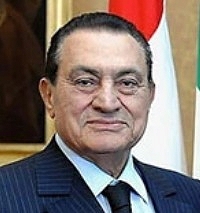
Hosni Mubarak
Fourth President of Egypt (1981–2011), former Egyptian Air Force commander, and military leader who served during the 1973 Yom Kippur War.
Born on May 4, 1928
Died on February 25, 2020
Age at death: 92
Profession: Former President, Military Officer
Place of Birth: Kafr El-Meselha, Monufia Governorate, Egypt
Place of Death: Cairo, Egypt
Hosni Mubarak, born Muhammad Hosni El Sayed Mubarak on May 4, 1928, was an Egyptian military officer and politician who served as the fourth President of Egypt from October 14, 1981, to February 11, 2011. Before entering politics, he was a career officer in the Egyptian Air Force and commanded the country's air forces during the 1973 Yom Kippur War against Israel. He became vice president under Anwar Sadat in 1975 and succeeded him following Sadat's assassination in October 1981. His presidency lasted almost thirty years and included Egypt's return to the Arab League, participation in the 1990–1991 Gulf War, economic reforms, and extensive restrictions on political opposition. Nationwide protests during the 2011 Egyptian Revolution forced him to resign. He subsequently faced criminal proceedings concerning the deaths of protesters and misuse of public funds.
Early Life and Family Background
Hosni Mubarak, whose full name was Muhammad Hosni El Sayed Mubarak, was born on May 4, 1928, in Kafr El-Meselha, a village in Egypt's Monufia Governorate in the Nile Delta region, northwest of Cairo.
He grew up during the period when Egypt was formally an independent monarchy but remained subject to considerable British political and military influence.
After completing his secondary education in Shibin El Kom, Mubarak pursued a military career and entered the Egyptian Military Academy in Cairo.
Military Education and Air Force Career
Hosni Mubarak graduated from the Egyptian Military Academy in February 1949 with a degree in military science. After serving briefly in the infantry, he transferred to aviation training.
He enrolled at the Egyptian Air Force Academy in Bilbeis and graduated in March 1950, qualifying as a military pilot.
During the following years, Mubarak served in several positions within the Egyptian Air Force. His training included advanced aviation and bomber operations, and he traveled to the Soviet Union for additional military education.
In 1964, he attended the Frunze Military Academy in Moscow, where he studied advanced military subjects and aviation operations.
His professional responsibilities included commanding bomber units and serving as acting commander of Cairo West Air Base.
From 1966 to 1969, Hosni Mubarak served as commander of the Egyptian Air Force Academy, overseeing the training of military pilots and aviation personnel.
In 1969, he became Chief of Staff of the Egyptian Air Force. Three years later, in April 1972, President Anwar Sadat appointed him commander of the Egyptian Air Force.
Role in the 1973 Yom Kippur War
In October 1973, Egypt and Syria launched a coordinated military offensive against Israel, beginning the conflict known as the Yom Kippur War or October War.
As commander of the Egyptian Air Force, Hosni Mubarak was responsible for directing air operations during the conflict. Egyptian aircraft participated in the opening attacks against Israeli military positions in the Sinai Peninsula.
The air campaign formed part of Egypt's broader offensive across the Suez Canal, intended to challenge Israeli control of territory captured during the 1967 Six-Day War.
Mubarak's role in the planning and execution of air operations increased his standing within the Egyptian military establishment.
Following the war, he was promoted to the rank of air chief marshal in 1974. His military career subsequently provided the basis for his appointment to senior political office.
Vice Presidency under Anwar Sadat
On April 16, 1975, President Anwar Sadat appointed Hosni Mubarak Vice President of Egypt.
As vice president, Mubarak participated in government administration, diplomatic visits, and discussions involving Egypt's foreign relations.
He undertook diplomatic assignments concerning regional disputes, including the disagreement over Western Sahara, formerly Spanish Sahara, involving Morocco, Algeria, and Mauritania.
During this period, Egypt was also pursuing a diplomatic settlement with Israel following the 1973 war.
President Sadat's negotiations with Israeli Prime Minister Menachem Begin led to the 1978 Camp David Accords and the signing of the Egypt–Israel Peace Treaty in March 1979.
The agreement provided for the eventual return of the Sinai Peninsula to Egyptian control but also caused tensions between Egypt and several other Arab governments.
Assassination of Anwar Sadat and Accession to the Presidency
On October 6, 1981, President Anwar Sadat was assassinated during a military parade in Cairo commemorating the anniversary of the 1973 war.
The assassination was carried out by Islamist militants opposed to Sadat's policies, including his peace agreement with Israel.
Hosni Mubarak, who was present at the parade, survived the attack. Following Sadat's death, parliamentary speaker Sufi Abu Taleb temporarily assumed presidential responsibilities.
Mubarak was subsequently nominated for the presidency and approved through a national referendum. He formally assumed office on October 14, 1981.
He also became leader of the ruling National Democratic Party (NDP), which had been established under Sadat.
Presidency of Egypt (1981–2011)
Hosni Mubarak remained President of Egypt for nearly thirty years, serving five consecutive presidential terms.
During his presidency, Egypt maintained the peace treaty with Israel while seeking to rebuild diplomatic relations with Arab countries that had criticized Sadat's policies.
His administration also continued cooperation with the United States, particularly in military assistance, regional security, and diplomatic relations.
Domestically, his government introduced economic changes, infrastructure projects, and privatization programs. Political authority, however, remained concentrated within the presidency, the ruling National Democratic Party, and the security establishment.
The emergency law, introduced after Sadat's assassination in 1981, remained in force throughout almost all of Mubarak's presidency. It provided the security authorities with expanded powers concerning detention, public assembly, and political activities.
1987, 1993, 1999 and 2005 Presidential Elections
Hosni Mubarak was approved for a second presidential term in October 1987. Official results credited him with approximately 97 percent of the vote.
He secured additional presidential terms in 1993 and 1999 through referendums in which voters were asked to approve the single presidential candidate nominated under the existing constitutional system.
In 2005, constitutional amendments introduced a system allowing multiple candidates to compete in a presidential election.
Mubarak won the September 2005 election and began his fifth consecutive term. However, opposition candidates and international observers criticized restrictions on political competition and the conditions under which the election was conducted.
During his presidency, the National Democratic Party controlled the central institutions of government, while opposition parties faced legal and administrative restrictions.
Human rights organizations documented allegations of arbitrary detention, torture, restrictions on freedom of expression, and interference with political opposition activities.
Relations with Israel and the Arab World
When Hosni Mubarak became president in 1981, Egypt's relations with other Arab countries remained strained because of the peace agreement signed with Israel in 1979.
Egypt had been suspended from the Arab League following the treaty. Mubarak sought to restore relations with neighboring governments while preserving the peace agreement.
In April 1982, Israel completed its withdrawal from most of the Sinai Peninsula under the treaty arrangements, returning the territory to Egyptian administration.
Egypt also pursued the return of the disputed Taba area through international arbitration. The territory was restored to Egyptian control in March 1989.
In 1989, Egypt was readmitted to the Arab League, and the organization's headquarters subsequently returned to Cairo.
Mubarak also participated in regional diplomatic initiatives involving the Israeli–Palestinian conflict and relations among Arab governments.
Although Egypt maintained diplomatic relations with Israel, its government criticized certain Israeli military operations, including the 1982 invasion of Lebanon.
The Gulf War (1990–1991)
During the 1990–1991 Gulf crisis, Hosni Mubarak supported the international response to Iraq's invasion of Kuwait in August 1990.
Egypt joined the multinational coalition assembled to remove Iraqi forces from Kuwait. Mubarak supported Saudi Arabia's decision to request assistance from international military forces.
The Egyptian government deployed military personnel to the Gulf region and participated in diplomatic negotiations with Arab governments and coalition partners.
The war ended in 1991 with the withdrawal of Iraqi forces from Kuwait.
Egypt's participation strengthened its military and diplomatic cooperation with several Gulf countries and the United States. The period also saw financial and debt-related arrangements involving Egypt and its international partners.
Assassination Attempts and Security Policies
During his presidency, Hosni Mubarak survived several reported assassination attempts.
On June 26, 1995, he escaped an attack in Addis Ababa, Ethiopia, shortly after arriving to attend a summit of the Organization of African Unity.
Armed attackers targeted his motorcade, but Mubarak escaped unharmed and returned to Egypt.
The attack occurred during a period of violent conflict between the Egyptian government and militant Islamist organizations.
His administration responded to armed Islamist movements through security operations, arrests, and prosecutions. Emergency powers were used extensively by the police and intelligence services.
Domestic and international human rights organizations criticized the use of prolonged detention, exceptional security courts, and allegations of mistreatment of prisoners.
The Muslim Brotherhood and Political Opposition
One of the principal opposition movements during Hosni Mubarak's presidency was the Muslim Brotherhood, an Islamist organization founded in Egypt in 1928 by Hassan al-Banna.
The Brotherhood remained formally prohibited as a political organization, although members participated in parliamentary elections at various times as independent candidates.
Mubarak's government restricted the movement's political activities, arrested members and leaders, and prosecuted individuals associated with the organization.
The relationship between the government and the Muslim Brotherhood varied over time, alternating between periods of limited political participation and extensive security crackdowns.
Other opposition groups, journalists, civil society organizations, and political activists also faced restrictions during Mubarak's presidency.
In the 2000s, opposition movements increasingly criticized the continuation of emergency rule, the concentration of political power, and the possibility that Mubarak's son Gamal Mubarak might succeed him as president.
Economic Policies and Domestic Development
Hosni Mubarak's government implemented economic reforms intended to expand private investment, reduce certain state controls, and modernize infrastructure.
In the 1990s, Egypt adopted economic restructuring measures supported by international financial institutions. These included privatization policies and changes to the regulation of public enterprises.
His administration oversaw major infrastructure projects, including the development of the Cairo Metro, irrigation projects, and transportation facilities.
However, economic growth was accompanied by concerns over unemployment, corruption, unequal access to public resources, and rising living costs.
During the later years of Mubarak's presidency, public dissatisfaction increasingly focused on economic inequality, unemployment among young people, and allegations of corruption involving political and business elites.
The 2011 Egyptian Revolution
In January 2011, widespread protests against Hosni Mubarak's government began in Egypt as part of the broader wave of political demonstrations known as the Arab Spring.
The protests followed the uprising in Tunisia, which resulted in the departure of President Zine El Abidine Ben Ali from power.
On January 25, 2011, demonstrators gathered in Cairo and other Egyptian cities to demand political reforms, an end to emergency rule, measures against corruption, and Mubarak's resignation.
Tahrir Square in central Cairo became a principal gathering place for protesters. Demonstrations continued despite police efforts to disperse crowds and increasing confrontations between protesters and security forces.
Hundreds of people were killed during the eighteen days of unrest, according to reports from Egyptian and international human rights organizations.
On January 29, Mubarak appointed Omar Suleiman, Egypt's intelligence chief, as vice president. It was the first time Mubarak had appointed a vice president during his presidency.
On February 1, 2011, Mubarak announced that he would not seek another presidential term but intended to remain in office until elections later that year.
The announcement failed to satisfy protesters, who continued demanding his immediate departure.
On February 10, Mubarak announced that he was transferring some presidential powers to Omar Suleiman but did not resign.
On February 11, 2011, Suleiman announced that Mubarak had stepped down and transferred authority to the Supreme Council of the Armed Forces.
His resignation ended nearly thirty years of presidential rule and brought the military council into control of the country's transitional government.
Arrest and Criminal Proceedings
Following his resignation, Hosni Mubarak became the subject of criminal investigations concerning corruption and the killing of protesters during the 2011 uprising.
In April 2011, Egyptian authorities ordered his detention. His trial subsequently began in Cairo, where he faced charges connected with the deaths of demonstrators and allegations of financial misconduct.
On June 2, 2012, Mubarak was sentenced to life imprisonment after a criminal court found him responsible in connection with the failure to prevent the killing of protesters during the uprising.
Former Interior Minister Habib el-Adly also received a life sentence in the same proceedings. Former Vice President Omar Suleiman was not sentenced alongside them.
The verdict generated divided public reactions. Some demonstrators called for harsher punishment, while others questioned whether the legal proceedings adequately addressed responsibility for the violence.
In January 2013, Egypt's Court of Cassation overturned Mubarak's conviction and ordered a retrial.
During the following years, he remained in custody or under medical supervision while separate criminal proceedings continued.
Corruption Conviction and Final Acquittal
In addition to the protester-deaths case, Hosni Mubarak faced proceedings concerning the misuse of public funds allocated for the maintenance and renovation of presidential palaces.
In 2015, an Egyptian court upheld a three-year prison sentence against Mubarak in that corruption case. His sons Alaa Mubarak and Gamal Mubarak also received prison sentences in connection with the proceedings.
On March 2, 2017, Egypt's Court of Cassation issued a final ruling acquitting Mubarak of responsibility for the killing of protesters during the 2011 uprising.
The decision ended the principal criminal proceedings concerning the protester deaths. It did not erase the separate conviction relating to the misuse of public funds.
On March 24, 2017, Mubarak was released from Maadi Military Hospital in Cairo, where he had spent much of his detention period, and returned to his residence.
Personal Life and Family
Hosni Mubarak married Suzanne Mubarak, born Suzanne Sabet, in 1959. She was educated at the American University in Cairo and was involved in educational, cultural, and social initiatives during her husband's presidency.
The couple had two sons, Alaa Mubarak and Gamal Mubarak.
Gamal became active in the ruling National Democratic Party and held senior positions within its political leadership. His growing political influence during the 2000s led to speculation that he might succeed his father as president.
Both sons became involved in legal proceedings following the 2011 revolution, including investigations into financial and corruption-related allegations.
Final Years and Death
After his release in March 2017, Hosni Mubarak lived largely outside public political life.
His health had deteriorated during his later years, and he received medical treatment for several conditions.
Hosni Mubarak died on February 25, 2020, at a military hospital in Cairo, Egypt, at the age of 91.
Following his death, Egypt held a military funeral attended by President Abdel Fattah el-Sisi and senior state officials. Mubarak was buried in the family cemetery in Heliopolis, Cairo.
Major Military and Government Positions
1981–2011 – President of Egypt
1981–2011 – Chairman of the National Democratic Party
1975–1981 – Vice President of Egypt
1972–1975 – Commander of the Egyptian Air Force
1969–1972 – Chief of Staff of the Egyptian Air Force
1966–1969 – Commander of the Egyptian Air Force Academy
1950–1975 – Officer in the Egyptian Air Force
Major Events During His Presidency
2011 – Resigned following eighteen days of nationwide protests during the Egyptian Revolution
2005 – Won Egypt's first multi-candidate presidential election
1995 – Survived an assassination attempt in Addis Ababa, Ethiopia
1990–1991 – Egypt participated in the international coalition during the Gulf War
1989 – Egypt returned to the Arab League
1989 – Egypt regained control of Taba following international arbitration
1987 – Reelected for a second presidential term
1982 – Completion of Israel's withdrawal from most of the Sinai Peninsula
1981 – Assumed the presidency following the assassination of Anwar Sadat
Source: Biyografiler.com
Frequently asked questions about Hosni Mubarak
Who is Hosni Mubarak?, Hosni Mubarak biography, Hosni Mubarak life story, Hosni Mubarak age, Hosni Mubarak facts, Hosni Mubarak birthplace, Hosni Mubarak photos, Hosni Mubarak videos, Hosni Mubarak career
Related Biographies


Lamine Yamal
Professional footballer

Erling Haaland
Professional footballer

Keanu Reeves
Actor

Kylian Mbappe
Professional footballer

Austin Abrams
Actor

Bad Bunny
Rapper, Songwriter

Ian Fleming
Novelist, Journalist

Ian Holm
Actor, Voice Actor

Ian McDiarmid
Actor

Ian McKellen
Actor, Voice Actor

Hyung-ki Joo
Pianist, Musician, Composer

Hosni Mubarak
Former President, Military Officer

Adewale Akinnuoye-Agbaje
Actor, Former Model

John Healey
Politician
Erling Haaland
Professional footballer
Lamine Yamal
Professional footballer

Ursula von der Leyen
Politician, Physician

Leonardo DiCaprio
Actor