
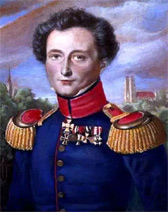
Carl von Clausewitz
The Father of Modern Military Theory
Born on June 1, 1780
Died on November 16, 1831
Age at death: 51
Profession: Military Commander
Place of Birth: Burg, near Magdeburg, Prussia
Place of Death: Breslau, Poland
Carl von Clausewitz is regarded as one of the most influential military thinkers in history. His work On War (originally published as Vom Kriege in 1832) became one of the most respected classical texts on military strategy and theory. His ideas on war, politics, and strategy continue to shape military thought, political science, and strategic studies worldwide.
Carl von Clausewitz was born on 1 June 1780 in Burg, near Magdeburg, Prussia, into an aristocratic family. The word “von” in his name indicates his noble status. His full name was Carl Philipp Gottlieb von Clausewitz. His father was also an officer in the Prussian army. Following a common practice of the era, Clausewitz entered military life at an early age; in 1792, when he was only 12 years old, he joined Prince Ferdinand’s Regiment (34th Regiment) in Potsdam, committing himself to a lifelong military career.
Carl von Clausewitz participated in his first battle at the age of 13. He rose steadily through the ranks, being promoted to brigadier general at the age of 38. He later married a woman from an aristocratic family. Between 1793 and 1795, he fought with his regiment in the War of the First Coalition, during which he was promoted to lieutenant. From 1801 to 1803, he studied at the Military Academy in Berlin, graduating with distinction. After completing his studies, he was appointed aide-de-camp to Prince August Ferdinand of Prussia and was promoted to captain in 1805.
In 1806, following France’s declaration of war on Prussia, Carl von Clausewitz joined the campaign alongside Prince August Ferdinand. During the Jena Campaign, he was captured by French forces on 28 October 1806 and spent nearly a year as a prisoner of war in France. This period allowed him to critically analyze the reasons behind Prussia’s defeat. He was only able to return to his homeland two years later.
In 1808, Carl von Clausewitz became closely associated with reform-minded Prussian officers and was promoted to staff captain. In 1810, he attained the rank of major and was appointed as an instructor in staff duties at the Berlin War Academy. Shortly before this appointment, he had been tasked with teaching military subjects to the Crown Prince, who would later become King Friedrich Wilhelm IV.
When King Friedrich Wilhelm III allied Prussia with France against Russia on 5 March 1812, obligating Prussian troops to support Napoleon Bonaparte’s Grand Army, Carl von Clausewitz strongly opposed the decision. Believing this alliance contradicted the broader War of Liberation against Napoleon, he resigned from the Prussian army along with like-minded officers and entered Russian service.
From the summer of 1812 onward, Carl von Clausewitz served as a lieutenant colonel in the Russian army, fighting against Napoleon Bonaparte. Although Prussia later renewed its alliance with Russia and declared war on France in March 1813, the Prussian king refused to readmit Clausewitz to the Prussian army. Consequently, he continued to serve with Russian forces until 1815. He played an important role in the decisive Battle of Waterloo in Belgium, fought between 16 and 18 June 1815, which ultimately ended Napoleon’s rule.
After Napoleon’s final defeat, Carl von Clausewitz returned to the Prussian army in 1815 and was appointed colonel and Chief of Staff of the newly formed 3rd Prussian Corps in Koblenz. He participated in subsequent campaigns following Napoleon’s escape from Elba and the events of the Hundred Days.
Following the end of the Napoleonic Wars with the Congress of Vienna, Carl von Clausewitz served in various military posts. In 1818, he was appointed commandant of the War Academy, a position he held for twelve years. In September 1818, he was promoted to major general. During this period, he devoted considerable time to research, reflection, and writing. The eight-volume draft of On War was developed largely during these years.
In 1830, Carl von Clausewitz was appointed Inspector of Artillery in Breslau. During the Polish Uprising, he served as Chief of Staff of an army formed in Posen in March 1831. After this force was disbanded, he returned to his duties in Breslau.
Carl von Clausewitz died on 16 November 1831 in Breslau, Poland, at the age of 51, during the last great cholera epidemic to sweep Europe. At the time of his death, he had not yet achieved the recognition he had hoped for in his own country and had not completed his magnum opus. His unfinished work On War was published posthumously in 1832 by his wife.
Carl von Clausewitz married Marie von Brühl in 1810, who played a crucial role in preserving and publishing his intellectual legacy.
Source: Biyografiler.com
Frequently asked questions about Carl von Clausewitz
Who is Carl von Clausewitz?, Carl von Clausewitz biography, Carl von Clausewitz life story, Carl von Clausewitz age, Carl von Clausewitz facts, Carl von Clausewitz birthplace, Carl von Clausewitz photos, Carl von Clausewitz videos, Carl von Clausewitz career
Related Biographies

Lamine Yamal
Professional footballer

Erling Haaland
Professional footballer

Austin Abrams
Actor

Keanu Reeves
Actor

Kylian Mbappe
Professional footballer

Bad Bunny
Rapper, Songwriter


Hongjoong
Singer, Rapper, Songwriter, Composer

Ludacris
Rapper, Actor

Kwon Eunbi
Singer

Sarah Wayne Callies
Actress, Screenwriter, Producer, Director

LaTavia Roberson
Singer, Actress, Entrepreneur
Kylian Mbappe
Professional footballer
Lamine Yamal
Professional footballer

Luiz Inacio Lula da Silva
Politician, President

Maria Corina Machado
Politician, Political Activist

Nicki Minaj
Rapper, Singer, Songwriter, Actress

Zhang Yiming
Entrepreneur, Software Developer