
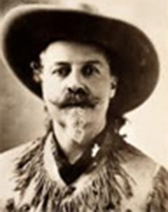
Buffalo Bill
The Legendary Showman of the American Frontier
Born on February 26, 1846
Died on January 10, 1917
Age at death: 71
Profession: Military Officer, Entrepreneur
Place of Birth: Le Claire, Iowa, United States
Place of Death: Denver, Colorado, United States
William Frederick Cody, widely known as Buffalo Bill, was one of the most iconic figures of the American Wild West. Although he earned his famous nickname through large-scale buffalo hunting, he later became a prominent advocate for regulated hunting seasons and Native American rights. As a soldier, scout, performer, and cultural icon, Buffalo Bill emerged as one of the most colorful personalities in frontier history, leaving lasting traces across literature, popular culture, and cinema.
William Frederick Cody was born on February 26, 1846, in Le Claire, Iowa, United States. His father, Isaac Cody, was fatally wounded after being stabbed by pro-slavery supporters because of his outspoken anti-slavery speeches. Following his father’s death, Cody was forced into responsibility at a very young age and began riding long distances on horseback to deliver mail and messages when he was only eleven years old.
In 1860, at the age of fourteen, Cody joined the Pony Express, working briefly as a mounted mail rider. Shortly afterward, he attempted to enlist in the army but was initially rejected due to his age. Between 1863 and 1865, he served as a private in the 7th Kansas Cavalry Regiment during the American Civil War. From 1868 to 1872, he worked as a civilian scout for the United States Army, gaining deep familiarity with frontier life and Native American territories.
The nickname Buffalo Bill was given to Cody between 1867 and 1868 after he reportedly killed a total of 4,860 buffalo to supply meat for workers of the Kansas–Pacific Railroad. In recognition of his conduct and service as a scout, he was awarded the Medal of Honor by the U.S. Army in 1872, a distinction that further elevated his public reputation.
After leaving military service in 1872, Cody moved to Chicago and, together with Texas Jack Omohundro and James Butler Hickok, developed a Wild West stage production titled Scouts of the Plains. The show quickly gained popularity and toured successfully for a decade. In 1883, this success evolved into the legendary Buffalo Bill's Wild West, first staged in Nebraska. Featuring a massive traveling tent and performers from various cultures—including Turkish, Arab, and Mongolian participants dressed in traditional attire—the show became the most comprehensive entertainment spectacle of its era.
In 1887, Cody traveled to England to perform before the British monarchy and remained there for six months. Two years later, in 1889, he embarked on an extensive European tour, presenting his Wild West show across multiple countries. This tour firmly established Buffalo Bill as one of the most influential cultural figures of the 19th century, turning him into an international celebrity.
In 1895, Cody purchased a large tract of land near Wyoming and founded the town of Cody, which was named after him. Recognized as a respected businessman, he later converted the town into a public entity in 1901. In 1902, he opened the Irma Hotel, named after his daughter, creating a new attraction for tourists eager to encounter the legendary figure of the Wild West.
On January 10, 1917, William Frederick Cody died of kidney failure at his family home in Denver, Colorado. He was buried at Lookout Mountain, Colorado. Following his death, tributes poured in from world leaders, and his legend continued to grow. Buffalo Bill became a recurring figure in postage stamps, novels, literary works, and later in Western cinema, particularly during the 1950s and 1960s when the genre reached its peak popularity.
For readers interested in Buffalo Bill’s own account of his life, the most authoritative source remains the 1879 autobiography The Life and Adventures of Buffalo Bill, written by Cody himself.
Source: Biyografiler.com
Frequently asked questions about Buffalo Bill
Who is Buffalo Bill?, Buffalo Bill biography, Buffalo Bill life story, Buffalo Bill age, Buffalo Bill facts, Buffalo Bill birthplace, Buffalo Bill photos, Buffalo Bill videos, Buffalo Bill career

Lamine Yamal
Professional footballer

Kylian Mbappe
Professional footballer

Erling Haaland
Professional footballer

Sam Altman
Entrepreneur, Investor, CEO

Austin Abrams
Actor

Bad Bunny
Rapper, Songwriter


Hongjoong
Singer, Rapper, Songwriter, Composer

Ludacris
Rapper, Actor

Kwon Eunbi
Singer

Sarah Wayne Callies
Actress, Screenwriter, Producer, Director

LaTavia Roberson
Singer, Actress, Entrepreneur

Pedro Sanchez
Politician

Adam Sandler
Actor

Cillian Murphy
Actor
Austin Abrams
Actor
Lamine Yamal
Professional footballer

Brad Pitt
Actor