
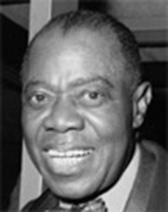
Louis Armstrong
The greatest trumpeter in jazz history
Born on August 4, 1901
Died on July 6, 1971
Age at death: 70
Profession: Musician, Singer, Composer, Actor
Place of Birth: New Orleans, Louisiana, United States
Place of Death: Queens, New York City, United States
Louis Armstrong, born Louis Daniel Armstrong, was an American jazz trumpeter, singer, composer, and actor who fundamentally transformed jazz music. Widely regarded as the greatest trumpeter in jazz history, Armstrong elevated jazz from regional dance music into a globally respected art form and became one of the first international superstars of popular music.
Louis Armstrong was born on 4 August 1901 in New Orleans, Louisiana, United States, into a poor family. His father William Armstrong abandoned the family when Louis was still a child. His mother, Mary Albert Armstrong, raised him alongside his younger sister Beatrice Armstrong. Armstrong’s childhood was shaped by hardship, responsibility, and survival.
Without access to formal education, Armstrong developed what he later described as “street knowledge.” To support his family, he worked various jobs and earned money singing on the streets. He later performed in brass bands and played on riverboats traveling along the Mississippi River, where he joined the ensemble led by the renowned bandleader Fate Marable. This experience provided him with disciplined musical training and exposure to a wide repertoire.
At the age of eleven, Armstrong was sent to a reform school after firing a gun into the air during a New Year’s Eve celebration. While incarcerated, he joined the institution’s band, first as a singer and later as a percussionist and cornet player. This period proved decisive, as music became the central purpose of his life. Upon his release, he worked delivering coal by horse-drawn cart while borrowing instruments and playing with any group willing to perform with him.
Armstrong’s extraordinary talent soon attracted the attention of Joe “King” Oliver, one of New Orleans’ leading jazz musicians. Oliver became Armstrong’s mentor and invited him to join his orchestra in Chicago. This collaboration marked a turning point in Armstrong’s career and opened the doors to national recognition.
In 1924, Armstrong married pianist Lillian Hardin, who played a crucial role in advancing his career. He later moved to New York City, where he joined the orchestra of Fletcher Henderson, the most prominent African American band of the era. Armstrong’s powerful trumpet style and inventive improvisations astonished New York audiences and redefined the role of the soloist in jazz.
Returning to Chicago in 1926, Armstrong began recording under his own name with the legendary groups Hot Five and Hot Seven. These recordings included iconic pieces such as Potato Head Blues, Muggles, and West End Blues. The trumpet introduction to West End Blues is widely regarded as one of the most important improvisations in jazz history and a defining moment in the evolution of the genre.
Through his technical mastery, rhythmic innovation, and expressive phrasing, Armstrong transformed jazz into a popular and respected musical language. Although his early success came primarily as a trumpeter, he later became one of the most influential jazz vocalists, popularizing scat singing and redefining jazz interpretation.
In the 1930s, Armstrong shifted his focus entirely from the cornet to the trumpet. He collaborated with major orchestras, including those led by Les Hite in Los Angeles and Chick Webb in New York City. Between 1932 and 1933, he made his first European tours, expanding his international reputation.
After touring extensively across the United States and Europe, Armstrong settled permanently in Queens, New York City, in 1943. Following the end of the Second World War, he emerged as a global cultural ambassador. His records topped charts, his radio appearances were in constant demand, and his worldwide tours attracted massive audiences, particularly in newly independent African nations. His 1956 concert tour in Africa drew hundreds of thousands of admirers.
From the 1950s onward, Louis Armstrong achieved worldwide fame not only as a trumpeter but also as a singer. His distinctive gravelly voice, charismatic stage presence, and universal appeal made him a beloved international star.
Armstrong’s personal life included several marriages. He married pianist Lillian Hardin in 1924 and divorced her in 1938. Later that same year, he married Alpha Smith, from whom he later separated. In 1942, he married Lucille Wilson, who remained his wife for the rest of his life.
Despite suffering from serious heart problems, Armstrong continued performing while keeping his condition largely hidden from the public. His dedication to music never diminished.
Louis Armstrong died on 6 July 1971 at the age of sixty-nine in Queens, New York City, after suffering a heart attack at his home. His death marked the end of an era, but his influence on jazz and popular music remains unparalleled.
Legacy and Influence
Louis Armstrong reshaped jazz through improvisation, virtuosity, and emotional expression. He inspired generations of musicians across jazz, blues, swing, and popular music, establishing the soloist as the central figure in jazz performance and helping transform the genre into a global art form.
Films
1930 – Ex-Flame
1932 – A Rhapsody in Black and Blue
1932 – I’ll Be Glad When You’re Dead You Rascal You
1936 – Pennies from Heaven
1937 – Artists & Models
1937 – Every Day’s a Holiday
1938 – Dr. Rhythm
1938 – Going Places
1943 – Cabin in the Sky
1944 – Jam Session
1945 – Pillow to Post
1947 – New Orleans
1950 – Young Man with a Horn
1953 – The Glenn Miller Story
1956 – High Society
1958 – Satchmo the Great
1959 – The Five Pennies
1960 – Jazz on a Summer’s Day
1961 – Paris Blues
1964 – Hello Dolly!
1967 – What a Wonderful World
Source: Biyografiler.com
Frequently asked questions about Louis Armstrong
Who is Louis Armstrong?, Louis Armstrong biography, Louis Armstrong life story, Louis Armstrong age, Louis Armstrong facts, Louis Armstrong birthplace, Louis Armstrong photos, Louis Armstrong videos, Louis Armstrong career

Lamine Yamal
Professional footballer

Sam Altman
Entrepreneur, Investor, CEO

Erling Haaland
Professional footballer

Kylian Mbappe
Professional footballer

Alice Weidel
Politician, Economist

Giorgia Meloni
Politician, Journalist


Hongjoong
Singer, Rapper, Songwriter, Composer

Ludacris
Rapper, Actor

Kwon Eunbi
Singer

Sarah Wayne Callies
Actress, Screenwriter, Producer, Director

LaTavia Roberson
Singer, Actress, Entrepreneur

Keanu Reeves
Actor

Ashley Tisdale
Actress, Singer

Eva Mendes
Actress, Model

Sydney Sweeney
Actress

Kevin Warsh
Economist
Lamine Yamal
Professional footballer