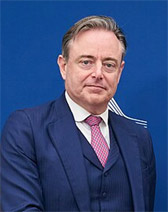
Bart De Wever
Belgium’s First Flemish Nationalist Prime Minister
Born on December 22, 1970
Age: 56
Profession: Politician, Historian
Place of Birth: Mortsel, Antwerp, Belgium
Bart De Wever is a Belgian politician, historian, author, and Flemish nationalist leader who has played a transformative role in modern Belgian politics. As the long-time leader of the New Flemish Alliance (N-VA), he turned a relatively small regional movement into one of Belgium’s most powerful political forces. On February 3, 2025, Bart De Wever became Prime Minister of Belgium, making history as the country’s first Flemish nationalist prime minister according to the official Belgian government biography.
Early Life and Education
Bart De Wever was born on December 22, 1970, in Mortsel, near Antwerp, Belgium. His full name is Bart Albert Liliane De Wever. He grew up in the town of Kontich, where his father, Henri De Wever, operated a small supermarket together with his mother Irene Wever. His family environment combined entrepreneurship, regional identity, and intellectual curiosity.
His older brother, Bruno De Wever, later became a respected historian and professor at Ghent University, contributing to a politically and academically engaged family atmosphere. During his youth, Bart De Wever developed a strong interest in history, identity politics, and Flemish cultural issues that would later define his public life.
He initially studied law at the University of Antwerp but shifted his focus to history after two years. He continued his studies at the Saint Ignatius University Centre in Antwerp before completing his history education at the Catholic University of Leuven. During his university years, he became active in Flemish student organizations, including the Flemish Liberal Students Association and Flemish Catholic student groups in Antwerp and Leuven.
Entry into Flemish Nationalist Politics
Bart De Wever became politically active through the Flemish nationalist movement during his student years. He initially joined Volksunie, a political party advocating greater Flemish autonomy within Belgium. Following internal divisions within the party, he became one of the founding figures behind the New Flemish Alliance (N-VA), a conservative and Flemish nationalist political movement.
In 2004, he was elected chairman of N-VA with overwhelming internal support, receiving approximately 95 percent of the vote despite being the sole candidate. Under his leadership, the party evolved from a relatively marginal political organization into the dominant force in Flemish politics.
Bart De Wever became nationally prominent after the 2010 Belgian federal elections, when N-VA achieved a major electoral breakthrough. The results dramatically reshaped Belgium’s political landscape and established him as one of the country’s most influential political figures.
Mayor of Antwerp
In 2013, Bart De Wever became Mayor of Antwerp, one of the most politically and economically important cities in Belgium. His election symbolized the growing strength of Flemish nationalism in urban politics.
He served as mayor from January 2013 until February 2025, overseeing policies focused on public security, migration control, urban development, and fiscal discipline. Under his administration, Antwerp became a major showcase for N-VA’s political agenda.
Even after becoming prime minister, he continued to be referred to as the honorary mayor of Antwerp, reflecting his long association with the city and its political identity.
Political Ideology and Leadership Style
Bart De Wever is widely associated with Flemish nationalism, conservative-liberal economics, strict migration policies, and institutional reform. Throughout his political career, he has advocated transforming Belgium into a more confederal state with greater autonomy for Flanders.
His rhetoric often focuses on the political, cultural, and economic differences between the Flemish-speaking north and the French-speaking Walloon region. Commentators have frequently compared aspects of his political strategy and communication style to other European conservative-nationalist figures such as Geert Wilders and Nigel Farage, although Bart De Wever has consistently positioned himself within mainstream democratic politics.
As both a historian and politician, he regularly references European history, national identity, and philosophical debates in his speeches and writings. His sharp debating style and intellectual approach have made him one of Belgium’s most recognizable and polarizing public figures.
Prime Minister of Belgium
Following the 2024 Belgian federal elections, lengthy coalition negotiations took place between N-VA, Vooruit, CD&V, MR, and Les Engagés. After approximately eight months of negotiations, a coalition agreement was finalized, and Bart De Wever officially became Prime Minister of Belgium on February 3, 2025.
His appointment represented a major symbolic turning point in Belgian political history. For decades, Bart De Wever had argued for stronger Flemish autonomy and structural reform of the Belgian state, yet he ultimately rose to lead the country’s federal government itself.
International media outlets, including Le Monde and Reuters, described his rise as a historic transformation from regional nationalist leader to head of the Belgian federal state.
As prime minister, his administration has focused on fiscal reform, pension restructuring, labor market modernization, migration policy, defense spending, and Belgium’s position within the European Union and NATO. His government has also emphasized reducing budget deficits and strengthening Belgium’s long-term economic competitiveness.
Writing Career and Intellectual Contributions
Alongside politics, Bart De Wever has maintained an active intellectual and literary presence. His books frequently address nationalism, identity, social cohesion, European civilization, political philosophy, and cultural debates.
Among his notable works are Het Kostbare Weefsel: Vijf Jaar Maatschappijkritiek, Over Identiteit, and Over Woke. He also collaborated with his brother Bruno De Wever on Nationalisme in België: Identiteiten in Beweging 1780-2000, an important work examining the history of nationalism in Belgium.
His writings and public speeches often place him within broader European debates concerning multiculturalism, national identity, immigration, and the future of Western civilization, themes also explored by intellectual figures such as Theodore Dalrymple, with whom he co-authored Vrijheid en Oprechtheid.
Personal Life
Bart De Wever married Dutch citizen Veerle Hegge in 2008. The couple has four children: Hendrik, Liesbet, Katrien, and Simon.
He is fluent in Dutch, French, English, and German, reflecting Belgium’s multilingual political environment. In 2012, he attracted international attention after losing approximately 58 kilograms through the medically supervised PronoKal diet program, a transformation that became widely discussed in Belgian media.
Published Books
1999 – Nationalisme in België: Identiteiten in Beweging 1780-2000 – with Bruno De Wever
2008 / 2009 – Het Kostbare Weefsel: Vijf Jaar Maatschappijkritiek
2011 – Vrijheid en Oprechtheid – with Theodore Dalrymple
2011 – Werkbare Waarden: Een Vervolg op Het Kostbare Weefsel
2013 – Derrière le Miroir
2019 – Over Identiteit
2021 – Botsen de Beschavingen?: 20 Jaar na 9/11 Nog Altijd het Noorden Kwijt – with Lisbeth Imbo and Khalid Benhaddou
2023 – Over Woke
2023 – Woke (French edition)
2023 – Het Verhaal van Antwerpen – with Johan Vermant
2026 – Over Welvaart
Source: Biyografiler.com
Frequently asked questions about Bart De Wever
Who is Bart De Wever?, Bart De Wever biography, Bart De Wever life story, Bart De Wever age, Bart De Wever facts, Bart De Wever birthplace, Bart De Wever photos, Bart De Wever videos, Bart De Wever career
Related Biographies


Lamine Yamal
Professional footballer

Sam Altman
Entrepreneur, Investor, CEO

Kylian Mbappe
Professional footballer

Alice Weidel
Politician, Economist

Erling Haaland
Professional footballer

Giorgia Meloni
Politician, Journalist


Hongjoong
Singer, Rapper, Songwriter, Composer

Ludacris
Rapper, Actor

Kwon Eunbi
Singer

Sarah Wayne Callies
Actress, Screenwriter, Producer, Director

LaTavia Roberson
Singer, Actress, Entrepreneur
Lamine Yamal
Professional footballer

Austin Abrams
Actor

Xi Jinping
Politician, Statesman, Head of State

Claudia Sheinbaum
President, Politician, Scientist, Academic

Colman Domingo
Actor, Director, Producer

Kaia Gerber
Model, Actress