
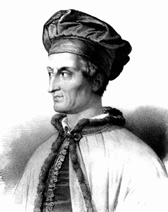
Amerigo Vespucci
Italian merchant and navigator whose voyages along the South American coast contributed to European recognition of the Americas as lands separate from Asia. The name America was introduced in his honor on Martin Waldseemüller's 1507 world map.
Born on March 9, 1451
Died on February 22, 1512
Age at death: 61
Profession: Merchant, Navigator, Explorer
Place of Birth: Florence, Republic of Florence (present-day Italy)
Place of Death: Seville, Spain
Amerigo Vespucci (March 9, 1451 – February 22, 1512) was an Italian merchant, navigator, and explorer born in Florence. He developed an interest in astronomy, cosmography, geography, and maritime navigation. After working for the commercial interests of the Medici family, he settled in Seville, Spain, and became involved in organizing Atlantic expeditions. Vespucci participated in voyages to the South American coast in 1499–1500 and 1501–1502, the latter under Portuguese sponsorship. His accounts helped establish the understanding that the lands encountered across the Atlantic were not part of Asia but belonged to a separate continent, which he described as the New World. In 1507, German cartographer Martin Waldseemüller used the name America in Vespucci's honor on a world map. In 1508, Vespucci was appointed chief pilot of Spain, a position he held until his death in 1512.
Early Life and Education
Amerigo Vespucci was born on March 9, 1451, in Florence, then an independent Italian republic. Some historical accounts give 1454 as his birth year.
He was the third son of Nastagio Vespucci, a notary associated with Florence's money-changing guild, and Lisabetta Mini. His family had commercial and political connections with the Medici family.
His early education was supervised by his uncle Giorgio Antonio Vespucci, a Dominican friar and scholar. He studied mathematics, astronomy, geography, Latin, and classical literature.
During his youth, Vespucci developed an interest in travel and geographical knowledge. He later entered commercial service, working for businesses associated with the Medici family.
Commercial Career in Florence and Seville
During the 1480s, Amerigo Vespucci worked for members of the Medici family, including Lorenzo di Pierfrancesco de' Medici. His duties involved commercial administration and financial transactions.
By 1492, Vespucci was living in Seville, Spain, where he represented Florentine commercial interests and became involved in businesses supplying ships for Atlantic voyages.
He worked with the merchant Gianotto Berardi, whose company helped equip expeditions organized by Christopher Columbus.
After Berardi's death in 1495, Vespucci participated in the administration of outstanding shipping contracts. These activities brought him into contact with navigators, merchants, and officials involved in Spanish overseas exploration.
His experience in maritime commerce eventually led him to participate directly in voyages across the Atlantic.
First Documented Voyage, 1499–1500
Some accounts attributed to Amerigo Vespucci describe an Atlantic expedition beginning in 1497. However, the existence of this voyage remains disputed among historians.
His first generally accepted expedition began in May 1499, when he sailed from Spain with a fleet commanded by Alonso de Ojeda. The expedition explored parts of the northern coast of South America.
The ships reached the region of present-day Guyana and Venezuela. Vespucci made observations concerning coastlines, river systems, vegetation, animals, and Indigenous communities.
Some accounts suggest that he separated from Ojeda during the expedition and explored additional coastal areas, possibly reaching the region of the Amazon River. The precise route remains uncertain.
The expedition returned to Spain in 1500. Vespucci's observations contributed to his growing interest in the geographical relationship between the newly encountered lands and the Asian continent.
Voyage to Brazil, 1501–1502
In 1501, Amerigo Vespucci entered Portuguese service and joined an expedition sponsored by King Manuel I of Portugal.
The fleet departed from Lisbon in May and crossed the Atlantic to the eastern coast of South America. It explored the coastline of present-day Brazil, traveling southward and recording geographical features.
The expedition reached areas near Cape São Roque and continued along the coast. Accounts of the voyage mention the region of Rio de Janeiro and suggest that the ships may have traveled much farther south, although their exact southernmost position remains debated.
Vespucci studied the stars, coastlines, and navigational conditions during the journey. He also recorded information about the peoples and natural environments encountered.
The expedition returned to Lisbon in 1502.
Following this voyage, Vespucci described the South American landmass as a New World, arguing that its geographical extent could not be explained as part of Asia.
The New World and Vespucci's Writings
Amerigo Vespucci's geographical observations became known through letters and published accounts circulated in Europe during the early sixteenth century.
One of the best-known publications was Mundus Novus (*New World*), printed around 1503–1504. It described the Portuguese expedition and presented the Atlantic lands as a previously unrecognized part of the world.
Another publication, Letter to Piero Soderini, appeared in the early 1500s and described four supposed voyages.
Historians have questioned the authenticity and accuracy of parts of these accounts, particularly the claimed voyage of 1497. Nevertheless, the publications circulated widely and influenced European geographical discussions.
Vespucci's argument that South America represented a separate continental landmass contributed to changing European interpretations of the Atlantic discoveries made by Columbus and subsequent navigators.
Final Expedition and Return to Spain
In 1503, Amerigo Vespucci reportedly joined another Portuguese expedition to the coast of Brazil under Gonçalo Coelho.
According to surviving accounts, the fleet encountered difficulties, including storms and the separation of its ships. The expedition did not achieve all its objectives, and Vespucci returned to Lisbon in 1504.
In 1505, he returned to Spanish service and obtained Castilian citizenship.
He subsequently became involved in navigation, maritime administration, and the examination of geographical information gathered from Atlantic expeditions.
Appointment as Chief Pilot of Spain
On August 6, 1508, Amerigo Vespucci was appointed *Piloto Mayor*, or Chief Pilot, of the Casa de Contratación in Seville.
His responsibilities included examining and training navigators, evaluating their knowledge of navigation, and supervising nautical charts used by Spanish expeditions.
He also contributed to maintaining the official master map, known as the *Padrón Real*, which incorporated geographical information collected by Spanish explorers.
Vespucci held the position until his death in 1512.
How America Received Its Name
In 1507, German cartographer Martin Waldseemüller produced a world map titled Universalis Cosmographia in Saint-Dié, in present-day France.
The map incorporated information obtained from the voyages of Amerigo Vespucci and other explorers. It depicted the newly encountered western lands as geographically separate from Asia.
In the accompanying geographical publication Cosmographiae Introductio, Waldseemüller and scholar Matthias Ringmann proposed naming the newly recognized continent America, using a Latinized form of Vespucci's first name.
The name initially appeared on the southern part of the New World, corresponding broadly to South America.
During the sixteenth century, other European cartographers adopted the name, and its use gradually expanded to include both North and South America.
The only known surviving copy of Waldseemüller's 1507 world map is preserved by the Library of Congress in Washington, D.C.
Personal Life and Death
Amerigo Vespucci married María Cerezo while living in Spain. The couple had no known children.
He spent his final years in Seville, continuing his duties as chief pilot and working with Spanish maritime authorities.
Amerigo Vespucci died on February 22, 1512, in Seville, Spain, aged approximately 60, according to the commonly cited birth year of 1451.
Selected Voyages and Publications
1497–1498 – Claimed Atlantic expedition; historical authenticity disputed
1499–1500 – Expedition to the northern coast of South America with Alonso de Ojeda
1501–1502 – Portuguese expedition along the Brazilian coast
1503–1504 – Reported second Portuguese expedition to Brazil
1503–1504 – Mundus Novus (*New World*) – Published account of the Portuguese voyage
1505 – Letter to Piero Soderini – Account describing four voyages, with disputed details
1508 – Appointed Chief Pilot of Spain
Source: Biyografiler.com
Frequently asked questions about Amerigo Vespucci
Who is Amerigo Vespucci?, Amerigo Vespucci biography, Amerigo Vespucci life story, Amerigo Vespucci age, Amerigo Vespucci facts, Amerigo Vespucci birthplace, Amerigo Vespucci photos, Amerigo Vespucci videos, Amerigo Vespucci career

Lamine Yamal
Professional footballer

Kylian Mbappe
Professional footballer

Keanu Reeves
Actor

Erling Haaland
Professional footballer

Brad Pitt
Actor

Bad Bunny
Rapper, Songwriter

Julian Assange
Activist, Computer Programmer

Jose Tolentino de Mendonça
Religious Leader, Priest

Joseph Stiglitz
Economist, Author

Jose Raul Mulino
President, Politician, Lawyer


Joseph Gordon Levitt
Actor, Director, Producer

David Yates
Film Director, Film Producer

Sofia Coppola
Film Director, Screenwriter

Jensen Huang
Entrepreneur, CEO

Gadi Eisenkot
Politician, Military Commander

Susie Wiles
Political Consultant
Brad Pitt
Actor