
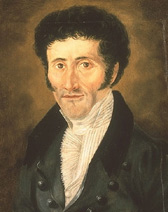
Amedeo Avogadro
Italian physicist and chemist known for Avogadro's Law, which states that equal volumes of gases at the same temperature and pressure contain equal numbers of molecules. His work contributed to the development of modern atomic and molecular theory.
Born on August 9, 1776
Died on July 9, 1856
Age at death: 80
Profession: Physicist, Chemist, Scientist
Place of Birth: Turin, Kingdom of Sardinia (present-day Italy)
Place of Death: Turin, Kingdom of Sardinia (present-day Italy)
Amedeo Avogadro, whose full name was Lorenzo Romano Amedeo Carlo Avogadro, Count of Quaregna and Cerreto, was born on August 9, 1776, in Turin, in the Kingdom of Sardinia. He was an Italian physicist and chemist best known for formulating Avogadro's Law in 1811. His hypothesis established that equal volumes of gases, under the same conditions of temperature and pressure, contain equal numbers of molecules regardless of their chemical composition. Building on the experimental findings of Joseph Louis Gay-Lussac, Avogadro distinguished between atoms and molecules and contributed to the development of modern molecular theory. He taught physics and mathematics at the Royal College of Vercelli and later became a professor at the University of Turin. The Avogadro Constant, which represents the number of elementary entities in one mole of a substance, was named in his honor.
Early Life and Education
Amedeo Avogadro was born on August 9, 1776, in Turin, then part of the Kingdom of Sardinia. He belonged to an aristocratic Piedmontese family with a long tradition of legal and government service.
His father, Filippo Avogadro, was a lawyer and government official. Following his family's tradition, Avogadro initially studied philosophy and law rather than the natural sciences.
He completed his legal education at the University of Turin and received a doctorate in canon law in 1796. He subsequently worked in legal and administrative positions.
Around 1800, his interest in mathematics, physics, and chemistry led him to pursue scientific studies independently. He studied experimental physics and began investigating electricity and the physical properties of matter.
Scientific Career and University Teaching
Between 1800 and 1805, Amedeo Avogadro devoted increasing attention to physics and mathematics. His early scientific research included studies of electricity and the behavior of insulating materials.
In 1809, he became a professor of physics and mathematics at the Royal College of Vercelli, where he continued his research into gases and molecular structure.
In 1820, he was appointed professor of mathematical physics, then known as *fisica sublime*, at the University of Turin.
Following political unrest in the Kingdom of Sardinia in 1821, the university chair was abolished in 1822. Avogadro consequently lost his teaching position.
The chair was restored in 1832 and initially assigned to mathematician Augustin-Louis Cauchy. Avogadro returned to the position in 1834 and continued teaching until his retirement in 1850.
Discovery of Avogadro's Law
In 1808, French chemist Joseph Louis Gay-Lussac published experimental findings concerning the combining volumes of gases in chemical reactions.
Amedeo Avogadro examined these results and sought to explain them through a molecular interpretation of matter.
In 1811, he published the scientific paper Essay on a Manner of Determining the Relative Masses of the Elementary Molecules of Bodies, and the Proportions in Which They Enter into These Compounds.
In this work, he proposed that equal volumes of gases at identical temperatures and pressures contain equal numbers of molecules.
His hypothesis also helped clarify the distinction between atoms and molecules. He recognized that some gaseous elements could exist as molecules containing more than one atom, explaining experimental observations that were difficult to reconcile with earlier atomic theories.
The relationship later became known as Avogadro's Law and is commonly expressed as V ∝ n when temperature and pressure remain constant, where V represents gas volume and n represents the amount of substance.
Avogadro's Constant
The Avogadro Constant is named after Amedeo Avogadro, although he did not personally calculate its numerical value.
The constant defines the number of elementary entities, such as atoms, molecules, or ions, contained in one mole of a substance.
Its exact value in the modern International System of Units is:
6.02214076 × 10²³ mol⁻¹
At a temperature of 0°C and a pressure of one standard atmosphere, one mole of an ideal gas occupies approximately 22.4 liters. This follows from the ideal gas law and Avogadro's principle.
Later scientists developed methods for estimating the number of particles in a given quantity of matter. Among them was Austrian physicist Johann Josef Loschmidt, who made an early estimate in 1865.
The value of Avogadro's Constant was refined through subsequent experimental research and became exact under the revised SI definition of the mole adopted in 2019.
Recognition of His Molecular Theory
Amedeo Avogadro's hypothesis was not widely accepted during his lifetime. Early nineteenth-century scientists disagreed about the distinction between atoms and molecules, and different methods for calculating atomic masses produced conflicting results.
Italian chemist Stanislao Cannizzaro later used Avogadro's ideas to explain atomic and molecular masses more consistently.
At the Karlsruhe Congress in Germany in 1860, Cannizzaro promoted an approach based on Avogadro's hypothesis. The discussions contributed to its wider acceptance among chemists.
Avogadro had died four years before the congress, but his work subsequently became part of the theoretical foundation of modern chemistry.
Other Scientific Work
In addition to his research on gases, Amedeo Avogadro studied electricity, magnetism, heat, and the physical properties of substances.
He investigated electrical polarization in insulating materials and contributed to discussions concerning chemical affinity and molecular interactions.
He also worked on scientific and administrative matters involving statistics, meteorology, patents, and systems of weights and measures.
Between 1837 and 1841, he published Fisica de' corpi ponderabili, a four-volume treatise examining the physical properties of matter.
Personal Life
On January 9, 1815, Amedeo Avogadro married Felicita Mazzè, the daughter of a Piedmontese noble family.
The couple had eight children.
Avogadro continued his scientific research and teaching while maintaining a family life in Turin and the surrounding Piedmont region.
Death
Amedeo Avogadro died on July 9, 1856, in Turin, at the age of 79.
He had retired from university teaching in 1850. His molecular hypothesis gained broader scientific recognition in the years following his death.
Selected Scientific Publications
1811 – Essay on a Manner of Determining the Relative Masses of the Elementary Molecules of Bodies, and the Proportions in Which They Enter into These Compounds – Original paper presenting Avogadro's hypothesis
1814 – Mémoire sur les masses relatives des molécules des corps simples – Research on the relative masses of molecules
1821 – Nouvelles considérations sur la théorie des proportions déterminées dans les combinaisons – Research on chemical combinations
1837–1841 – Fisica de' corpi ponderabili – Four-volume treatise on physics
Source: Biyografiler.com
Frequently asked questions about Amedeo Avogadro
Who is Amedeo Avogadro?, Amedeo Avogadro biography, Amedeo Avogadro life story, Amedeo Avogadro age, Amedeo Avogadro facts, Amedeo Avogadro birthplace, Amedeo Avogadro photos, Amedeo Avogadro videos, Amedeo Avogadro career

Lamine Yamal
Professional footballer

Kylian Mbappe
Professional footballer

Keanu Reeves
Actor

Erling Haaland
Professional footballer

Brad Pitt
Actor

Bad Bunny
Rapper, Songwriter

Julian Assange
Activist, Computer Programmer

Jose Tolentino de Mendonça
Religious Leader, Priest

Joseph Stiglitz
Economist, Author

Jose Raul Mulino
President, Politician, Lawyer


Joseph Gordon Levitt
Actor, Director, Producer

David Yates
Film Director, Film Producer

Sofia Coppola
Film Director, Screenwriter

Jensen Huang
Entrepreneur, CEO

Gadi Eisenkot
Politician, Military Commander

Susie Wiles
Political Consultant
Brad Pitt
Actor